

By Jorge Vazquez, CEO & Co-Founder, Graystone Investment Group
Over my more than two decades in real estate investing—building portfolios, navigating market cycles, and working with thousands of investors across Florida—I’ve seen plenty of trends come and go. But when you strip away the hype, real estate wealth relies on two primary growth engines: cash flow and appreciation.
While cash flow keeps your business alive day-to-day, the long-term appreciation of real estate is what turns ordinary investors into wealthy portfolio owners.
However, relying blindly on home prices to go up is not a strategy—it’s gambling. To build lasting wealth, you must understand what drives real estate appreciation, the crucial difference between natural and forced equity, and how to position your investments to capture both.
In this article, I’ll share how we analyze and leverage the appreciation of real estate at Graystone Investment Group to deliver consistent, market-beating returns.
Understanding the Appreciation of Real Estate
At its core, the appreciation of real estate refers to the increase in a property’s market value over time. Unlike cars, machinery, or technology—which depreciate as they age—land and residential real estate tend to gain value over extended horizons.
Real estate appreciation generally happens through two distinct mechanisms:
1. Natural Market Appreciation
This occurs due to macro-economic forces outside an individual investor’s control, including:
-
Inflation: As the price of materials, labor, and goods increases, the cost to build new housing rises, lifting existing property values.
-
Supply and Demand Imbalances: When population growth outpaces housing inventory (a story we know very well here in Florida), competition drives prices upward.
-
Infrastructure & Economic Development: New transit lines, major commercial hubs, hospitals, and corporate relocations increase the desirability of surrounding neighborhoods.
2. Forced Appreciation (Value-Add Equity)
Unlike market appreciation, forced appreciation is 100% within your control. This happens when an investor actively increases a property’s intrinsic value or net operating income (NOI) through strategic renovations, structural additions, or operational improvements.
Cash Flow vs. Appreciation: The Dual-Engine Strategy
One of the most common debates I hear among investors is whether to focus on immediate cash flow or long-term appreciation.
My answer? You shouldn’t have to choose.
At Graystone Investment Group, our core philosophy is built around a dual-engine strategy:
-
Cash Flow Protects Your Downside: A property must generate positive cash flow from Day 1 to cover debt service, maintenance, property taxes, and insurance. Positive cash flow ensures you never find yourself in a position where you are forced to sell during a market dip.
-
Appreciation Multiplies Your Upside: Long-term property appreciation provides equity growth, allowing you to execute tax-deferred 1031 exchanges, refinance capital tax-free, and compound your net worth over time.
When you combine positive cash flow with high-growth submarkets, the compound effect on your wealth is staggering.
4 Keys to Maximizing the Appreciation of Real Estate
If you want to maximize the capital appreciation of your portfolio, apply these four principles during your underwriting process:
1. Follow Path-of-Growth Markets
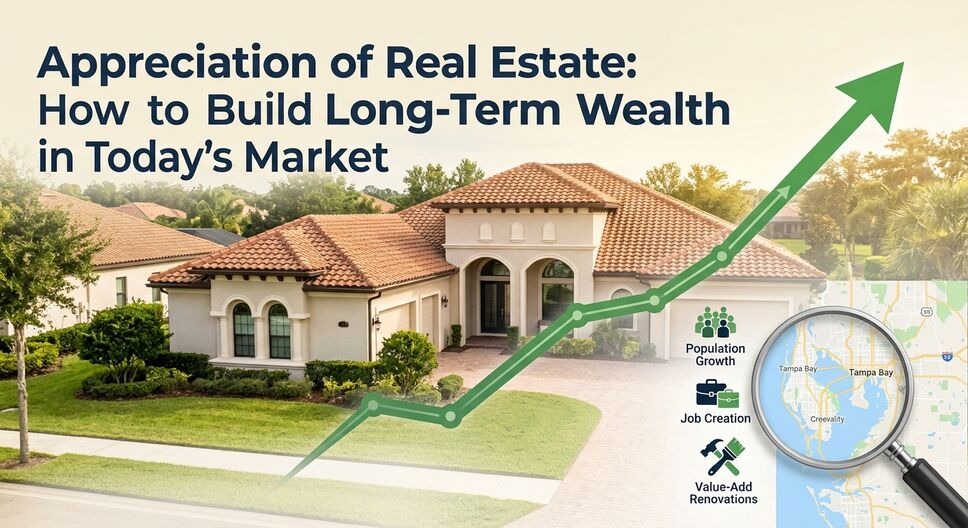
Property values don’t appreciate evenly across cities or zip codes. Identify areas benefiting from demographic shifts, job creation, and infrastructure investments. In Tampa Bay, for instance, major redevelopment projects and tech corridor expansions continue to anchor neighborhood appreciation.
2. Focus on Value-Add Opportunities
Don’t just wait for the market to move—create your own equity. Purchasing properties that need cosmetic or functional updates allows you to buy at a discount, force equity through smart rehabs, and command higher rental yields immediately.
3. Maintain Property Standards
A poorly maintained asset depreciates relative to its market over time. Proactive capital expenditures—such as updating roofs, HVAC systems, and modernizing finishes—protect your baseline asset value and keep tenant quality high.
4. Optimize Rental Income
For multi-family and commercial properties, real estate appreciation is directly tied to Net Operating Income (NOI). Raising rents to market rates, lowering vacancy, and introducing ancillary revenue streams (like laundry, parking, or storage fees) directly increases the appraised value of the property.
Final Thoughts from Jorge
Understanding the appreciation of real estate isn’t about guessing where the market will be next month or next quarter. It’s about buying solid assets in strong growth corridors, forcing value through smart management and upgrades, and letting time and inflation do the heavy lifting for your net worth.
Whether you are looking to purchase your first rental property or expand an existing portfolio across Central Florida, our team at Graystone Investment Group is dedicated to helping you find and execute high-yield deals.
Internal & Related Resources
-
Meet the Author: Meet the Man Behind Graystone: Jorge Vazquez, CEO & Co-Founder
-
Florida Real Estate Strategy: The Florida Investor’s Blueprint: How to Scale & Build Passive Wealth
-
Market Analysis: Top 10 Transformative Developments in Tampa: Investor Perspective
-
External Economic Data: Federal Housing Finance Agency (FHFA) – House Price Index (HPI)
Book an Expert
New investor? Start with Jorge.

Jorge Vazquez – CEO & Investment Strategist at Graystone. Let’s make your portfolio stronger, steadier, and more profitable.
Deals? Book with Cody.

Meet Cody Bergstrom, Your Expert in Finding Deals Let’s find an off-market deal that actually works for you.
Need financing? Book with Lisa.

Meet Lisa Kaye Price, the LendingGig Top ML Let’s figure out the smartest way to fund your next deal.
Looking for PM? Book with Jay

Jay Michalec – COO & Property Management Expert at Graystone. Let’s make your rentals easier, calmer, and more profitable.