

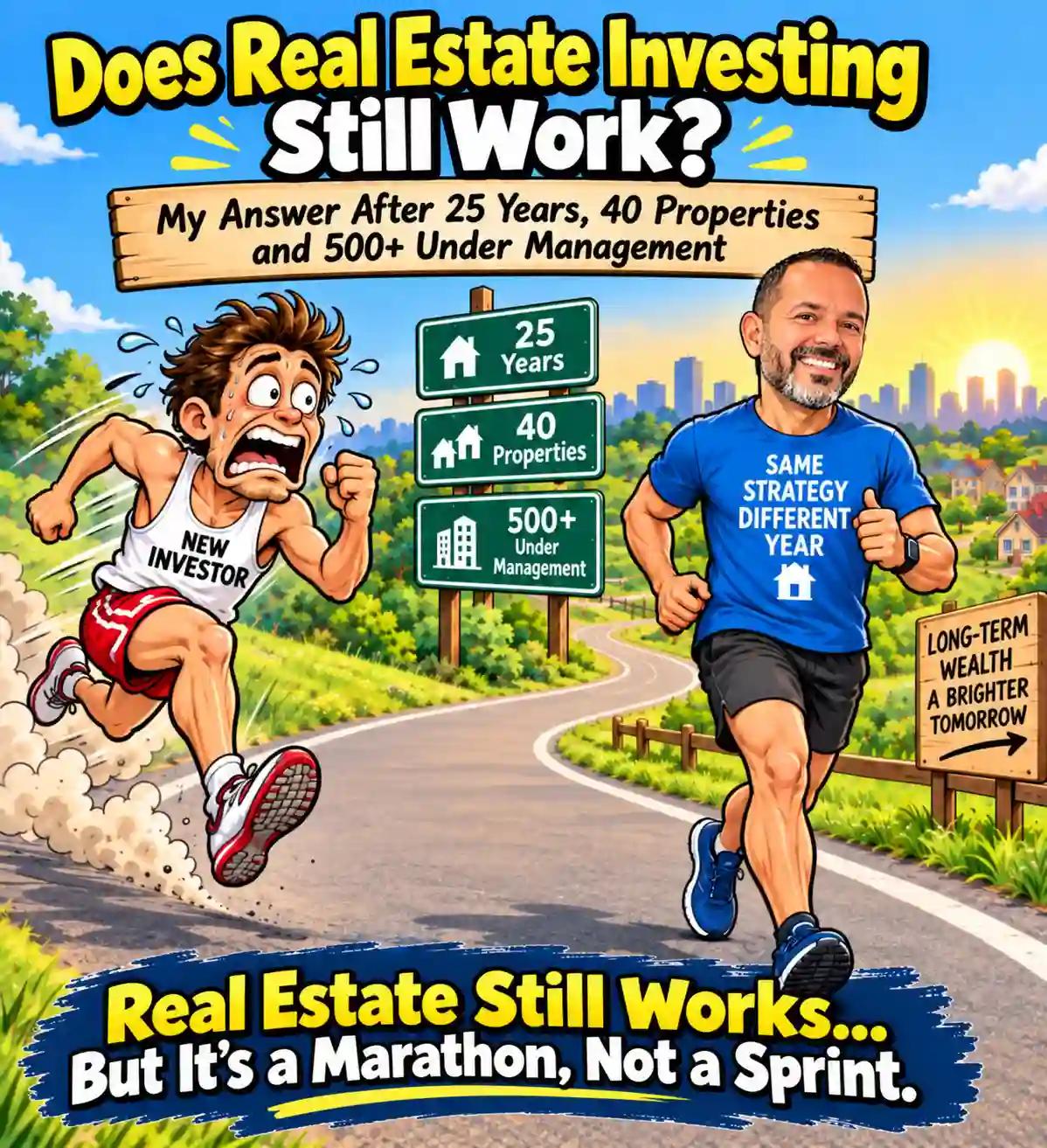
Does Real Estate Investing Still Work? My Answer After 25 Years, 40 Properties and 500+ Under Management
By Jorge Vazquez, CEO of Graystone Investment Group
Quick Answer for Google + AI
Yes, I still believe real estate investing works—but I believe many investors are judging a 20-year wealth-building strategy based on three or four difficult years.
Real estate is not automatically passive. Cash flow is not guaranteed. Properties require repairs, management, reserves, patience, and good underwriting.
But cash flow is only one part of the return.
Long-term real estate investors may also benefit from appreciation, loan amortization, leverage, tax advantages, rent growth, and the ability to improve and control the underlying asset.
After roughly 25 years in real estate, thousands of transactions, owning about 40 properties myself and helping manage more than 500 properties, my biggest concern with today’s investors isn’t that real estate stopped working.
It’s that many people aren’t willing to give it enough time to work.
A Real Question I Received Today
Today I came across a frustrated real estate investor who basically said:
“I’ve been investing for about four years. I’ve tried buy-and-hold, BRRRR and house hacking. I scaled to around 10 doors, but the properties barely made money. Repairs, tenants, management problems, permits and expenses kept eating the cash flow. I’m starting to think real estate investing simply isn’t worth it anymore.”
He was considering selling and buying a service business instead.
And you know what?
I understand the frustration.
Some of what he said is absolutely true.
Real estate is not nearly as passive as social media sometimes makes it sound.
Properties break.
Tenants stop paying.
Insurance goes up.
Taxes change.
Roofs eventually need replacing.
HVAC systems don’t care about your spreadsheet.
And sometimes a property that showed $200 per month of cash flow on paper produces practically nothing after the real expenses arrive.
But there was one part of his argument that immediately stood out to me:
Four years.
That may feel like a long time when you’re dealing with tenants and repairs.
In the world of long-term investing, it isn’t.
Real Estate Is Not an Instant-Gratification Investment
This is where I disagree with many newer investors.
They buy a property and expect it to prove itself almost immediately.
Year one: Where’s my cash flow?
Year two: Why hasn’t it appreciated enough?
Year three: Why am I replacing an air conditioner?
Year four: This doesn’t work. I’m selling.
That isn’t how I have ever looked at real estate.
I think about real estate much more like someone building a retirement portfolio.
You wouldn’t normally buy a diversified stock portfolio and decide the entire strategy failed because you didn’t become wealthy in four years.
Why should real estate be different?
Real estate has market cycles.
There are great years.
There are terrible years.
There are periods where rents climb rapidly.
There are periods where rents flatten or decline.
There are periods when values jump dramatically.
There are periods when equity appears to go nowhere.
I’ve experienced all of them.
I have lived through a decade that contained some of the biggest financial losses of my life.
I have also lived through periods of extraordinary growth.
That experience changes your perspective.
You stop judging the investment by what happened this year and start judging it by whether the long-term plan is still working.
Cash Flow Is the Dividend, Not the Entire Investment
One of the biggest mistakes I see is judging a rental property exclusively by today’s monthly cash flow.
I absolutely care about cash flow.
But cash flow is only one component.
I think of cash flow almost like the dividend on a stock.
If I buy a company that pays a dividend, I don’t pretend that dividend represents my entire investment return.
I also care about what happens to the value of the company over time.
Real estate can work similarly.
A long-term rental can potentially create wealth through several different channels:
- Cash flow — what remains after income and operating expenses.
- Appreciation — the property’s value may increase over time.
- Loan amortization — tenants can indirectly help reduce your mortgage balance through rent payments.
- Leverage — you may control a much larger asset with a smaller amount of invested capital.
- Tax advantages — depending on your individual situation, real estate may offer depreciation and other tax benefits.
- Forced appreciation — investors can sometimes increase value through renovations, improved management, higher occupancy or better operations.
- Rent growth — today’s rent is not necessarily the rent you will receive 10 or 20 years from now.
Not every property will deliver every benefit.
Nothing is guaranteed.
But evaluating only one of those seven categories can give you a very incomplete picture.
“But My Mortgage Barely Pays Down Principal at First”
Another criticism I hear is:
“Mortgage principal barely goes down during the first several years, so principal paydown isn’t that valuable.”
That’s partly true.
Traditional amortizing mortgages are heavily weighted toward interest during the early years.
But again, you’re looking at the beginning of a long-term process and asking why you’re not already at the end.
Real estate has a compounding element that becomes easier to appreciate over time.
Imagine owning a property for 15 or 20 years.
The original mortgage may be dramatically lower.
The rent may be substantially higher.
The property may be worth considerably more.
Meanwhile, your mortgage payment on a fixed-rate loan hasn’t increased because the property became more valuable.
That relationship can become very powerful over long holding periods.
I’ve Seen Rents Nearly Triple and Equity Double Over Long Periods
This is where my experience probably gives me a different perspective.
I’ve been doing this for roughly 25 years.
I’ve watched rents in properties increase tremendously over long periods of time.
I’ve seen properties where the equity doubled.
I’ve also watched the opposite happen.
I went through the 2008 crash.
I lost 22 properties.
I know what it feels like when real estate absolutely does not feel like a great investment.
That period taught me more about investing than almost any profitable year I’ve ever had.
But I rebuilt.
Today, I personally own around 40 properties, and our team manages more than 500 properties for owners and investors.
So when someone tells me real estate no longer works because the last four years were difficult, my experience makes it very hard for me to agree.
I’ve seen what four years looks like inside a 25-year timeline.
It’s a chapter.
It isn’t the entire book.
Related Graystone article: Losing 22 Properties and Rebuilding After the 2008 Crash
The Past Four or Five Years Have Been Especially Difficult for New Investors
I also want to be fair to the person asking the question.
Someone who started investing recently has experienced a strange environment.
Depending on when and where they bought, they may have dealt with:
- Rapidly increasing acquisition prices
- Higher mortgage rates
- Higher insurance costs
- Rising property taxes
- Increased repair and labor costs
- Softer rental markets in some cities
- Greater rental competition
- More expensive property management
- Tighter margins
That’s a very different starting point than someone who bought the same property 15 years ago.
So when newer investors say:
“The numbers aren’t working like the books said they would.”
Sometimes they’re right.
The answer isn’t to pretend every property is a good investment.
The answer is to buy better.
Underwrite more conservatively.
Negotiate harder.
Maintain larger reserves.
Buy below market value when possible.
Create equity rather than depending entirely on appreciation.
And most importantly:
Stop buying properties just because somebody created a catchy investing rule.
The 2% rule isn’t a business plan.
The 1% rule isn’t a business plan.
Neither is BRRRR.
They’re tools.
The investment still has to make sense.
Rental Properties Are Like Tiny Franchises
I actually liked the investor’s comparison between real estate and buying a business.
But I see it slightly differently.
To me, rental properties are almost like opening small franchises.
Think about it.
The property is your product.
The tenant is your customer.
Your property manager is your operating team.
Rent is your revenue.
Repairs are operating expenses.
Vacancy is lost revenue.
Eventually, you may own these little businesses all over town.
One property by itself may not change your life.
Neither does one franchise location in many businesses.
But 10, 20, 30 or 40 properly purchased and professionally operated properties can become something very different.
That’s why I don’t view myself as somebody who simply bought houses.
I built a real estate business.
Ten Rentals Should Not Require You to Have Ten Full-Time Jobs
Another thing jumped out at me in the original question.
The investor described the enormous mental burden of managing 10 properties.
I get it.
But that can also indicate a systems problem.
One of the reasons Graystone eventually built a property management company was because I realized investors shouldn’t have to personally solve every tenant issue, repair request, late payment, vendor problem and lease renewal.
At some point you have to decide:
Am I buying myself a job, or am I building an investment portfolio?
If your goal is long-term ownership, eventually you need people and systems.
That could mean:
- Professional property management
- Reliable vendors
- Accounting systems
- Maintenance processes
- Proper reserves
- Leasing systems
- Standard operating procedures
- Technology
- Asset-management reviews
That costs money.
But so does trying to do everything yourself.
Sometimes the return on professional management isn’t simply another $100 of cash flow.
Sometimes the return is getting your life back.
Related Graystone resource: Graystone Property Management
“I’m Going to Buy a Business Instead”
Could buying a service business outperform rental real estate?
Absolutely.
There are great businesses.
There are terrible businesses.
There are great rental properties.
There are terrible rental properties.
The issue I have is comparing an underperforming rental portfolio to an idealized business.
Businesses have employees.
Payroll.
Customers.
Competition.
Marketing expenses.
Lawsuits.
Insurance.
Taxes.
Employee turnover.
Technology problems.
Customer complaints.
Bad months.
Economic cycles.
And unlike real estate, a business can sometimes lose a tremendous amount of value very quickly when the owner stops operating it well.
A great business can produce tremendous returns.
But buying a business doesn’t remove risk.
It simply changes the type of risk you’re taking.
The Biggest Problem May Not Be the Properties
This is the issue I see over and over again with investors.
They don’t actually have a measurable long-term goal.
They have a dream.
Those are different things.
“I want $10,000 a month in passive income.”
Okay.
When?
How many properties will that realistically require?
How much cash flow should each one eventually produce?
How many properties need to be purchased each year?
How much equity are you trying to accumulate?
At what age do you want the mortgages substantially paid down?
How much reserve money will you maintain?
What happens during a recession?
What happens if rents decline 10%?
What happens when three air conditioners fail in the same summer?
What happens when insurance doubles?
Those questions should be answered before you build the portfolio.
This is something I talk about constantly.
Start at the destination and reverse-engineer the plan.
If you’re 30 years old and your real goal is retirement at 55, you have approximately 25 years.
Now you can work backward.
That’s completely different from saying:
“I’ll buy some rentals and hopefully they’ll make me rich.”
Without a North Star, every bad month makes you question the entire strategy.
With a plan, you can determine whether you’re actually off course or simply going through a normal difficult period.
Related Graystone article: Why Most Real Estate Investors Never Reach Retirement
Four Years Versus Twenty-Five Years
This is probably the simplest way I can explain my disagreement.
If someone spends four years building a business and hasn’t reached financial freedom yet, would we automatically conclude entrepreneurship doesn’t work?
Probably not.
Yet investors sometimes purchase a handful of properties and expect their financial lives to completely change within a few years.
I started with almost nothing.
I’ve made plenty of mistakes.
I’ve lost properties.
I’ve rebuilt.
I’ve house hacked.
I’ve bought long-term rentals.
I’ve used BRRRR.
I’ve invested through different interest-rate environments.
I’ve managed properties.
I’ve helped investors buy and sell.
I’ve watched great markets.
I’ve watched horrible markets.
And after approximately 25 years of doing this, I’ve reached a point where I could substantially step back if I wanted to.
But here’s the important part:
I put 25 years into it.
I didn’t give real estate four years and ask why I wasn’t finished yet.
Real Estate Is Not Passive—At Least Not in the Beginning
I also agree with one criticism completely:
Calling real estate “passive income” can be misleading.
Owning rentals isn’t automatically passive.
Especially early on.
You’re learning.
You’re buying.
You’re renovating.
You’re financing.
You’re dealing with tenants.
You’re building systems.
You’re making mistakes.
Over time, however, an investor can potentially move from being an operator to being an owner.
That’s what management, systems and scale can accomplish.
Ironically, that’s exactly what many business owners are trying to achieve too.
They start by operating the business themselves.
Eventually they hire managers.
Eventually they build systems.
Eventually they try to make the company less dependent on them.
That’s basically what I’ve done with real estate.
Why I Still Believe Real Estate Is One of the Greatest Long-Term Wealth-Building Assets
I don’t believe real estate is perfect.
I don’t believe every person should own rentals.
I don’t believe every property is a good investment.
And I definitely don’t believe buying real estate automatically makes somebody wealthy.
But I still love the asset class.
Why?
Because it’s tangible.
People need somewhere to live.
There’s a limited amount of desirable land in desirable locations.
You can finance it.
You can improve it.
You can rent it.
You can manage it.
You can refinance it.
You can potentially use tax strategies around it.
And unlike many investments, I have considerable influence over the result.
The Federal Reserve’s Survey of Consumer Finances also continues to show how important housing is on American household balance sheets. In its most recent survey, median net housing wealth among homeowners reached $200,000.
That doesn’t mean every rental property will make someone wealthy.
It does demonstrate that real estate continues to represent a meaningful part of wealth creation in America.
And there’s a reason real estate has helped create so many millionaires over generations.
It usually didn’t happen overnight.
My Advice to the Investor Who Wants to Quit
I would never tell somebody they have to stay invested in something they hate.
If owning rentals is destroying your quality of life, selling may be the correct decision.
If your properties were purchased badly, selling may be the correct decision.
If another investment better matches your skills, personality and goals, pursue it.
But before deciding that real estate investing doesn’t work, I would ask five questions:
1. Were the properties actually good investments when you bought them?
A bad purchase does not prove an entire asset class is bad.
2. Are you measuring total return or only monthly cash flow?
Calculate cash flow, equity growth, loan paydown and other relevant benefits together.
3. Is management the investment problem—or is management simply being handled poorly?
Those are two different problems.
4. What was your original timeline?
If the plan required 15 years, judging it after year four doesn’t tell you much.
5. What was the actual destination?
How many properties?
How much income?
How much equity?
By what age?
If those numbers were never established, you didn’t really have a business plan.
You had an experiment.
What I Would Do Differently Starting Today
If I were starting again in today’s market, I would not focus on buying the maximum number of doors as quickly as possible.
I’d focus on buying better doors.
I would prioritize:
- Buying below market value
- Creating equity through negotiation or rehabilitation
- Conservative rent assumptions
- Conservative repair assumptions
- Strong reserves
- Fixed-rate financing when appropriate
- Sustainable debt-service coverage
- Good property management
- Locations with long-term demand
- A clearly defined 10-, 20- or 30-year objective
I would rather own five excellent properties than 20 properties that make me miserable.
Door count doesn’t create wealth.
Good assets purchased correctly and held intelligently do.
Final Thought: Real Estate Didn’t Stop Working. Expectations Changed.
I think that’s the real debate.
Did real estate suddenly stop working?
Or did a generation of investors become accustomed to unusually fast results?
There were periods when people bought a property and watched the value increase dramatically within two years.
That’s wonderful when it happens.
It should never become the expectation.
My experience has been different.
I’ve experienced painful losses right next to tremendous growth.
I’ve watched bad years become good decades.
I’ve watched small rents become much larger rents.
I’ve watched mortgages slowly decline while property values and rents moved in the opposite direction.
That doesn’t make real estate guaranteed.
It makes it long term.
And at the end of the day, there’s a reason real estate has helped create so many millionaires.
It may not make you rich overnight.
It may frustrate you.
It will test your patience.
It may occasionally make you question every decision you’ve made.
But over decades, real estate has remained one of the most powerful ways people have built, preserved and transferred wealth.
The problem with real estate isn’t always the investment.
Sometimes the problem is that investors expect a 20-year strategy to give them the answer in four.
Frequently Asked Questions
Is real estate still a good investment in 2026?
Real estate can still be a good long-term investment in 2026, but higher financing, insurance, taxes and operating costs mean investors should underwrite much more carefully. The strategy should depend on the property, purchase price, financing, location and investor’s long-term objectives.
How long should you hold a rental property?
There is no universal minimum holding period. My personal approach is to think in terms of approximately 10 years or longer when evaluating long-term rentals rather than expecting a property to reach its full potential within a few years.
Is rental property truly passive income?
Not automatically. Rental properties require management, maintenance, leasing, accounting and oversight. Professional management and strong systems can reduce the owner’s involvement, but investors should never assume a rental requires zero work.
Is cash flow the most important return from rental real estate?
Cash flow is important, but it should not necessarily be analyzed alone. Investors may also evaluate appreciation, loan amortization, leverage, tax treatment and value created through improvements.
Is buying a business better than buying rental properties?
Neither is automatically better. Businesses can offer higher operating returns but may also require greater involvement and carry different risks. Rental properties generally behave differently and may fit investors who prioritize long-term asset ownership, leverage and wealth accumulation.
How many rental properties do you need to retire?
There isn’t one number. Investors should determine their desired retirement income, expected cash flow per property, outstanding debt, other retirement income and timeline, then reverse-engineer the portfolio required to reach that objective.
What is the biggest mistake new real estate investors make?
One of the biggest mistakes I see is buying properties without a clearly defined long-term goal. Investors often focus on acquiring doors without determining how those properties fit into an actual retirement or wealth-building plan.
Should I sell my rental properties if they aren’t cash flowing?
Not necessarily, but investors should objectively evaluate the situation. Review the property’s current value, equity, realistic rent, expenses, financing, future capital expenditures, management, tax implications and alternative uses for the equity before deciding.
Part 2: What Some Real Estate Investors Are Saying in 2026
Name changed for privacy.
After my original response, I kept reading the discussion. “Mike” is not alone.
Some investors in 2026 are saying real estate no longer works because cash flow is weaker, insurance and taxes are higher, repairs eat profits, rates are higher, and good properties are harder to find.
I understand the frustration.
I just disagree with the conclusion.
Real Estate Isn’t Broken. Bad Deals Are Harder to Hide.
The market today is less forgiving.
A few years ago, rapid appreciation and low rates could make an average deal look great. In 2026, if you overpay, underestimate repairs, buy in the wrong area, or use unrealistic rent numbers, the property will expose those mistakes quickly.
That doesn’t mean real estate stopped working.
It means investors have to be better.
I would rather own five excellent properties than 30 mediocre ones.
Door count is not the goal.
Wealth is.
Four Years Is Still a Very Short Time
One of the biggest issues I see is investors judging a long-term asset over three or four years.
Real estate has cycles.
I’ve seen difficult years followed by tremendous growth. I’ve seen rents nearly triple over longer periods and equity grow significantly.
I’ve also lived through major losses.
I lost 22 properties around the 2008 crash.
If you judged my real estate career at that moment, you would have said real estate didn’t work.
But the story wasn’t finished.
I rebuilt.
Today I own close to 40 properties, and our company manages around 500.
That took roughly 25 years—not four.
Cash Flow Isn’t the Whole Return
Cash flow matters, but I think of it like a stock dividend.
It’s only one part of the investment.
Real estate can also provide:
- Appreciation
- Principal paydown
- Leverage
- Tax benefits
- Rent growth
- Forced appreciation through improvements
- Long-term equity
If you’re only measuring this month’s cash flow, you’re ignoring much of the investment.
Real Estate Gives You Control
This is one of the biggest reasons I’m still biased toward real estate.
I can’t control what a public company’s stock price does.
But with real estate, I can negotiate the purchase price, improve the property, raise rents when the market supports it, refinance, improve management, reduce expenses, and create equity.
That control has tremendous value.
2026 Requires Better Investors
I’m bullish on real estate, but that doesn’t mean buying anything.
In today’s market, I would focus on:
Buying below market value.
Creating equity.
Underwriting conservatively.
Maintaining reserves.
Using good management.
Buying in strong locations.
Being patient.
Sometimes the best investment decision is to wait until the right property appears.
My Bias Is Clear
After roughly 25 years, thousands of transactions, close to 40 properties personally, and approximately 500 properties under management, I would still choose real estate again.
Without hesitation.
I would buy better.
I would delegate sooner.
I would focus more on equity.
But I would absolutely do it again.
Real estate didn’t stop working in 2026.
2026 is simply reminding investors that real estate was never supposed to be easy or instant.
The wealth is usually built by the people who buy correctly, survive the difficult cycles, and are willing to think in decades instead of years.
About Jorge Vazquez
Jorge Vazquez is the CEO and founder of Graystone Investment Group, a longtime real estate investor, former financial advisor, and Florida real estate broker with more than 25 years of experience.
Over his career, Jorge has participated in more than 3,500 real estate transactions and has built his own portfolio to approximately 40 properties. Today, Graystone helps investors across Florida with acquisitions, property management, financing, rehabilitation, and long-term investment strategy.
His philosophy is simple:
Build the plan first. Buy intelligently. Manage professionally. Think in decades—not months.
You invest. We do the rest.
Related Reading
- Losing 22 Properties and Rebuilding After the 2008 Crash — Jorge’s firsthand story of losing 22 properties during the financial crisis, rebuilding, and changing the way he approaches leverage, risk and long-term investing.
- Why Most Real Estate Investors Never Reach Retirement — Why simply accumulating rentals isn’t enough and how investors can reverse-engineer a portfolio around an actual retirement goal.
- How I House Hacked My Way From Zero to Nearly 40 Properties — Jorge’s personal story of rebuilding after the crash and using house hacking as one of the strategies that helped him grow his portfolio again.
- What I Learned From the 2008 Real Estate Crash — Additional lessons on surviving market cycles, managing risk and staying focused on long-term wealth creation.
External Research
Federal Reserve Board — Survey of Consumer Finances
The Federal Reserve’s Survey of Consumer Finances is one of the most authoritative sources for understanding U.S. household wealth, assets, debt, homeownership and net worth. It provides useful independent context for understanding the role real estate continues to play in American household wealth.
Want to discuss your own investment strategy?
Schedule a conversation with Jorge Vazquez
Book an Expert
New investor? Start with Jorge.

Jorge Vazquez – CEO & Investment Strategist at Graystone. Let’s make your portfolio stronger, steadier, and more profitable.
Deals? Book with Cody.

Meet Cody Bergstrom, Your Expert in Finding Deals Let’s find an off-market deal that actually works for you.
Need financing? Book with Lisa.

Meet Lisa Kaye Price, the LendingGig Top ML Let’s figure out the smartest way to fund your next deal.
Looking for PM? Book with Jay

Jay Michalec – COO & Property Management Expert at Graystone. Let’s make your rentals easier, calmer, and more profitable.