
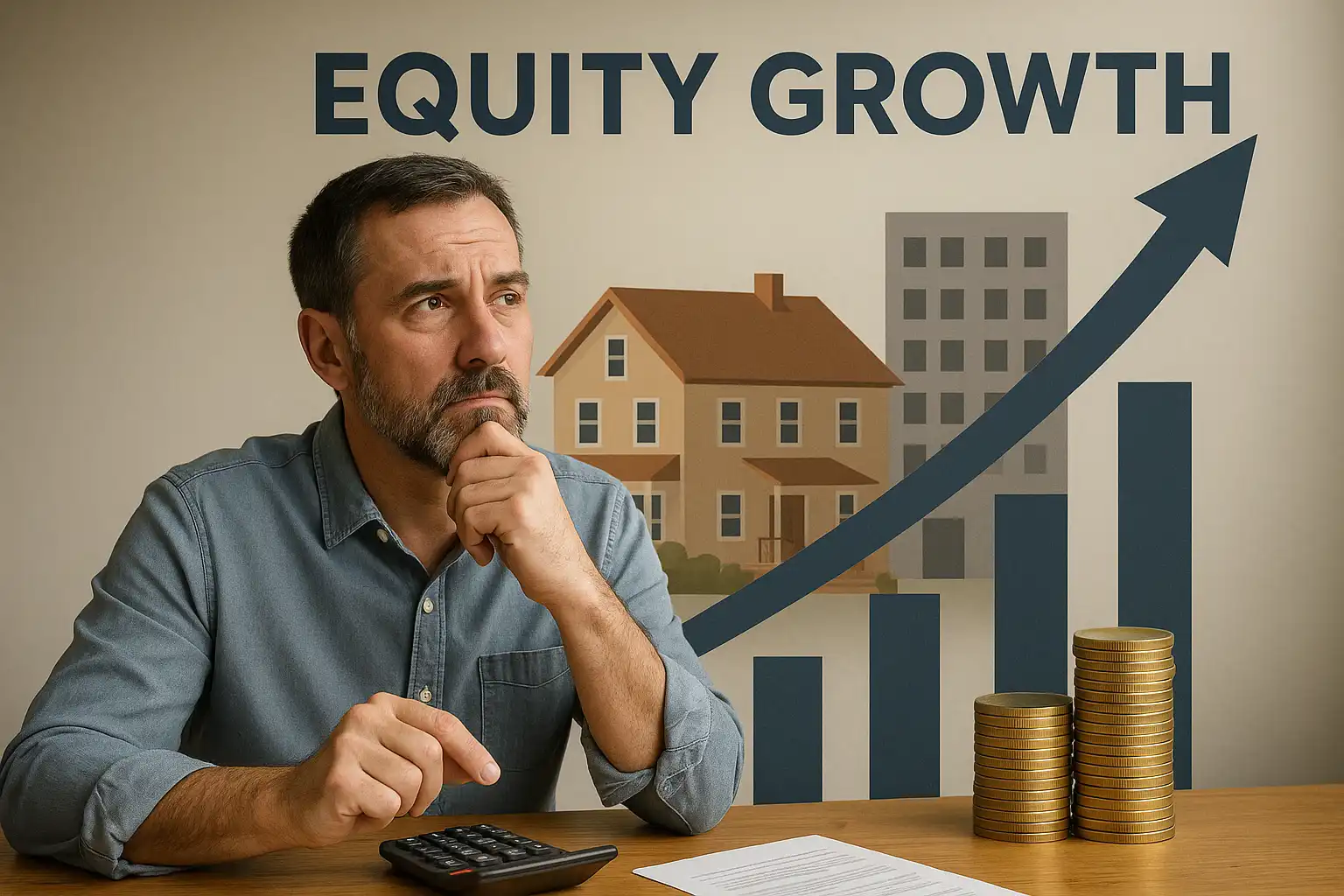
How to Calculate the Real Use of Equity
A 20-Year Lesson I Learned the Hard Way
A few months ago, I got a message that stopped me for a second. Not because the numbers were crazy. Not because the deal was amazing. But because the question was one I’ve been asked hundreds of times over the last 20 years.
It came from an investor in his late 30s. Solid income. A couple of properties. No disasters. No drama. Just that quiet moment where you look at your portfolio and think, “Am I doing this right… or am I just being safe?”
He owned a handful of rentals. Some were almost paid off. One barely cash flowed. Another did okay. On paper, everything looked fine. But buried inside the numbers was a big chunk of equity just sitting there. Not growing. Not shrinking. Just… existing.
And that’s when the real question shows up.
Not “Should I refinance?”
Not “Should I buy more?”
But this one:
What is my equity actually doing for me right now?
That’s the question most investors never slow down enough to answer.
Equity Isn’t Good or Bad. It’s Just There.
One of the biggest mistakes I see investors make is treating equity like a trophy.
“I have equity.”
“Look how much equity I’ve built.”
“I don’t want to touch my equity.”
None of that tells me whether you’re winning.
Equity isn’t good.
Equity isn’t bad.
Equity is just money sitting somewhere.
That’s it.
The moment you understand that, everything changes.
Every dollar you own has one of two things attached to it. A cost or a return. No exceptions. Even when you think nothing is happening, something is happening.
If your equity could be earning 6 percent somewhere else and it’s earning zero where it is, the cost of doing nothing is 6 percent. You just don’t see it on a statement.
Same thing with cash. If you’ve got money sitting in a savings account earning 3 percent while inflation is running at 3 percent, you’re not growing. You’re not losing either. You’re just standing still.
That’s not safety. That’s stagnation.
The Story Investors Rarely Tell Themselves
Back to the investor who reached out.
He wasn’t reckless. He wasn’t chasing shiny objects. He had done things “right.” Bought decent properties. Held them. Let time do its thing.
But when we really broke it down, most of his net worth growth had already happened. Appreciation had done the heavy lifting. Loan balances had come down. The question was what happens next.
Do you just wait?
Do you ride it out?
Or do you ask a more uncomfortable question.
Is my equity working… or am I working around it?
That’s where most people freeze. Because once you start asking that question, you can’t unsee the answer.
The Three Things I Always Look At
After 20 years of investing, I don’t complicate this anymore. I look at three things. Every time. No matter the market. No matter the strategy.
First, how much equity or liquidity do you actually have?
Not what Zillow says. Not what feels good. Real, usable equity.
Second, what is the cost or return on that money right now?
Is it earning something? Is it costing you something? Or is it pretending to be “safe” while quietly doing nothing?
Third, and this is the most important part, how much experience and knowledge do you actually have?
That last one is the multiplier. And most people ignore it.
Why Knowledge Is the Multiplier That Changes Everything
Two investors can look at the same pile of equity and make opposite decisions. One grows. One blows up. The difference isn’t the deal. It’s the operator.
Someone with experience knows how to manage leverage. They understand risk. They’ve lived through repairs, vacancies, rate changes, and bad tenants. They don’t panic when things wobble.
Someone without that experience can take the same leverage and turn it into stress, bad decisions, and sleepless nights.
This is why blanket advice is dangerous.
“Always leverage.”
“Never refinance.”
“Cash is king.”
“Debt is bad.”
None of those statements mean anything without context.
The Simple Formula I Use
If you strip away the noise, the math is actually simple.
Equity or liquidity.
Plus or minus the cost or return.
Multiplied by your knowledge.
That’s it.
In cleaner terms, you’re asking:
How much money do I have
What is it costing or earning me
And how capable am I of improving that outcome
If your knowledge multiplier is low, the answer might be to do nothing. That’s not a failure. That’s honesty.
If your knowledge multiplier is high and your equity is sitting idle, that’s when “playing it safe” quietly becomes expensive.
A Different Scenario, Same Lesson
Let’s change the scenario completely.
Imagine an investor owns three small rentals in different neighborhoods. Nothing fancy. They’re stable. Rents come in. Expenses go out. Net cash flow is modest.
Over time, appreciation does its thing. Loans get paid down. Suddenly there’s a large amount of equity across those properties.
On paper, they feel wealthy.
In reality, most of that money isn’t doing much.
Cash flow hasn’t meaningfully increased. Net worth growth has slowed. The portfolio looks good but feels stuck.
Now the investor is older, wiser, and far more capable than when they started. Better team. Better judgment. Better systems.
The real risk at this stage isn’t doing too much.
It’s doing nothing out of habit.
The Hidden Cost of “I’ll Just Wait”
Waiting feels responsible. It feels mature. It feels safe.
But waiting has a cost.
If your equity is earning 1 percent in effective return and you have the ability to responsibly earn more, the difference isn’t theoretical. It’s real. It compounds quietly year after year.
This doesn’t mean you rush out and refinance everything tomorrow.
It means you stop lying to yourself about what your money is doing.
Why There Is No One Right Answer
This is where people get frustrated. They want a yes or no.
Should I use my equity or not?
The truth is boring. It depends.
It depends on your numbers.
It depends on your market.
It depends on your goals.
It depends on your experience.
And most of all, it depends on whether you’re making decisions based on fear or clarity.
The Question I Always End With
Whenever someone asks me this question, I don’t tell them what to do. I ask them something instead.
If nothing changes for the next five years, are you okay with what your equity produces?
If the answer is yes, leave it alone.
If the answer is no, then the problem isn’t the market. It’s not interest rates. It’s not the property.
It’s the fact that your money has outgrown the strategy you’re using.
Final Thought
Equity is not a badge of honor.
It’s not a retirement plan by itself.
And it’s definitely not something you avoid touching just because someone online said debt is scary.
Equity is a tool.
Like any tool, it can build or destroy depending on who’s holding it.
The goal isn’t to use equity at all costs.
The goal is to understand the cost of not using it.
Once you see that clearly, the decision usually makes itself.
Keep it consistent, stay patient, stay true—if I did it, so can you. This is Jorge Vazquez, CEO of Graystone Investment Group and all our amazing companies, and Coach at Property Profit Academy. Thanks for tuning in—until the next article, take care and keep building!
If you’d like to connect directly with me, feel free to book a time here: https://graystoneig.com/ceo.
Book an Expert
New investor? Start with Jorge.

Jorge Vazquez – CEO & Investment Strategist at Graystone. Let’s make your portfolio stronger, steadier, and more profitable.
Deals? Book with Cody.

Meet Cody Bergstrom, Your Expert in Finding Deals Let’s find an off-market deal that actually works for you.
Need financing? Book with Lisa.

Meet Lisa Kaye Price, the LendingGig Top ML Let’s figure out the smartest way to fund your next deal.
Looking for PM? Book with Jay

Jay Michalec – COO & Property Management Expert at Graystone. Let’s make your rentals easier, calmer, and more profitable.