

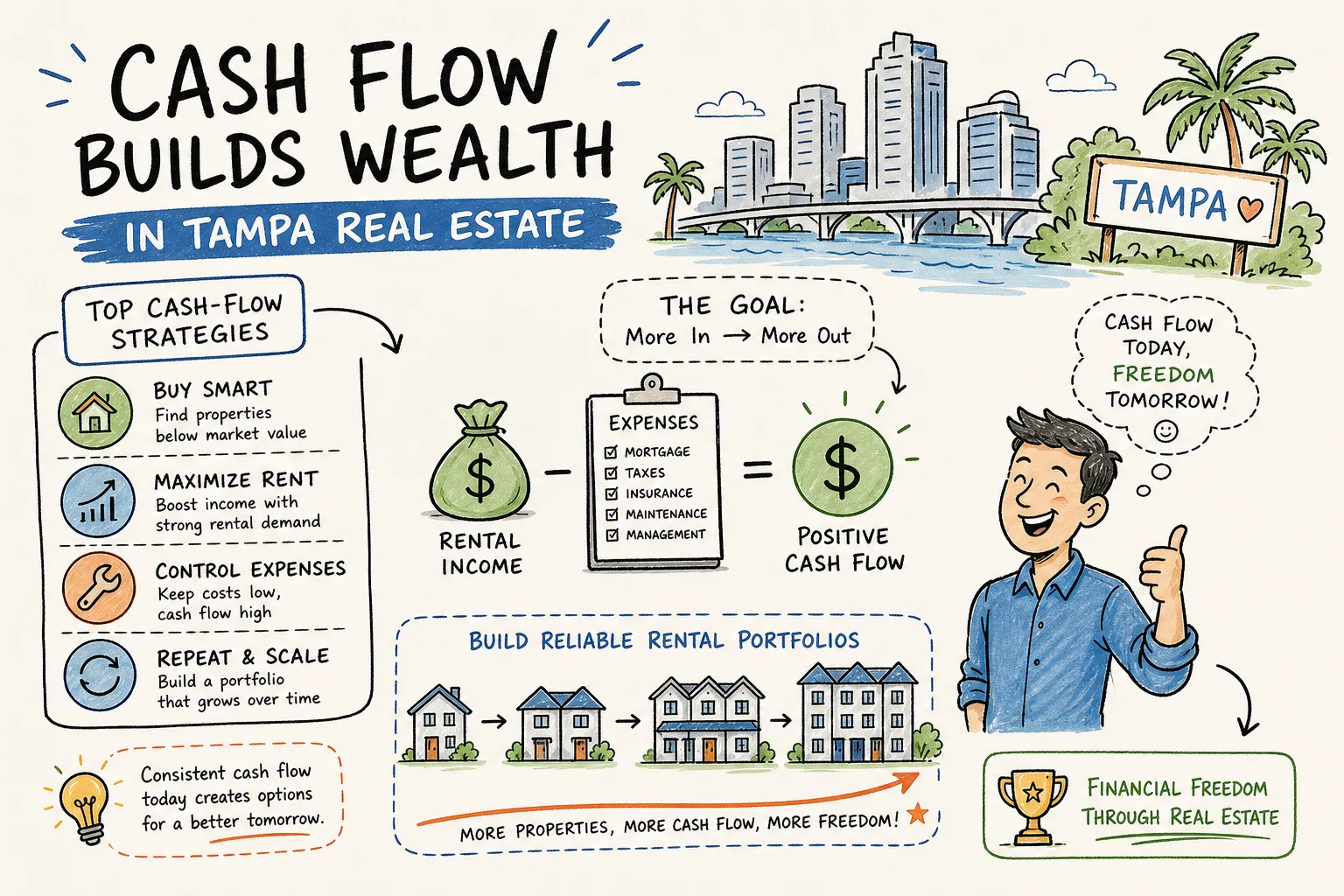
Top Cash-Flow Strategies Tampa Real Estate Investors Use to Build Reliable Rental Portfolios
Tampa real estate investors are navigating a 2026 market that is neither broken nor booming. Median home values sit between $377,000 and $479,000 depending on which data source you use and which measurement window you pull. Median rents are running near $2,100 per month. Inventory is up 14 to 25 percent year over year, and homes are sitting at 65 days on market in some pockets. That is not a crash signal. It is a window, and serious buyers know how to use one.
The core tension in this market is simple. Tampa draws rental property buyers because of genuine population growth and sustained rental demand. But deals that pencil on paper still blow up in the field when the underwriting is sloppy or the operator is guessing. The frameworks and data in this article come from the work done at Graystone Investment Group, a Tampa-based firm led by Jorge Vazquez with over 20 years of experience and more than 3,500 completed transactions across the Tampa Bay market. This is not theory. It is what the numbers actually look like when you do this seriously.
What Tampa real estate investors need to know about the 2026 rental market
The numbers that matter for cash-flow analysis
Zillow pegs Tampa’s average home value at $377,566 as of August 2026. Redfin shows a median sale price closer to $478,683 over the same period. The gap between those figures reflects different measurement methods, but both are useful anchors. Pair either number against a median rent of $2,100 per month and you get a gross annual yield of roughly 5.3 to 6.7 percent before a single expense hits the ledger.
Gross yield is not your return. It is a screening tool, nothing more. Once you apply realistic property taxes, insurance, vacancy, maintenance reserves, and management fees, that 6.7 percent gross yield frequently lands at 4 to 5.5 percent net. That is still workable in many submarkets, but only if you start with honest inputs rather than optimistic ones.
What rising inventory means for your strategy
Active listings are up significantly year over year, and the days-on-market figure has stretched to 65 days on Realtor.com. Tampa real estate investors who sat out the 2021 to 2023 frenzy now have more negotiating leverage than they have seen in years. Sellers are less likely to dismiss inspection contingencies or refuse to share operating history when their home has been sitting for two months.
The neighborhoods absorbing this inventory fastest tend to be the premium core areas like Hyde Park and South Tampa, where strong rental demand keeps landlords competitive. The better cash-flow plays in 2026 are in Brandon, Riverview, Seminole Heights, and Wesley Chapel, where entry prices remain lower and rents hold steady. Ybor City continues to attract renter interest driven by ongoing redevelopment. These are the submarkets worth studying before you make any offer.
The cash-flow metric to use before you ever make an offer
Two screening tools belong at the front of every deal review: gross rent multiplier and cap rate. For a quick field calculation, take a $400,000 Tampa property renting at $2,100 per month. That is $25,200 in annual gross rent. Divide the purchase price by annual gross rent and you get a gross rent multiplier of 15.9. Divide the net operating income (gross rent minus operating expenses) by the purchase price to get your cap rate. On conservative assumptions, a deal that initially looks like a 6.5 percent cap rate often becomes 4.5 to 5 percent after honest inputs are applied. Run both numbers before you call anyone.
Three acquisition strategies Tampa property investors use for different goals
First-time buyers: start with one door and control your exposure
If you are buying your first rental property in Tampa, the goal is not maximum yield. The goal is low complexity and a clean first experience. Turnkey single-family homes in established rental submarkets, financed conventionally, fit that objective. A property that already has a tenant in place, with a documented rent history and a recent inspection on file, removes a significant amount of first-deal risk.
The worst first-deal mistake Tampa investors make is buying a value-add property when they have no renovation experience, no local contractor relationships, and no timeline buffer. Jumping straight into a gut-rehab, for example, when you have never managed a single contractor or pulled a permit, is how first-time buyers turn a promising deal into a six-month money pit. Start simple. Get the process right before you get clever.
Out-of-state investors: why the right local operator is the whole strategy
Remote investing in Tampa without a trusted local partner is a liability, not a strategy. Out-of-state property buyers who attempt self-management consistently lose money on deferred maintenance, mispriced rents, and tenant turnover costs they never anticipated. The acquisition decision and the management relationship need to be solved simultaneously, not one after the other.
The question to ask any prospective local partner is whether they manage properties themselves or outsource management while only profiting on the acquisition. A firm that manages its own doors has real operating data. A firm that only sells and passes the management burden to someone else is one step removed from accountability.
Portfolio builders: scale requires systems, not just more deals
Investors adding their fifth through twentieth door face a different problem than first-time buyers. The bottleneck is no longer finding deals. It is underwriting consistency, financing that does not stall on every acquisition, and property management that generates useful performance data rather than just collecting rent. At this stage, the business of investing matters as much as the individual investments. Investors who scale without systems simply accumulate problems at a faster rate.
How to underwrite a Tampa rental deal without fooling yourself
The conservative assumptions that protect your cash flow
Here is what conservative Tampa underwriting actually looks like. Rent at 95 percent of asking, not the top of the market range. Vacancy at 8 to 10 percent. Maintenance reserve at 1 to 1.5 percent of property value annually. Property management at 8 to 10 percent of collected rents. Insurance and taxes as actual quotes, not estimates.
When you run those numbers honestly on a deal that initially looks like a 7 percent cap rate, the real figure frequently settles between 4.5 and 5 percent. That is fine if you underwrote to that number from the start. It is a problem if you underwrote to the optimistic version and bought at the wrong price.
A pre-offer due diligence checklist
Before making any offer on a Tampa rental property, work through the following steps in order:
- Confirm current rent against the verified lease agreement, not the seller’s verbal claim
- Pull 12 months of actual operating expense history, including repairs, utilities paid by owner, and management fees
- Order a third-party inspection before you finalize your offer, not after you are already under contract
- Verify neighborhood rental comps using closed leases, not active listings
- Confirm flood zone status and get current insurance quotes, not ballpark figures from two years ago
Where most investors cut corners and pay for it later
The two most common underwriting errors in Tampa both involve the same mistake: using optimistic inputs to justify a decision that was already made emotionally. The first error is using listing rents instead of actual market rents. The second is treating deferred maintenance as a single vague number rather than a line-item cost. Both errors produce a deal that looks fine until month three, when the HVAC dies and the real rent is $200 lower than the projection.
What a third-party inspection and Diligence Vault reveal before you commit
Why inspection findings change deal economics more than price negotiations
A third-party inspection is not a formality. It quantifies the gap between asking price and true value. Roof age, HVAC condition, plumbing configuration, and foundation status directly change your five-year cash flow projection in ways that no amount of negotiating on purchase price can offset. Investors who skip or rush inspections absorb $10,000 to $30,000 in unexpected costs within their first two years far more often than those who treat the inspection as a non-negotiable step.
How Graystone’s Diligence Vault works in practice
Every property Graystone Investment Group presents to investors undergoes a third-party inspection before it reaches the investor’s desk. The inspection evaluates major systems, overall property condition, and potential repair exposure. All findings, positive and negative, are uploaded to a shared Diligence Vault that the investor can access before making any decision. There is no selective disclosure. There are no surprises after closing. Traditional brokerage models built on commission incentives rarely include this step.
What 3,500 transactions teach you about what to trust
After 3,500-plus completed deals, the patterns become obvious. Sellers who resist inspection contingencies, refuse to share operating history, or pressure buyers toward fast timelines are not simply difficult to work with. They are signaling something specific about the asset. Graystone’s underwriting team treats these behaviors as elimination criteria, not negotiating nuances. The deal that takes the most pressure to close is usually the one you should walk away from fastest.
Where Tampa Bay investors find deals, partners, and real market intelligence
The active investor groups worth your time in 2026
Tampa REIA holds its main meeting on the second Thursday of each month at 6:00 PM, with members attending free and guests paying $20 online or $25 at the door. The group runs deal-focused programming, renovation subgroups, and late-night networking after the main event. TBREIA meets on the third Thursday of the month at 5101 N Rome Ave, Tampa, with members attending free and non-members paying $30. TBREIA also runs satellite meetings in St. Pete and North Tampa on separate weekly schedules. Wealth Builders REEA covers the Clearwater and Tampa Bay corridor with over 1,000 members and offers deal flow connections across the broader metro.
Across these real estate investment clubs in Tampa, you get something no national platform delivers: a ground-level read on what the Tampa Bay real estate network is actually transacting right now, straight from people who closed deals in the last 90 days. Tampa real estate meetups like these also surface off-market opportunities that never hit the MLS.
How to vet a Tampa investor group before you invest your time
Not every meetup generates serious deal flow. A strong group brings active investors with recently closed deals, not primarily service vendors packaging coaching programs. The simplest vetting question you can ask is: what percentage of members closed a transaction in the last 12 months? If nobody in the room knows the answer, that room is probably not your primary source of deal intelligence.
Watch the meeting structure carefully. If every speaker is selling a product or service rather than discussing an actual deal or market condition, you are attending a sales event with an investor label on it. Attend once as an observer before committing to membership. Ask how members are vetted and what the group actually produces beyond networking.
When a full-service partner replaces the need to network your way to every deal
Some Tampa property investors build their pipeline entirely through REIA meetings and personal networks. That approach works if you have the time and the local relationships to make it function. Others work with a firm like Graystone Investment Group that brings acquisitions, underwriting, financing coordination, and in-house property management under one roof. Both paths can produce results. The question is whether you have the bandwidth to build and maintain a local network, or whether you need a trusted operator running that function on your behalf while you focus on other priorities.
Your next concrete step toward a Tampa rental portfolio
Tampa real estate investors who build reliable rental portfolios share a few non-negotiable habits. They carry a realistic read on what the 2026 market actually supports: gross yields in the 5 to 6.7 percent range, operating expenses that routinely consume 35 to 50 percent of gross rent, and cap rates that rigorous underwriting puts between 4.5 and 6 percent in most established submarkets. They use actual data rather than listing optimism at every stage of underwriting. And they align with a trustworthy local operator or partner who runs diligence the same way whether the investor is watching or not.
Tampa’s rising inventory and moderating prices make 2026 a reasonable entry point for buyers who are not speculating on appreciation. The deals are there. The process is what separates the investors who find them from those who overpay or walk away empty-handed. Tampa real estate investors who want current inventory reviewed against their specific criteria should contact Graystone Investment Group directly to request a property vault review or schedule a consultation with the acquisitions team.
Book an Expert
New investor? Start with Jorge.

Jorge Vazquez – CEO & Investment Strategist at Graystone. Let’s make your portfolio stronger, steadier, and more profitable.
Deals? Book with Cody.

Meet Cody Bergstrom, Your Expert in Finding Deals Let’s find an off-market deal that actually works for you.
Need financing? Book with Lisa.

Meet Lisa Kaye Price, the LendingGig Top ML Let’s figure out the smartest way to fund your next deal.
Looking for PM? Book with Jay

Jay Michalec – COO & Property Management Expert at Graystone. Let’s make your rentals easier, calmer, and more profitable.