

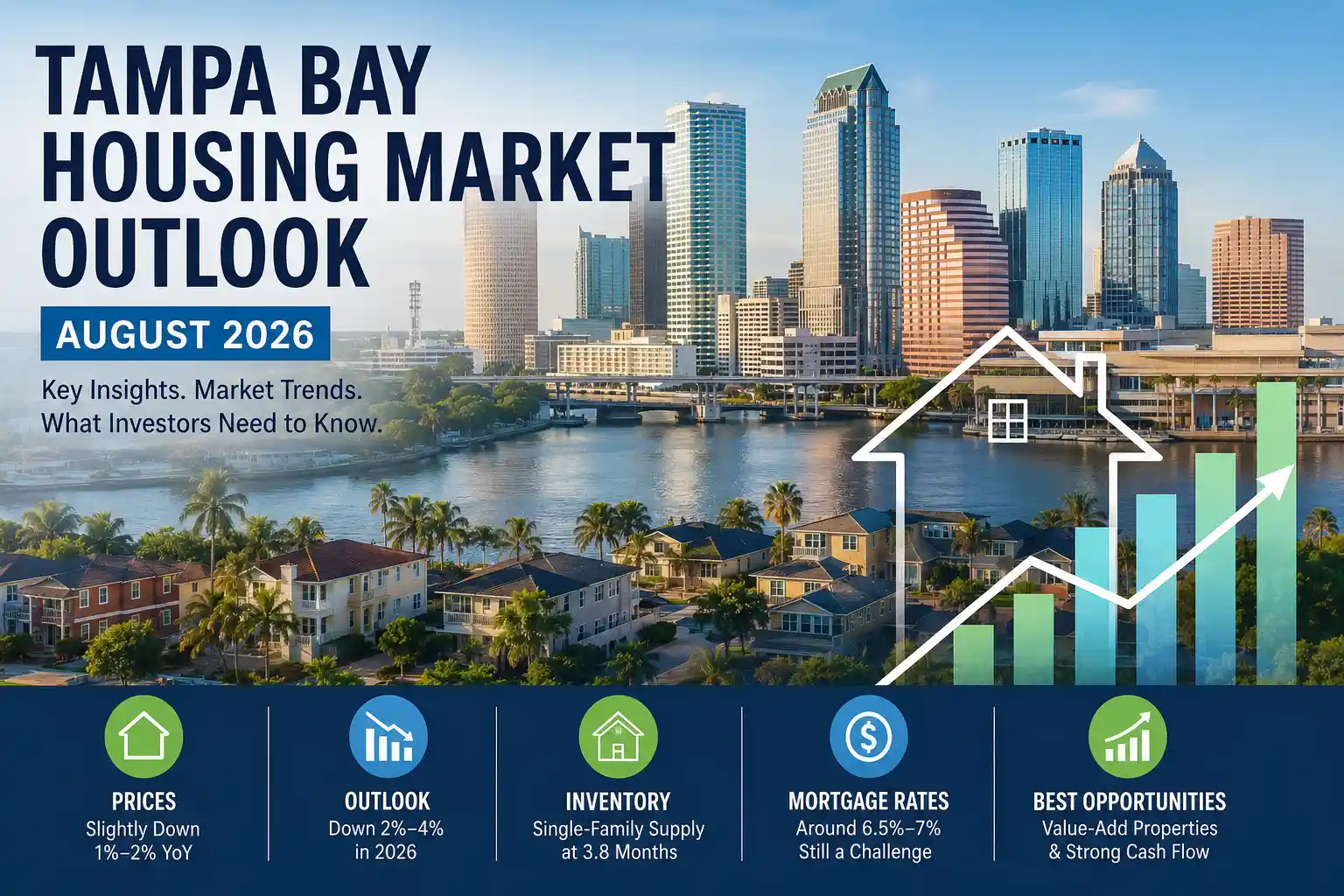
Tampa Bay Housing Market Outlook — August 2026
Executive conclusion
Tampa Bay is going through a segmented market correction—not a broad housing crash.
The underlying indicators show that metro home values are generally down approximately 1%–2% year over year, while July asking prices were down 4.2%. However, single-family inventory has fallen sharply and remains at only 3.8 months of supply, which is preventing a much larger decline. (S&P Global)
The biggest weakness is concentrated in:
- Older condominiums with large HOA fees, reserve deficiencies or assessments.
- Flood- and wind-exposed properties.
- New-construction-heavy areas where builders offer incentives.
- Rentals that depend on aggressive rent growth.
- Overpriced properties that have not adjusted to 2026 financing costs.
The strongest part of the market is generally well-priced, insurable single-family housing in established inland neighborhoods.
My expectation: Tampa Bay will probably finish 2026 with broad property values approximately 2%–4% lower year over year, followed by a mostly flat to modestly positive market in 2027—assuming mortgage rates remain in the low-to-mid 6% range and the local economy avoids a meaningful contraction.
Important data note
This report treats Tampa as the Tampa–St. Petersburg–Clearwater metropolitan area, with separate county and City of Tampa statistics where appropriate.
As of August 16, 2026:
- July 2026 listing data is available.
- June 2026 is the latest official Florida Realtors closed-sales report.
- Florida Realtors is scheduled to release July closed-sales data on August 17.
- Mortgage-rate data is current through August 13.
- Zillow’s rental data is current through August 15. (Realtor)
1. Tampa market dashboard
| Indicator | Latest reading | What it means |
|---|---|---|
| City of Tampa typical home value | $380,300, down 1.3% | Underlying city values are slightly negative. (Zillow) |
| Tampa Case-Shiller index | Down 1.6% | Repeat-sales data confirms a mild metro-level correction. (S&P Global) |
| Metro median asking price | $397,450, down 4.2% | Sellers are adjusting expectations more quickly than closed-sale prices suggest. (Realtor) |
| Listings with price reductions | 25.4% | Roughly one in four listings has had an asking-price cut. (Realtor) |
| Single-family median closed price | $424,900, up 3.6% | This is influenced by which homes sold and should not be interpreted as pure appreciation. |
| Single-family active inventory | 12,031, down 15.4% | Inventory is tightening rather than building into a large glut. |
| Single-family months of supply | 3.8 months | Approximately balanced, but still supportive of properly priced homes. |
| Condo/townhome months of supply | 6.4 months | More buyer-friendly than single-family housing. |
| City of Tampa rent index | $1,992, down 0.9% | Rent growth is no longer supporting weak acquisitions. (Zillow) |
| 30-year mortgage rate | 6.67% | Affordability remains the market’s biggest obstacle. (Freddie Mac) |
| Metro unemployment | 4.7% | The economy is not collapsing, but employment growth is weak. (Bureau of Labor Statistics) |
| Metro employment growth | Up only 0.2% | Tampa’s former rapid job-growth tailwind has slowed considerably. (Bureau of Labor Statistics) |
2. Are Tampa property prices rising or falling?
The best answer is:
Underlying Tampa Bay property values are slightly declining, even though some monthly median sale prices are still showing increases.
Three different measurements illustrate the issue:
- Zillow shows the typical City of Tampa home value down 1.3%.
- Case-Shiller’s repeat-sales index shows Tampa metro prices down 1.6%.
- Florida Realtors shows the median single-family closing price up 3.6%.
Those figures are not necessarily contradictory. Zillow and Case-Shiller attempt to measure changes in underlying property values. A monthly median price only measures the middle price of the homes that happened to close that month. If a larger proportion of expensive homes sells, the median can increase even while comparable properties are losing value. (Zillow)
That is why I would not publish a market update saying “Tampa prices increased 3.6%.” A more accurate statement would be:
June’s median closing price increased because of the sales mix, but broader Tampa value indexes remain approximately 1%–2% below last year.
3. Single-family homes remain the most resilient segment
The Tampa Bay metro recorded 3,759 single-family sales in June, down only 0.8% year over year. More importantly, active single-family inventory fell 15.4%, from 14,216 homes to 12,031, leaving only 3.8 months of supply.
This is not the inventory structure normally associated with a major housing crash. Prices can continue drifting lower because affordability is weak, but limited resale supply makes a rapid, widespread decline less likely without a recession, major job losses or forced selling.
Single-family homes also received a median of 96.6% of their original asking price, with a median of 34 days to contract. Sellers have lost the extraordinary leverage they had in 2021 and 2022, but buyers are not receiving enormous discounts on every house.
County-by-county single-family snapshot
| Area | June median | Sales | Inventory | Supply | Interpretation |
|---|---|---|---|---|---|
| Hillsborough | $445,155, +1.2% | -1.0% | -14.9% | 3.7 months | Relatively stable, but slower than the pandemic market. |
| Pinellas | $480,000, +5.5% | +3.9% | -26.6% | 3.5 months | Tight resale supply, although insurance and flood risk create major property-level differences. |
| Pasco | $390,000, +1.3% | -10.7% | -4.9% | 4.1 months | Weaker transaction activity and greater competition from new construction. |
What this means
Hillsborough: Probably the most balanced large county. Properly priced single-family homes should remain relatively stable, especially in established areas with limited new construction.
Pinellas: Existing single-family inventory is unusually tight, but property condition, flood exposure, roof age, wind coverage and prior storm damage can create a massive difference between two nearby houses.
Pasco: More buyer-friendly. Sales were down nearly 11%, pending sales were down 10%, and months of supply increased slightly. Resale sellers must compete against builders offering closing-cost assistance, rate buydowns and new-home warranties.
4. Condos are a completely different market
Metro condo and townhome inventory stood at 6.4 months of supply, compared with only 3.8 months for single-family homes. Condo sellers received a median of 93.6% of their original asking price, and properties took a median of 59 days to enter into contract.
Pinellas condos provide an even clearer example. June condo sales increased 16.6%, and the median price increased to $295,000. Nevertheless:
- Sellers received only 91.9% of the original asking price.
- Median time to contract was 71 days.
- Median time to closing was 105 days.
- Inventory represented 7 months of supply.
- Nearly 59% of transactions were cash purchases.
That is not a strong seller’s market. It means transactions are happening, but usually after additional time, price negotiations or concessions.
The headline median price increase should also be treated cautiously because the mix of units closing can change significantly from one year to the next.
Why older condos remain vulnerable
Florida law generally prevents qualifying condominium associations from waiving required structural reserves for budgets adopted after December 31, 2024. Associations with buildings of three or more habitable stories are also subject to structural integrity reserve study requirements. Most applicable existing associations were required to complete a study by the end of 2025, with certain milestone-inspection situations permitted no later than the end of 2026. (Online Sunshine)
This can lead to:
- Higher monthly association fees.
- New or expanded special assessments.
- Association loans passed through to owners.
- Financing and insurance difficulties.
- More owners deciding to sell simultaneously.
Some condos will become excellent opportunities, but only when the discount exceeds the building’s financial and structural risks.
For every condo acquisition, investors should obtain the structural reserve study, milestone inspection, current budget, master insurance policy, pending assessment information, association loan documents, recent meeting minutes, delinquency rate and litigation disclosures.
5. Tampa’s rental market is soft
Tampa rental performance is currently one of the biggest warnings for investors.
Zillow’s quality-adjusted City of Tampa rent index was $1,992 in July, down 0.9% year over year. Zillow’s broader rental-manager dataset showed an average advertised rent of approximately $2,000, down $150 from the previous year. (Zillow)
Realtor.com reported that the median asking rent for studios, one-bedroom and two-bedroom units in the Tampa metro was $1,645 in May, down 4.5% year over year. (Realtor)
The multifamily market has an additional supply problem:
- Apartment asking rents increased only 0.1% on a trailing three-month basis.
- Occupancy fell to 93.3%, down 140 basis points.
- Developers delivered 3,128 units through May.
- Another 16,146 units were under construction. (Yardi Matrix)
These rental statistics use different methodologies, so the exact rent number varies. However, they all communicate the same message:
Tampa rent growth is currently flat to negative, and landlords should expect more competition, concessions and longer leasing times in supply-heavy areas.
Single-family rentals may perform better than new luxury apartments, particularly larger inland homes suitable for families. Nevertheless, investors should not underwrite 4%–5% annual rent increases to make a deal work.
6. Mortgage rates remain the market’s biggest obstacle
The national average 30-year fixed mortgage was 6.67% on August 13, slightly higher than the 6.58% average from one year earlier. (Freddie Mac)
To illustrate the affordability effect:
- A $400,000, 30-year loan at 3% has principal and interest of approximately $1,686 per month.
- At 6.67%, that same loan is approximately $2,573 per month.
- That is roughly $887 more each month, before taxes, insurance, HOA costs or mortgage insurance.
This explains why modest price reductions have not produced a major surge in buyer demand. Prices would have to fall substantially—or mortgage rates would have to decline—to recreate pandemic-era monthly payments.
High rates are also producing a standoff:
- Many existing owners do not want to surrender their lower-rate mortgages.
- Buyers cannot afford as much as they could several years ago.
- Sellers who must move are reducing prices.
- Sellers who do not have to move often withdraw rather than accept a lower offer.
That dynamic is contributing to both lower values and lower inventory at the same time.
7. Population growth continues, but at a slower pace
The Tampa Bay metro population increased from approximately 3.405 million in 2024 to 3.419 million in 2025—growth of approximately 0.4%. The previous year’s increase was closer to 1%. (FRED)
That means Tampa continues to attract and retain residents, but the migration surge is no longer strong enough by itself to overcome high financing, insurance and ownership costs.
The local job market has also slowed. June employment was only 0.2% higher year over year, while unemployment stood at 4.7%. Education and health services were the strongest major sector, growing 2.4%, while information employment was down 3.9% and financial activities were down 0.6%. (Bureau of Labor Statistics)
This is a stabilizing economy, not a booming economy. Housing demand can continue, but buyers will be more price-sensitive.
8. Florida insurance is stabilizing—but it is not inexpensive
There are genuine signs of improvement in Florida’s insurance market.
As of April 2026, the Florida Office of Insurance Regulation reported average statewide admitted-market homeowners premiums of:
- $3,757 including wind coverage.
- $2,586 excluding wind coverage.
- $1,800 for a condo unit-owner policy including wind.
Surplus-lines averages were considerably higher. These are statewide averages, not estimates for any specific Tampa Bay property.
OIR’s recent rate data also shows that many weighted-average approved rate changes have been negative, and preliminary 2026 reinsurance data indicates that nearly half of participating insurers experienced risk-adjusted pricing reductions of 15%–25%. Florida domestic property insurers also produced a combined ratio of 83% in 2025, compared with losses and ratios above 100% in several earlier years.
That suggests the statewide insurance system is becoming financially healthier.
It does not mean every Tampa investor will receive a lower quote. Individual premiums will continue to depend heavily on:
- Roof age and permit history.
- Wind mitigation features.
- Replacement cost.
- Electrical and plumbing condition.
- Flood zone and elevation.
- Distance from the coast.
- Prior claims.
- Property age and construction type.
- Whether Citizens or surplus-lines coverage is required.
The right message for a market update is:
Florida insurance appears to be stabilizing, but insurance remains a major property-selection issue and a serious component of investment returns.
9. Investors remain active in Tampa
Corporate investors represented approximately 12.8% of Tampa Bay purchases in 2025, purchasing 7,581 properties. Their median purchase was $280,000—approximately 22.4% below the metro’s overall median. (Realtor)
This indicates that investors remain focused primarily on the lower-priced and value-add portions of the market.
Nationally, small investors now represent roughly two-thirds of corporate-entity investor purchases, while large and mega-investor activity has pulled back considerably from its pandemic peak. (Realtor)
For Tampa, that means the sub-$300,000 investment market may remain competitive even while the overall market is soft. A buyer looking for an entry-level rental is not necessarily competing against the same demand conditions affecting a $700,000 owner-occupied house.
10. Published Tampa forecast for 2026
Realtor.com’s official 2026 forecast ranked Tampa 93rd among the 100 largest metropolitan areas for combined price and sales growth. It projected:
- Existing-home sales down 3.1%.
- Median existing-home price down 3.6%.
- Combined price and sales change of negative 6.8%. (Realtor)
That forecast is consistent with the current direction of the underlying data. Values and asking prices are already slightly negative, while transaction activity remains constrained.
My Tampa Bay projection
The following ranges are my synthesis of the current data rather than a guarantee.
| Scenario | Remainder of 2026 | 2027 expectation |
|---|---|---|
| Base case | Broad values finish approximately 2%–4% lower year over year | Approximately -1% to +3%, depending on rates |
| Better case | Rates fall toward 6%, buyer demand improves | Prices increase approximately 2%–5% and sales recover |
| Downside case | Rates remain around or above 7%, employment weakens or a major storm disrupts insurance | Broad prices decline 6%–10%, with riskier condos potentially declining more |
Most likely outcome
The most likely outcome is a slow grinding market, not a dramatic crash or rapid recovery.
The factors preventing a major crash are:
- Single-family inventory remains limited.
- Tampa is still gaining population.
- Local employment remains positive, although barely.
- Existing owners generally have substantial equity.
- Properly priced homes are still selling.
The factors preventing meaningful appreciation are:
- Mortgage rates remain near 6.7%.
- Rent growth is flat or negative.
- Apartment construction remains elevated.
- Insurance remains expensive.
- Condo reserve and assessment costs are still working through the market.
- Job and population growth have slowed.
Where I expect the best opportunities
| Property type | Outlook |
|---|---|
| Inland single-family with newer roof and reasonable insurance | Most resilient |
| Distressed single-family bought substantially below renovated value | Strong value-add opportunity |
| Pasco resale competing against builders | Potential negotiating opportunity |
| Family-sized rentals in established neighborhoods | Better than supply-heavy apartment corridors |
| Older condo with fully funded reserves and no major assessment | Possible opportunity after deep due diligence |
| Older coastal condo with unclear reserves or inspections | Highest risk |
| Turnkey rental producing weak cash flow at today’s rent | Avoid relying on appreciation |
| Flip with a thin margin | High risk in a flat-price environment |
Conservative investor underwriting for the next 12 months
For acquisitions made today, I would use:
| Assumption | Conservative approach |
|---|---|
| Appreciation | 0% in the base underwriting |
| First-year rent growth | 0% |
| Financing | Stress-test approximately 6.5%–7.5% |
| Refinancing | Do not assume an automatic return to 5% rates |
| DSCR | At least 1.25 after actual taxes and insurance |
| Insurance | Obtain a property-specific quote during due diligence |
| Property taxes | Calculate the likely post-sale reassessment |
| Condo costs | Include current HOA, assessments and probable reserve changes |
| Exit value | Test a scenario with the property worth 5%–10% less |
| New construction competition | Include builder incentives when selecting resale comparables |
For a BRRRR acquisition, the strategy should be based on buying below value and creating equity through rehabilitation—not on expecting Tampa appreciation to rescue the refinance.
Copy-ready Tampa market update
Tampa Bay Real Estate: A Correction, Not a Collapse
Tampa Bay’s real estate market has changed significantly in 2026, but the numbers do not point to a broad housing crash. Underlying home values are approximately 1%–2% lower than last year, and metro asking prices are down 4.2%. However, single-family inventory has also fallen 15.4%, leaving only 3.8 months of supply. That limited inventory is helping prevent a larger decline. (S&P Global)
The market is now separating into different categories. Well-priced single-family homes in established inland neighborhoods remain relatively resilient. Condos are much more buyer-friendly, particularly older buildings dealing with higher HOA fees, reserve requirements, inspections or special assessments. Rental properties also require more conservative underwriting because Tampa rents are generally flat to down, while more than 16,000 apartment units remain under construction.
Mortgage rates remain the biggest obstacle. With the average 30-year rate around 6.67%, buyers have substantially less purchasing power than they had during the pandemic. My expectation is that Tampa Bay property values will finish 2026 approximately 2%–4% lower, followed by a mostly flat to modestly positive market in 2027 if rates begin to ease. (Freddie Mac)
For investors, this is not the time to depend on appreciation or aggressive rent increases. The opportunity is to buy below current value, focus on properties with manageable insurance costs, create equity through improvements and make sure the rental numbers work based on today’s rents and today’s financing. The Tampa market still offers opportunities—but property selection and disciplined underwriting matter more than ever.
Book an Expert
New investor? Start with Jorge.

Jorge Vazquez – CEO & Investment Strategist at Graystone. Let’s make your portfolio stronger, steadier, and more profitable.
Deals? Book with Cody.

Meet Cody Bergstrom, Your Expert in Finding Deals Let’s find an off-market deal that actually works for you.
Need financing? Book with Lisa.

Meet Lisa Kaye Price, the LendingGig Top ML Let’s figure out the smartest way to fund your next deal.
Looking for PM? Book with Jay

Jay Michalec – COO & Property Management Expert at Graystone. Let’s make your rentals easier, calmer, and more profitable.