

By Jorge Vazquez
CEO & Co-Founder, Graystone Investment Group
As someone who lost 22 properties during the 2008 financial crisis, I understand why people ask, “When will the real estate market crash?”
When you’ve lived through a true real estate collapse, the fear of another one is always lurking in the back of your mind. Whenever inventory ticks up, interest rates shift, or insurance costs rise, headlines immediately start warning of an impending market meltdown. Hopeful buyers sit on the sidelines waiting for prices to drop 40%, while anxious homeowners worry their equity is about to evaporate.
However, after 20+ years in this industry and over 3,500 closed transactions, I can tell you that market crashes are not caused by bad vibes or high prices alone. They are caused by systemic failure in market fundamentals.
If you are waiting for a widespread real estate crash before you make your next move, here is an honest, data-backed analysis of where the market actually stands—and why the better question isn’t when it will crash, but how you can build a portfolio that thrives regardless of market cycles.
Why a Widespread Market Crash Is Unlikely Today
To understand whether the real estate market will crash, you have to compare today’s conditions to what caused the collapse in 2008. When you look under the hood, the structural foundation of today’s market is entirely different.
1. Lending Standards Are Rigid, Not Loose
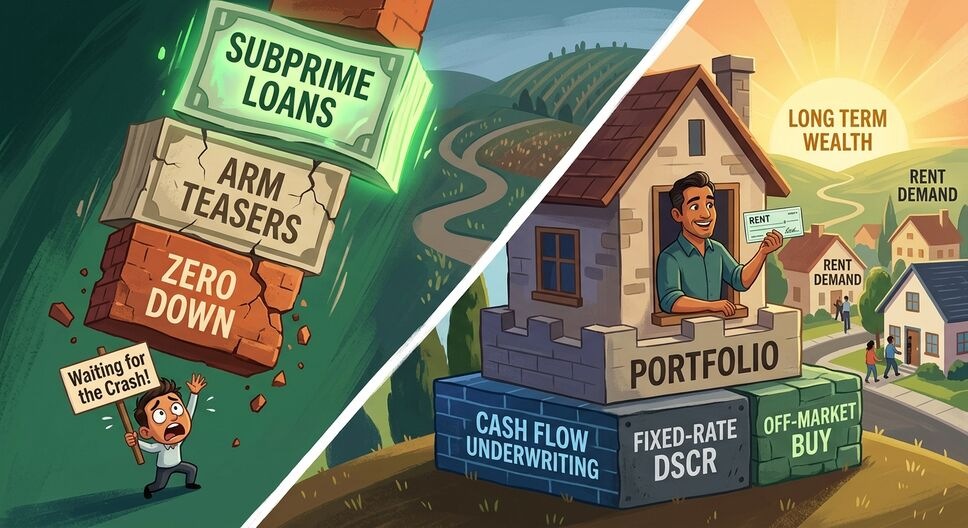
The 2008 crash was fueled by subprime lending, stated-income “liar loans,” and zero-down adjustable-rate mortgages given to unqualified borrowers. When those teaser rates adjusted, millions defaulted. Today, lending standards have been exceptionally strict for well over a decade. Buyers over the last ten years qualified under rigorous underwriting with verified income, strong credit scores, and substantial down payments.
2. Record Home Equity vs. Negative Equity
In 2008, millions of homeowners owed more on their homes than the properties were worth. Today, equity levels are near historic highs. Most homeowners sitting on 3% or 4% fixed-rate mortgages have a massive cushion of equity. Even if local home values adjust downward by 5% or 10%, vast majority of homeowners are not going underwater, nor are they forced to sell.
3. Structural Housing Shortage
Prices crash when supply massively outweighs demand. Prior to 2008, homebuilders were drastically overbuilding. Today, the nation has experienced over a decade of underbuilding following the Great Recession, resulting in an estimated shortage of millions of housing units. While inventory has increased in specific regional markets—particularly in parts of the Sunbelt—nationwide supply remains tight relative to long-term demographic demand.
What We Are Seeing Instead: Market Corrections & Micro-Adjustments
Instead of a single, nationwide economic crash, today’s real estate market is experiencing localized corrections and deceleration.
-
Price Growth Deceleration: The double-digit annual appreciation experienced in recent years was unsustainable. We are moving back toward historical norms of modest 1% to 4% annual price adjustments in most stabilized regions.
-
Hyper-Local Inventory Spikes: Cities or submarkets that saw massive surges in new construction or sharp increases in holding costs (like insurance and property taxes) are seeing longer days on market and localized price cuts.
-
The “Lock-In” Effect: Because millions of owners locked in sub-4% mortgage rates, standard inventory remains constrained. Sellers who don’t need to move are simply choosing to stay put, preventing panic selling.
Rather than a sudden cliff drop, we are looking at a market that is rebalancing, stabilizing, and becoming far more selective.
The 4 Rules for Investing in Any Market Cycle
If you wait for a housing market crash, you might be waiting years while inflation erodes your purchasing power and tenants continue paying off someone else’s mortgage. Instead of trying to time the market, adopt a practitioner-proven strategy built to withstand market shifts:
1. Underwrite for Cash Flow, Not Speculation
If a property only makes financial sense assuming 10% annual price appreciation, it’s not an investment—it’s a gamble. A well-bought rental property should generate positive net cash flow from day one after factoring in realistic taxes, insurance, vacancy, and maintenance reserves.
2. You Make Your Money on the Buy
You can’t control macro interest rates or national economic trends, but you can control purchase price. Focus on sourcing off-market deals, probate properties, or value-add real estate where you can buy at a genuine discount and create instant equity.
3. Use Fixed-Rate and Debt-Service Coverage Financing
Avoid speculative short-term debt unless you have a clear, guaranteed exit strategy. Utilizing fixed-rate long-term financing or Debt Service Coverage Ratio (DSCR) loans ensures your debt obligation remains static while rents and property values rise over time.
4. Stop Asking “When Will It Crash?”
Ask yourself this instead: “If home prices go flat or dip 5% tomorrow, will this rental property still pay me every month?” If the answer is yes, you hold an income-producing asset that will pay down debt and build long-term wealth over time.
Internal Resources from Graystone Investment Group
Deepen your real estate knowledge and market analysis with our latest investor guides:
External Resource
-
Federal Reserve Bank of St. Louis (FRED) Real Estate Data – Official economic and housing data, tracking national inventory, mortgage debt, and price indices.
Book an Expert
New investor? Start with Jorge.

Jorge Vazquez – CEO & Investment Strategist at Graystone. Let’s make your portfolio stronger, steadier, and more profitable.
Deals? Book with Cody.

Meet Cody Bergstrom, Your Expert in Finding Deals Let’s find an off-market deal that actually works for you.
Need financing? Book with Lisa.

Meet Lisa Kaye Price, the LendingGig Top ML Let’s figure out the smartest way to fund your next deal.
Looking for PM? Book with Jay

Jay Michalec – COO & Property Management Expert at Graystone. Let’s make your rentals easier, calmer, and more profitable.