
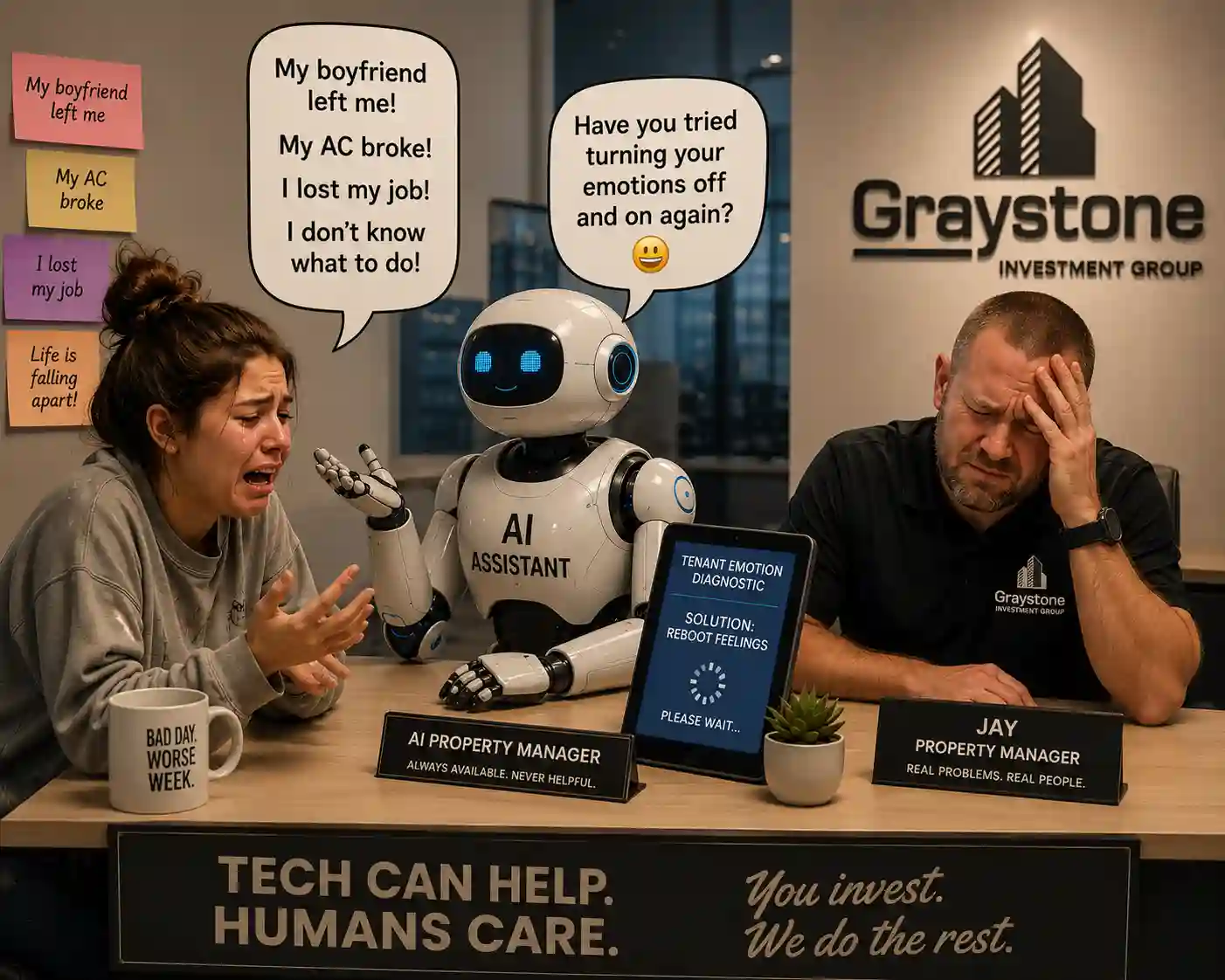
Artificial intelligence will automate many jobs, but real estate will likely remain one of the industries where human interaction, emotional intelligence, trust, negotiation, and relationship-building continue to matter for decades. While AI can help analyze deals, automate paperwork, and improve efficiency, it still struggles with the deeply human side of real estate: understanding fear, confidence, stress, motivation, family decisions, tenant emotions, investor psychology, and complex real-world situations.
Owning real estate may also become one of the few remaining ways people can preserve long-term wealth in an AI-driven economy.
Why Real Estate Will Stay “Real” in an AI World
Artificial intelligence is moving fast.
Every week, another headline appears:
- AI replacing customer service jobs
- AI writing code
- AI generating videos
- AI answering legal questions
- AI creating marketing campaigns
- AI automating accounting tasks
For many people, it creates an uncomfortable question:
What jobs will still matter in the future?
Ironically, the answer may already be hiding inside the words real estate.
Because while artificial intelligence can become smarter at processing information, real estate is still built around something AI struggles to replicate:
Real human behavior.
And that matters more than most people realize.
Real Estate Is More Emotional Than Logical
People love to pretend real estate is all numbers.
Cap rates.
Cash flow.
Interest rates.
ARVs.
Repair budgets.
Debt ratios.
But after investing for decades, one thing becomes obvious:
Most real estate decisions are emotional first and logical second.
A buyer says they want a rental property with maximum ROI.
Then they walk into a house and suddenly say:
“I just don’t feel right about this one.”
A seller refuses an offer that mathematically makes sense because they are emotionally attached to the property.
A tenant calls angry about a maintenance issue, but what they really need is reassurance and someone to listen.
An investor panics during a market dip and wants to sell everything, even though the numbers still work.
AI can analyze data.
But understanding people under stress?
That is a completely different skill.
The Future Belongs to People Who Can Manage Human Emotions
One of the most underrated skills in real estate is not underwriting.
It is emotional management.
Especially in property management.
A tenant may call upset because the AC stopped working.
Yes, the repair matters.
But often the bigger issue is this:
- They feel ignored
- They feel frustrated
- They feel unheard
- They feel stressed
- They want empathy
A computer can send automated responses.
But when somebody is angry, anxious, emotional, or overwhelmed, people still want another human being.
Someone who understands tone.
Someone who can calm the situation.
Someone who knows when to push and when to listen.
That human interaction is incredibly difficult to automate.
Especially in moments involving:
- Money
- Family
- Housing
- Stress
- Fear
- Uncertainty
- Security
And real estate touches all of them.
Consulting Investors Is More Than Just Data
Many people think investors only care about spreadsheets.
That is not true.
The best real estate consultants are part advisor, part therapist, part strategist, and part problem solver.
A good investor consultation is rarely just:
“Here are the numbers.”
Instead, it sounds more like:
- “What are your long-term goals?”
- “How much risk are you comfortable with?”
- “Are you trying to create cash flow or appreciation?”
- “How do you feel about managing rehabs?”
- “What keeps you up at night?”
- “Do you want passive income or active investing?”
These are deeply personal conversations.
And they require something AI still lacks:
Human judgment mixed with human understanding.
An experienced real estate professional can look at a client’s personality, risk tolerance, emotions, family goals, and financial behavior and guide them accordingly.
That is not easy to automate.
At least not anytime soon.
Real Estate Is Physical, Local, and Messy
AI works best in digital environments.
But real estate is physical.
And physical businesses are messy.
A property may look perfect on paper but have:
- A bad smell
- A strange neighborhood feel
- Loud traffic
- A difficult tenant
- Unpermitted work
- Drainage problems
- Foundation concerns
- Emotional seller situations
- Hidden maintenance issues
You cannot always “algorithm” your way through reality.
Sometimes you need experience.
Sometimes you need instinct.
Sometimes you need to physically walk the property.
Sometimes you need to sit across the table from somebody and understand what is really happening.
That is why many experienced investors still trust boots-on-the-ground operators.
Not just software.
AI Will Replace Parts of Real Estate — Not All of It
Let’s be realistic.
AI will change real estate.
A lot.
Some jobs inside the industry will absolutely shrink.
Tasks that are repetitive, administrative, or heavily data-driven are already being automated:
- Basic customer service
- Appointment scheduling
- Lead qualification
- Data entry
- Market analysis
- Document summaries
- Listing descriptions
- Initial underwriting
- Email follow-ups
But replacing tasks is not the same as replacing the entire profession.
That distinction matters.
The professionals who survive will likely become:
- Better communicators
- Better advisors
- Better negotiators
- Better operators
- Better relationship builders
- Better problem solvers
In other words:
The future may belong to people who become more human, not less.
Owning Real Assets May Become More Important Than Ever
As AI becomes more powerful, many digital skills could become commoditized.
But real estate remains tied to something fundamental:
People will always need places to live, work, store things, and operate businesses.
That gives real estate a unique advantage.
It is tangible.
You can touch it.
You can improve it.
You can rent it.
You can leverage it.
You can pass it down.
And in a future where technology disrupts income streams faster than ever, owning real assets could become one of the strongest forms of long-term wealth preservation.
That does not mean every property becomes a good investment.
But it does mean real estate may continue to hold value because it solves a basic human need.
And humans are not going away.
The Real Estate Professionals Who Will Win
The people who thrive in the AI era will probably not be the ones fighting technology.
They will be the ones using AI while doubling down on human strengths.
That means becoming exceptional at:
- Communication
- Relationship-building
- Leadership
- Trust
- Emotional intelligence
- Problem-solving
- Negotiation
- Operations
- Local market understanding
- Investor guidance
AI may help process information.
But trust still closes deals.
Empathy still retains tenants.
Relationships still create referrals.
Experience still prevents expensive mistakes.
And confidence still helps investors make decisions during uncertain times.
Final Thoughts
For years, people thought technology would completely remove the human side of business.
Instead, something interesting happened.
The more technology advanced, the more valuable authentic human interaction became.
And real estate may become one of the clearest examples of that.
Because behind every property is still a person:
- A nervous first-time buyer
- A stressed-out landlord
- A frustrated tenant
- A retiring seller
- An anxious investor
- A family making life-changing decisions
Artificial intelligence can assist the process.
But real estate is still deeply connected to real life.
And that is exactly why real estate may stay “real” longer than almost any other industry.
If I did it all over again, I would still choose real estate.
Not because it is easy.
But because even in a world becoming more artificial every day, people will always need real relationships, real guidance, and real assets.
And that is something algorithms alone may never fully replace.
— Jorge Vazquez
CEO, Graystone Investment Group
20+ Years Real Estate Investing Experience
Learn more at GraystoneIG.com