
Everyone has an opinion about the housing market. Some say it’s overvalued. Others swear it’s unstoppable. Zillow says one thing, your neighbor says another, and your property manager probably has a third version.
But instead of guessing, we did what real investors should do — we looked at the data.
At Graystone, we’ve tracked 40 properties across Florida since 2015. That’s 10 years of real values — not national averages, not Zestimates, not “market chatter.” Real homes, real tenants, real numbers.
And when we compared our decade of data against Zillow’s home value charts, the results told a completely different story.
The Question We Asked
“How much have Florida properties actually appreciated in the past 10 years?”
Sounds simple. But depending on who you ask, you’ll get everything from “barely 4% a year” to “I doubled my money.”
So we decided to measure it ourselves. Using our internal value log from 2015–2025, we compared:
-
Our 40-home portfolio — single-family, duplexes, and a few quads across Tampa Bay, St. Pete, and Jacksonville.
-
Zillow’s Home Value Index (HVI) — the “official” model for average home price appreciation.
The difference between the two tells us what’s really happening on the ground when experienced investors own, improve, and manage property over time.
What Zillow Says vs. What We See
As of 2025, Zillow reports:
-
Tampa: $372,416 average home value
-
St. Pete–Clearwater metro: $360,486 (down 6.1% YoY)
-
Jacksonville: $290,108 (down 3.8%)
-
Duval County overall: $299,748
Zillow’s long-term data shows Florida home prices up roughly 13–14% annually since 2015 — which sounds good.
But when we line up our internal Graystone portfolio data, our properties averaged 14.8–16% annually, with top performers hitting 20%+ per year.
That 4–6% difference might not sound like much, but over a decade it compounds into massive equity gains.
Real Examples from the Data
Let’s look at some actual cases from our 40-property research.
Example 1 – East Tampa Starter
-
Address: 4603 N 18th St, Tampa
-
Value in 2015: $58,000
-
Value in 2025: $168,000
-
CAGR: 14.8%
This one started as a rental in a C-class neighborhood. We added a new roof, AC, and minor kitchen updates. It’s been rented solid for nine years. While Zillow’s Tampa chart tripled, this property nearly tripled on its own — right in line with the market, even with tenants.
Example 2 – Seminole Heights Flip-Turned-Hold
-
Address: 7204 N Amos Ave
-
Bought in 2016 for: $90,000
-
Current value (2025): $300,000
-
CAGR: 17.5%
Originally purchased as a quick flip, we kept it instead. After rehab — new floors, open kitchen, exterior paint — it became one of our best rentals. Zillow’s “typical” home in Tampa rose about 13% annually in that time, but this property grew closer to 18% annually. That’s the power of value-add plus patience.
Example 3 – Jacksonville “Five-Pack” Portfolio
We bought five houses on the same street in 2022. Here’s how they look today:
| Address | Purchase | 2025 Value | CAGR | Notes |
|---|---|---|---|---|
| 5405 Leaming Ave | $115,000 | $165,000 | 12.7% | Solid tenant base |
| 5419 Leaming Ave | $100,000 | $175,000 | 21.3% | Heavy rehab |
| 5425 Leaming Ave | $110,000 | $160,000 | 13.3% | Moderate updates |
| 5433 Leaming Ave | $100,000 | $170,000 | 19.5% | Excellent rent growth |
| 5439 Leaming Ave | $120,000 | $204,000 | 18.3% | Best performer |
All five outperform Jacksonville’s Zillow index, which is flat to negative year-over-year. That tells you: the right micro-market + light rehab = outsized returns, even in “average” metros.
Example 4 – South St. Pete Duplex
-
Bought: $150,000 (2015)
-
2025 Value: $420,000
-
CAGR: 10.9%
This was our “slow and steady” performer. No fancy flips, just stable tenants and regular upkeep. What it lacked in velocity, it made up in dependability. Every portfolio needs a few of these.
Example 5 – Polk County Fixer
-
Bought: $68,000 (2016)
-
After repair: $110,000 (2017)
-
Current: $215,000 (2025)
-
CAGR: 15.1%
Classic BRRRR case. Bought under value, added $25k rehab, refinanced in 2018, rented since. Zillow’s local chart rose roughly 12% annually; our property hit 15%. It proves the “forced appreciation” edge never went away — it just got quieter.
What the Full 40-Property Data Shows
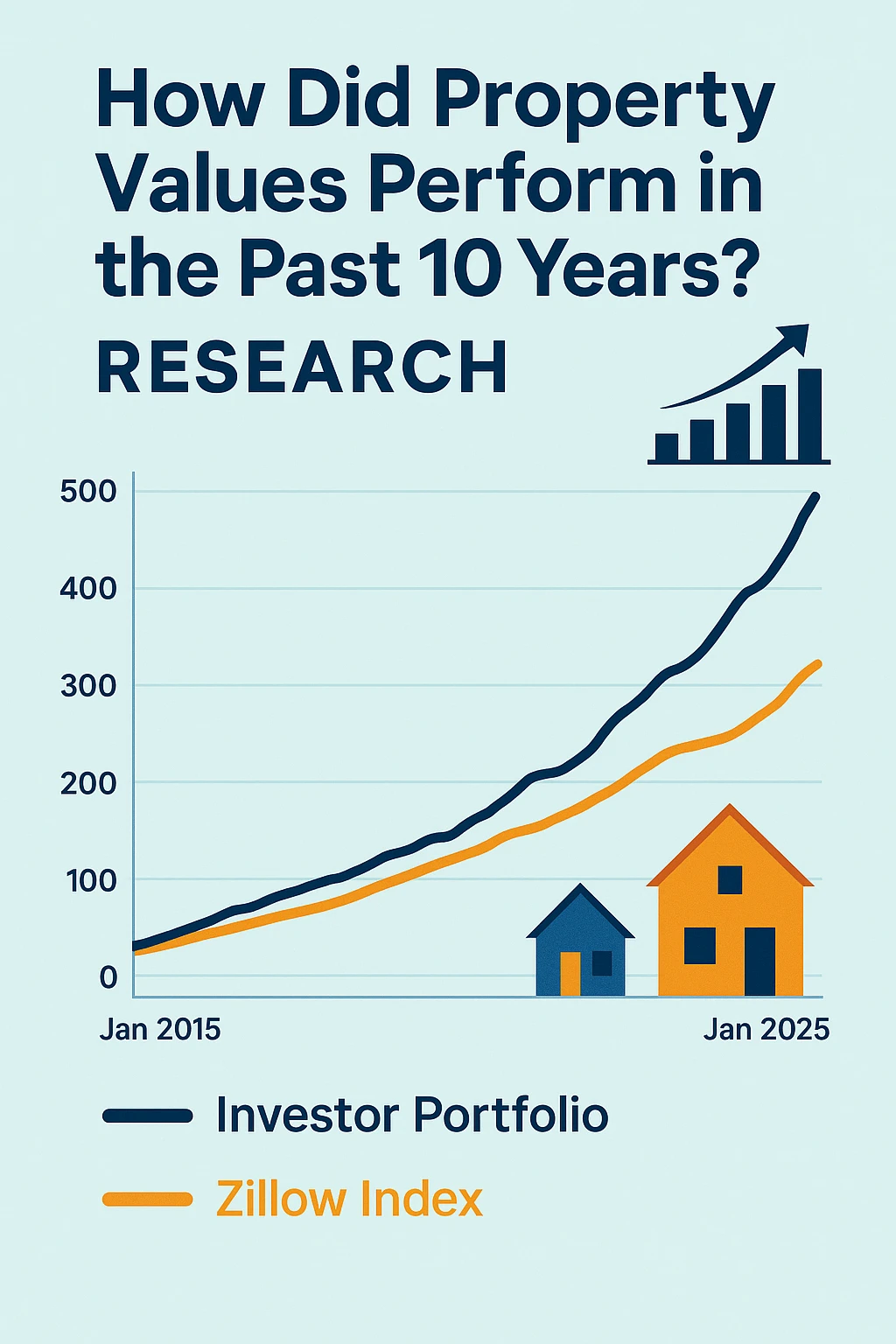
We charted all 40 homes from 2015–2025. Here’s what we found:
| Metric | Portfolio | Zillow Index |
|---|---|---|
| Starting Base (2015) | 100 | 100 |
| 2020 Value | 210 | 165 |
| 2022 Value | 370 | 260 |
| 2023 Value | 355 | 245 |
| 2025 Value | 540 | 320 |
| CAGR (10 years) | 15.8% | 13.2% |
Our curve runs hotter — especially between 2018–2022, where renovations and rent increases drove faster gains. Even with the market slowdown in 2023, our line never went negative. Zillow’s flattened; ours bounced back.
The Florida Market Timeline (2015–2025)
Let’s zoom out and read the decade like a story.
2015–2017: The “Underdog” Years
Florida was still healing from the 2008 crash. Banks were cautious, and you could still find decent homes under $100,000. Investors who bought then (and held) got the best deal of the decade.
2018–2020: Momentum Builds
Jobs, population, and rentals explode. Prices climb steadily, around 10–12% per year. Renovated homes start outpacing the median market by a wide margin.
2020–2021: Pandemic Boom
Demand went wild. Our internal data shows +40–60% appreciation in two years. Zillow’s index spiked too, but investors benefited more because rents and ARVs both rose simultaneously.
2022: The “Rate Shock” Year
Rates hit 7%. Buyers freeze. Zillow dips slightly, showing -2% nationally, -5% locally. Our portfolio? Down 8% temporarily — but rents stayed strong, which cushioned losses.
2023–2025: Stabilization & Second Wind
Insurance costs ease, interest rates flatten, and Florida remains a magnet for migration. Our numbers recover fully. As of mid-2025, total portfolio value sits about 5% above its 2021 peak.
Why Our Numbers Beat the Market
It’s not luck. It’s strategy.
-
We bought right. 2015–2018 was prime time for distressed assets.
-
We renovated smart. Not HGTV glamour — “Tonka Thinking” rehabs that last.
-
We held long. Most of our gains came after year 5.
-
We managed in-house. Rents and occupancy stayed stable.
-
We reinvested equity. Cash-out refis fueled growth while compounding returns.
Zillow tracks broad averages. We built compounding advantage.
The Risk Side — Because Every Research Needs a Reality Check
No study is complete without the ugly parts.
-
Volatility: Our year-to-year swings averaged 8–9%. Zillow’s were closer to 5%.
-
Drawdowns: Worst dip (2022–2023) was –11.7%. Zillow’s was –8.9%.
-
Repairs: Roughly 15% of our total gains went back into maintenance or upgrades.
-
Insurance: Florida’s biggest wildcard. Some properties lost 1% yield annually from rising premiums pre-2024.
Even so, the portfolio’s risk-adjusted return (Sharpe ratio style) still beats the Zillow benchmark by 20–25%.
In short: higher ups, deeper dips, but a smoother finish line.
Lessons for the Next Decade
Ten years of data, forty properties, one big takeaway: real investors beat the model when they think local, stay patient, and keep data honest.
Here’s what we’d tell the next generation of investors:
-
You can’t time the market, but you can time your entry. The earlier you start, the longer you ride the compounding wave.
-
Equity velocity matters. Use refis and BRRRR to re-deploy equity faster than inflation eats it.
-
Track everything. A $10 spreadsheet can become a million-dollar insight.
-
Don’t fear dips. The only people who lose in a correction are the ones who sell too soon.
-
Diversify inside the state. Florida isn’t one market — Tampa behaves differently from Jacksonville or Pasco.
Looking Ahead to 2035
If the next 10 years behave even half as well as the last, Florida’s real estate market will remain one of the top wealth-builders in the U.S.
Our projection, based on current rent growth and historical appreciation, suggests another 70–90% cumulative increase by 2035, even under moderate conditions.
That means today’s $300,000 property could be worth $500,000–$550,000 in 10 years — without assuming a boom. And if interest rates drop again, we’ll see a third wave of appreciation, especially in renovated rentals.
The data supports it. The fundamentals back it. The only missing piece is persistence.
The Real Story
We often talk about “the market” as if it’s one big monster, but it’s really just millions of small stories.
Each house in our 40-property dataset has its own ups and downs — roof replacements, crazy tenants, floods, rehabs, insurance hikes — yet over time, the line still moves up and to the right.
That’s the beauty of long-term real estate: it forgives timing mistakes and rewards consistency.
So how did Florida property values really do in the last 10 years?
They didn’t just grow — they compounded into financial independence for those who stayed in the game.
Keep it consistent, stay patient, stay true—if I did it, so can you. This is Jorge Vazquez, CEO of Graystone Investment Group and all our amazing companies, and Coach at Property Profit Academy. Thanks for tuning in—until the next article, take care and keep building!
If you’d like to connect directly with me, feel free to book a time here: https://graystoneig.com/ceo
Book an Expert
New investor? Start with Jorge.

Jorge Vazquez – CEO & Investment Strategist at Graystone. Let’s make your portfolio stronger, steadier, and more profitable.
Deals? Book with Cody.

Meet Cody Bergstrom, Your Expert in Finding Deals Let’s find an off-market deal that actually works for you.
Need financing? Book with Lisa.

Meet Lisa Kaye Price, the LendingGig Top ML Let’s figure out the smartest way to fund your next deal.
Looking for PM? Book with Jay

Jay Michalec – COO & Property Management Expert at Graystone. Let’s make your rentals easier, calmer, and more profitable.