
Your Content Goes Here
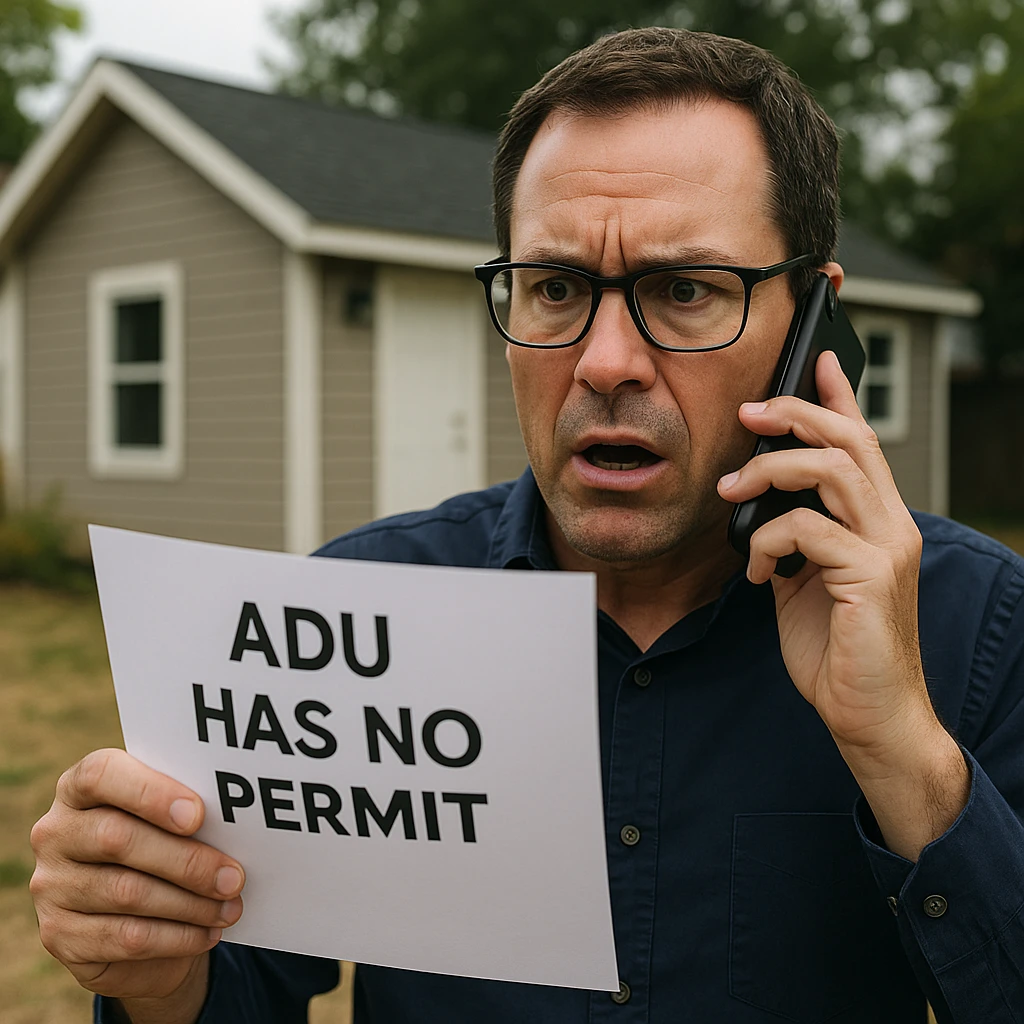
When Your ADU Has No Permit—According to the Appraiser
Cody called me today, and I could already hear the frustration.
“Jorge, you’re not gonna believe this. The appraiser said the ADU has no permit.”
I laughed because I’ve been there. “No permit? It’s been standing there since the early ’80s! What, do they think it magically appeared?”
He sighed, “Yeah, apparently if it’s not labeled ‘ADU’ in their system, it doesn’t exist.”
And that’s how this mess started.
The Appraisal Dilemma
If you’ve been in this business long enough, you know appraisals can ruin a perfectly good day. You’ve got a beautiful property, solid numbers, great upgrades—and then the appraiser says, “Sorry, can’t find the permit for that extra unit.”
That’s what happened with one of our Citrus County properties. It has an Accessory Dwelling Unit (ADU) out back—a nice, self-contained apartment that’s been generating income for years.
But because it was built in 1983, the appraiser couldn’t find the “ADU permit.” Why? Because the word ADU didn’t even exist back then. It was called an addition, or maybe a mother-in-law suite.
And that single wording difference almost cost the deal tens of thousands.
Finding the Missing “Nonexistent” Permit
Cody pulled up the county property record, and what do you know—right there in black and white:
Permit #36582 – ADDITION
Issued: 04/01/1983
Completed: 05/01/1984
Value: $4,480
So yes, it’s permitted. It just doesn’t say ADU.
The county record even shows:
-
Main living area: 1,228 sq ft
-
Total under roof: 2,266 sq ft
That’s a 1,000-square-foot difference, and no, it’s not all porch. The 384 sq ft “FLR LIV AREA” listed in the document is the addition—what we now call the ADU.
In other words, the ADU is there, it’s legal, and it’s been part of the official record since Ronald Reagan was president.
Why Appraisers Miss It
To be fair, most appraisers aren’t trying to short-change anyone. But they’re working with databases built around today’s terminology.
When they search for “ADU permit,” nothing comes up—because Citrus County (and many others in Florida) didn’t start labeling things as ADUs until decades later.
So they assume there’s no permit.
It’s like searching your grandma’s attic for an iPhone. The thing you’re looking for exists—it just goes by another name.
What That Mistake Can Cost You
Leaving an ADU out of an appraisal isn’t a small thing.
If the unit adds 350–400 square feet, and local values are around $150 a foot, that’s $50,000 to $60,000 missing from your valuation.
That’s the difference between a deal closing and a deal collapsing—especially when you’re refinancing or working with DSCR loans where leverage depends on appraised value.
In our case, if we hadn’t caught it, the appraiser’s report would’ve left out a fully functional, rentable space that generates income every single month.
How Cody Fixed It
Cody stayed calm. He didn’t argue—he educated.
He told the appraiser:
“Hey, I think we’re looking at a terminology issue. The ADU was built in 1983, back when the county used the term ‘addition.’ You can see it right here—Permit #36582, labeled ADDITION, shows 384 square feet of finished living area. It’s also recorded under ‘FLR LIV AREA.’ Plus, we have two separate electrical permits from 2022 that confirm it’s active and maintained.”
That was it. Facts, not feelings.
The appraiser checked the record, saw the details, and updated the report to include the extra living area.
Problem solved.
What Every Investor Should Learn
Here’s what this little adventure taught (or reminded) us—and hopefully helps you too:
1. Pull the Full Property Record
Don’t rely on the one-page summary. Go into the Land & Agriculture section or Property Record Card and look for every building permit.
2. Old Words, New Meaning
If your property was built before 2000, the term “ADU” probably won’t appear. Look for “Addition,” “Guest House,” or “Mother-in-Law Suite.”
3. Compare Living Area Numbers
If the “total under roof” is much larger than the “main living area,” the difference usually includes an addition—often your missing ADU.
4. Check for Electrical or HVAC Permits
Separate permits for electrical or mechanical work often indicate an independent living unit.
5. Take Screenshots and Highlight
When sending evidence to an appraiser, highlight the permit number, dates, and square footage difference. Make it easy for them to see what you see.
Why It Happens So Often
Florida’s property databases are old. Like, floppy disk old.
Many records were scanned from handwritten cards, and county systems don’t automatically connect old “additions” to the modern “ADU” term.
So when an appraiser types “ADU,” they get a blank screen. Meanwhile, your perfectly legal addition sits quietly in the record, waiting to be rediscovered.
It’s not fraud. It’s just bureaucracy being… bureaucracy.
Real Estate Reality Check
There are thousands of Florida homes with older permitted ADUs that don’t show up under that label. And as property values rise, that missing terminology can cost owners a lot of money during appraisals, refis, or insurance valuations.
Some of these units were built stronger than new homes—block, slab, separate power lines, even kitchens. But since they were built before ADUs were a “thing,” the system treats them like invisible square footage.
That’s where smart investors step in—people like you and Cody who know how to dig through records and find the proof.
What to Say to the Appraiser
If you’re on the phone with an appraiser who says, “We can’t find a permit for the ADU,” keep it simple:
“It’s permitted as an addition. Check Permit #36582—it’s listed in the property record as FLR LIV AREA, 384 square feet. It’s been there since 1983 and still shows as finished living area. The newer electrical permits confirm it’s an active, maintained structure.”
Don’t argue, don’t pressure—just show them where to look.
The moment they see it in the county system, it becomes part of the valuation.
How to Avoid This Next Time
At Graystone, we now keep a digital folder for every property with an older addition or second dwelling. We call it “Proof of Existence.”
Inside, we include:
-
Screenshots of the property appraiser’s detailed record
-
Permit numbers and descriptions
-
Total square footage notes
-
Any recent electrical or structural permits
So if an appraiser, lender, or inspector ever asks, you can forward a single PDF and save hours of explaining.
Quick Humor Break
Florida’s permitting systems are like time capsules. Sometimes I think there’s a retired clerk somewhere still typing property records on a typewriter.
Cody once joked, “If an ADU was built before the internet, it doesn’t exist until you re-upload it yourself.”
And honestly, he’s not wrong.
But that’s where good investors earn their edge. We find the hidden value others overlook.
The Takeaway
When your ADU “has no permit,” it usually means no one’s looked deep enough.
-
Check the building permits.
-
Verify older additions.
-
Compare the numbers.
-
Document everything.
An appraiser’s software may not recognize the word ADU, but value is value—and the proof is sitting right in your property record.
So next time someone tells you your extra unit “doesn’t exist,” smile and say, “Let me show you something from 1983.”
Keep it consistent, stay patient, stay true—if I did it, so can you.
This is Jorge Vazquez, CEO of Graystone Investment Group and all our amazing companies, and Coach at Property Profit Academy.
Thanks for tuning in—until the next article, take care and keep building!
Book an Expert
New investor? Start with Jorge.

Jorge Vazquez – CEO & Investment Strategist at Graystone. Let’s make your portfolio stronger, steadier, and more profitable.
Deals? Book with Cody.

Meet Cody Bergstrom, Your Expert in Finding Deals Let’s find an off-market deal that actually works for you.
Need financing? Book with Lisa.

Meet Lisa Kaye Price, the LendingGig Top ML Let’s figure out the smartest way to fund your next deal.
Looking for PM? Book with Jay

Jay Michalec – COO & Property Management Expert at Graystone. Let’s make your rentals easier, calmer, and more profitable.