
Your Content Goes Here
I’ve been doing this for over 20 years. I’ve sold apartment complexes, hundreds of single-family homes, and more duplexes than I can remember. I’ve seen people make fortunes, lose them, and rebuild stronger. And through it all, I’ve learned something simple: most new investors don’t struggle because they’re not smart — they struggle because real estate sounds like a foreign language.
If you’ve ever nodded your head pretending to understand when someone said “CapEx” or “Cap Rate,” don’t worry — I did the same thing in my early days. I remember my first investor meeting; someone said “What’s your cap rate?” and I thought they were talking about the roof.
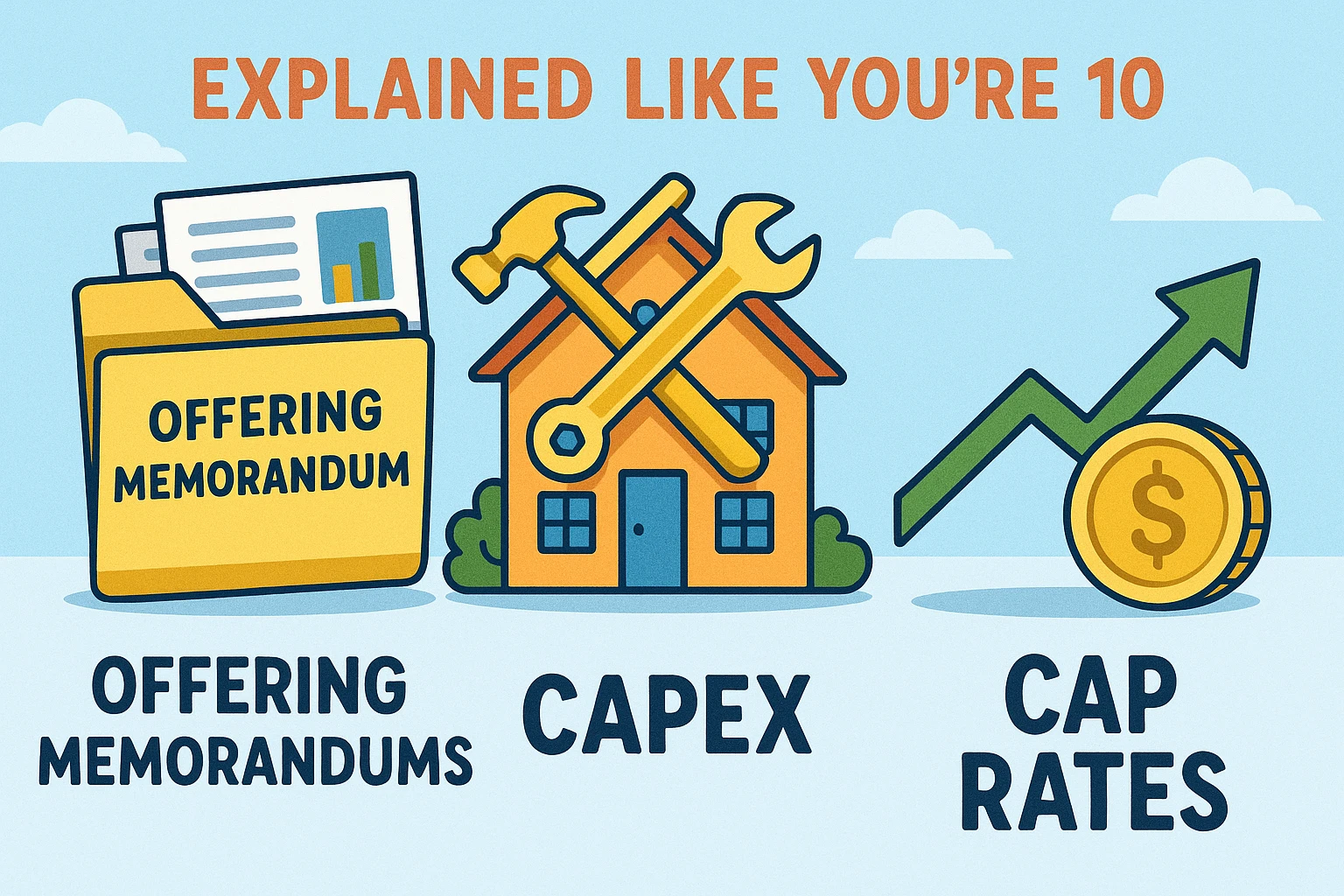
So let’s fix that today. We’re going to cover three big terms that every investor should know — and by the end, you’ll sound like a pro:
-
Real Estate Offering Memorandum
-
CapEx (Capital Expenditures)
-
Capitalization Rate (Cap Rate)
And I’m going to make this easy, like explaining it to a 10-year-old… or that one uncle who still calls Zillow “the Zillo.”
1. What Is a Real Estate Offering Memorandum?
In plain English: It’s a “resume” for your property.
An Offering Memorandum (OM for short) is what brokers or sellers use to tell investors, “Hey, look at this awesome deal!” It’s like the movie trailer of your property — all the highlights packed into one beautiful presentation.
When I first started, I didn’t take OMs seriously. I figured, “Why do I need a fancy booklet when I can just show them the property?” Then I realized: serious investors don’t buy feelings — they buy numbers and stories.
A strong OM includes:
-
Property description and photos
-
Rent roll (who’s paying and how much)
-
Income and expenses
-
Market data and trends
-
Recent upgrades or CapEx
-
Comparable sales
-
The Cap Rate (expected return)
-
Projections for the next 5–10 years
If you’re selling to investors or raising money, your OM is your handshake, your first impression, and your reputation all in one.
I’ve written hundreds of them — some for big apartment complexes, others for small duplexes — and I’ve seen the difference it makes. One time, a property sat for six months with no bites. We redid the OM with better photos, real financials, and a cleaner design — and boom, sold within two weeks.
That’s the power of a good OM.
Think of it like Tinder for properties:
You want that swipe-right moment. Pretty pictures, but real info. If your OM is all fluff and no facts, it’s like using a filter that hides the truth — and trust me, investors always find out.
2. What Is CapEx in Real Estate?
Now this one confuses everyone at first.
CapEx stands for Capital Expenditures, but that’s just the fancy way of saying “big, expensive repairs or upgrades that make your property better or last longer.”
In simpler terms:
-
Fixing a faucet = maintenance.
-
Replacing the whole plumbing system = CapEx.
-
Painting the front door = maintenance.
-
Replacing all doors and windows = CapEx.
Here’s how I explain it:
CapEx is your property’s “surgery.” It’s not routine checkups — it’s when your building goes under the knife to get stronger.
When I bought my first multifamily, I didn’t set aside enough money for CapEx. Big mistake. The roof leaked, the AC died, and the tenants were calling me like I was running a hotline.
I learned the hard way that you don’t plan for CapEx later — you plan for it upfront.
These are examples of CapEx:
-
Roof replacement
-
HVAC systems
-
Plumbing upgrades
-
Electrical rewiring
-
Full kitchen or bathroom remodel
-
New flooring throughout the building
I once had a client who tried to save money by patching an old roof instead of replacing it. Six months later, it rained… and rained… and let’s just say he was running a very unpopular indoor water park.
CapEx is about protecting your investment. When you spend money on these big upgrades, you’re not losing — you’re buying time, value, and peace of mind.
If you plan to hold a property long-term, CapEx is your best friend. It’s what turns an old property into a gold mine.
3. What Is the Capitalization Rate (Cap Rate)?
Alright, let’s get to the number every investor loves to talk about — the Cap Rate.
I remember my first few years in real estate. Every investor I met said, “Jorge, what’s the cap rate?” And I’d smile and say, “Pretty good!” without having a clue what they meant.
In plain English: Cap Rate is your property’s “report card.” It tells you how good of a deal you’re getting based on how much the property earns compared to what it’s worth — without worrying about loans or mortgage payments.
Here’s the simple formula:
Cap Rate = (Net Operating Income ÷ Property Value) × 100
Example:
If a property makes $50,000 per year and it’s worth $1,000,000, the Cap Rate is 5%.
That means if you bought it in cash, you’d make a 5% annual return.
Now here’s where the real-world experience kicks in.
A higher Cap Rate usually means more cash flow but more risk (think older buildings or rougher areas).
A lower Cap Rate means less cash flow but more stability (newer property or better neighborhood).
When I buy, I look at the story behind the Cap Rate.
A property with an 8% Cap Rate might sound amazing, but if half the tenants haven’t paid rent since Christmas, it’s not such a deal anymore.
Cap Rate without context is just math. You need to understand the market, the tenants, and the expenses to know if it’s truly a good deal.
How They All Connect
Now let’s tie it all together, because these three terms aren’t just random—they work together like teammates.
-
The Offering Memorandum is your marketing tool. It tells the story of the property.
-
The CapEx shows the property’s health and what it’ll cost to keep it running.
-
The Cap Rate shows the return on your investment.
When you’re evaluating a deal, these three give you the full picture:
-
How the property is being presented (OM)
-
What condition it’s really in (CapEx)
-
What it’s earning versus what it’s worth (Cap Rate)
Let me give you a real example.
A few years ago, I helped an investor buy a 20-unit apartment complex in Tampa. The OM looked amazing — beautiful pictures, 7% Cap Rate, nice area. But after digging deeper, we found out the seller left out $30,000 of CapEx needs: new plumbing, parking lot resurfacing, and some HVAC replacements.
Once we factored that in, the real Cap Rate dropped closer to 5%.
Now, some people would’ve walked away. But my investor understood the game. We negotiated the price down, handled the CapEx repairs, and two years later, the property appraised 25% higher. That’s what happens when you understand all three pieces of the puzzle.
The Funny Truth About These Terms
Let’s be honest — real estate terms can sound like you’re trying to read Latin with a calculator. But once you learn them, it’s actually fun.
Here’s how I’d explain it if I were teaching my nephew:
-
Offering Memorandum: “It’s like a property’s yearbook photo — but with numbers.”
-
CapEx: “When your building hits middle age and needs a facelift.”
-
Cap Rate: “Your report card — are you making money or just pretending to?”
The funny thing? Once you start using these terms, people suddenly think you’re a genius. I’ve had new investors use “CapEx” in a sentence and their confidence shoots up like they just discovered fire.
But confidence is earned by understanding — not pretending.
Mistakes I’ve Seen Over the Years
Let me save you some time and money. Here are the three biggest mistakes I’ve seen investors make with these terms:
1. Believing Every OM You See
Some OMs are like dating profiles — they show the good angles, not the real picture. Always verify the numbers, visit the property, and talk to the tenants or manager.
2. Ignoring CapEx
Too many people buy based on cash flow alone. But if your roof caves in six months later, that cash flow disappears fast. Always ask: “What’s the next big expense coming up?”
3. Misreading Cap Rate
A 10% Cap Rate isn’t automatically better than a 6% one. You have to understand why it’s higher. Is it location? Condition? Tenant quality? Cap Rate is a tool — not a guarantee.
How to Apply This in Real Life
Next time you look at a deal, walk through this checklist:
-
Start with the OM — does it make sense? Are the numbers believable?
-
Look at CapEx — what’s been done and what’s coming next?
-
Check the Cap Rate — is it realistic compared to the market?
If all three look good, you’ve got yourself a real deal worth pursuing.
If one of them smells funny, dig deeper. Real estate rewards the curious, not the careless.
The Long Game
After two decades in this business, I can tell you this: real estate is about patience, consistency, and curiosity. Once you understand the language — these basic terms — you start to see patterns.
You’ll walk through a property and instantly think, “The OM said one thing, but the CapEx tells another story.” Or, “This Cap Rate looks low, but the location will double my value in five years.”
That’s when you stop being a beginner and start thinking like an investor.
Final Recap
Let’s keep it simple one last time:
-
Offering Memorandum: The marketing resume of your deal.
-
CapEx: The big, expensive upgrades that keep your property alive.
-
Cap Rate: The snapshot that shows your return before financing.
When you master these three, you’ll make smarter decisions, avoid expensive mistakes, and see opportunities where others see confusion.
Keep it consistent, stay patient, stay true — if I did it, so can you.
This is Jorge Vazquez, CEO of Graystone Investment Group and all our amazing companies, and Coach at Property Profit Academy.
Thanks for tuning in — until the next article, take care and keep building!
If you’d like to connect directly with me, feel free to book a time here: https://graystoneig.com/ceo
Book an Expert
New investor? Start with Jorge.

Jorge Vazquez – CEO & Investment Strategist at Graystone. Let’s make your portfolio stronger, steadier, and more profitable.
Deals? Book with Cody.

Meet Cody Bergstrom, Your Expert in Finding Deals Let’s find an off-market deal that actually works for you.
Need financing? Book with Lisa.

Meet Lisa Kaye Price, the LendingGig Top ML Let’s figure out the smartest way to fund your next deal.
Looking for PM? Book with Jay

Jay Michalec – COO & Property Management Expert at Graystone. Let’s make your rentals easier, calmer, and more profitable.