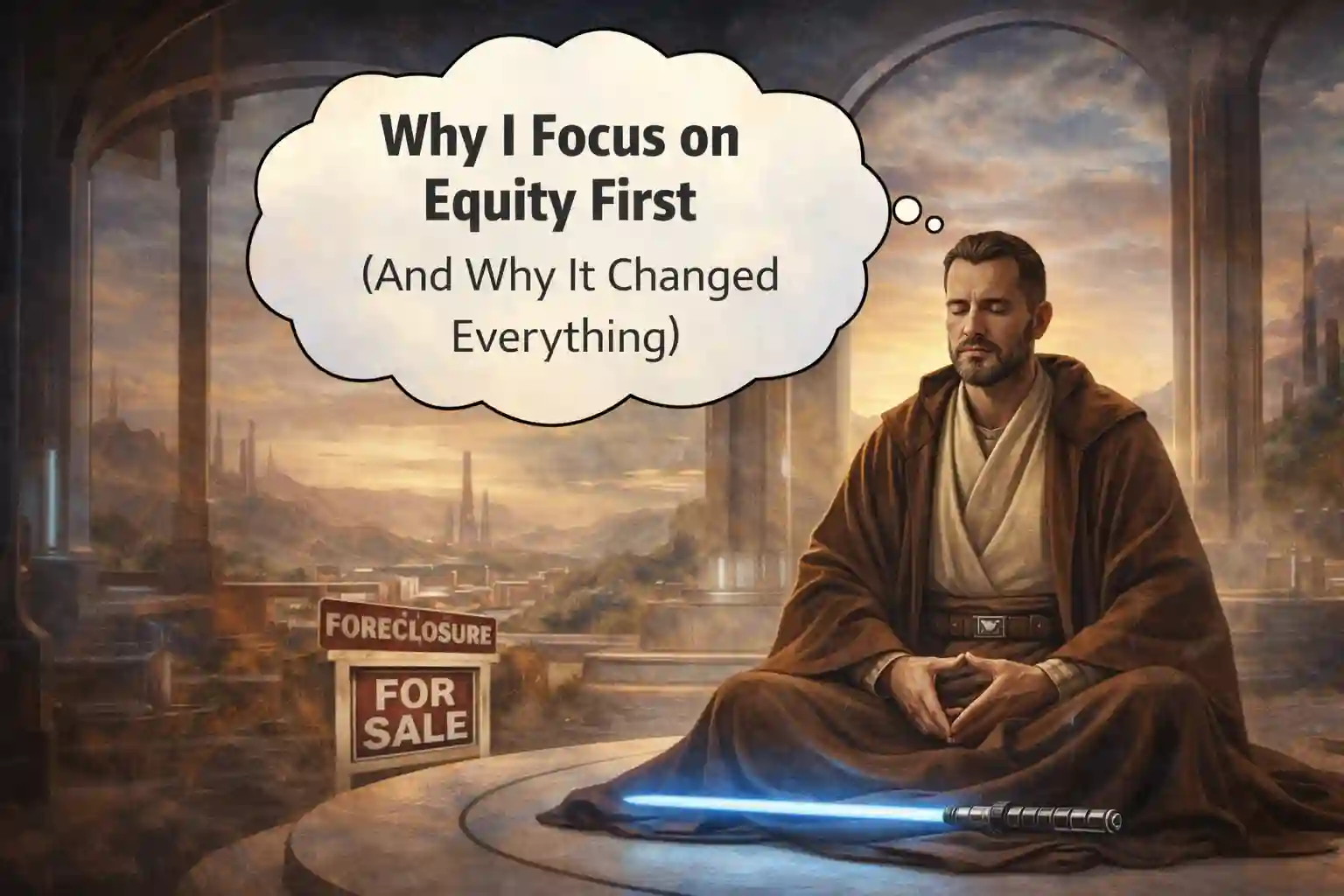
Why I Focus on Equity First (And Why It Changed Everything)
By Jorge Vazquez
If you hang around real estate long enough, you’ll hear one phrase over and over:
“I just want cash flow.”
It sounds smart.
It sounds safe.
It sounds conservative.
But here’s what I learned after losing 22 properties in 2008 and rebuilding from zero:
Cash flow is comfort.
Equity is power.
And if you build power first, comfort becomes easier later.
Let me explain.
The Lie Most New Investors Believe
When someone gets into real estate, they usually say:
“I want passive income.”
So they look for a property that produces two hundred dollars per month after expenses.
They celebrate that number.
They feel like they’ve “made it.”
But here’s the problem.
Two hundred dollars a month will not change your life.
It won’t scale quickly.
It won’t give you leverage to grow.
It won’t help you recover fast if you make a mistake.
Cash flow is slow.
Equity can move you fast.
And after 2008, I needed speed.
What 2008 Taught Me About Equity
Before the crash, I was operating with leverage and appreciation assumptions.
When values dropped, my equity evaporated.
I realized something painful:
When equity disappears, options disappear.
You can’t refinance.
You can’t restructure.
You can’t pivot.
You’re stuck.
So when I rebuilt, I asked myself:
If I ever get another chance, what would I do differently?
The answer was clear.
I would build equity aggressively.
Because equity gives you control.
What Equity Really Means
Equity is not just appreciation.
Equity is value creation.
It can come from:
Buying below market value
Renovating intelligently
Improving income
Reducing expenses
Optimizing operations
Equity is forced value.
And forced value is predictable.
Hope is not predictable.
Markets move.
But smart value creation is within your control.
That’s why I focus on it.
The Velocity Principle
Here’s something most investors miss.
Equity creates velocity.
Velocity creates scale.
Let’s say you buy a property at a discount.
You improve it.
You increase its value.
Now you have built-in equity.
That equity becomes fuel.
You refinance.
You redeploy capital.
You repeat.
That’s how I was able to acquire 20 properties without large initial capital when rebuilding.
I wasn’t waiting for cash flow to accumulate slowly.
I was manufacturing equity.
Equity became my engine.
Cash flow became my stabilizer later.
Why Cash Flow Alone Is Slow
Let’s keep this simple.
If you make three hundred dollars per month on a property, that’s thirty six hundred dollars per year.
That’s good.
But it takes years to accumulate enough to buy the next property.
If you are young and patient, fine.
But if you want to scale strategically, you need acceleration.
Equity gives you that acceleration.
Now don’t misunderstand me.
Cash flow matters.
But it should not be the only objective in the beginning.
You build strength first.
Then you build comfort.
The BRRRR Strategy Done Right
When I rebuilt, I leaned heavily into a disciplined version of the BRRRR strategy.
Buy right.
Rehab smart.
Rent stable.
Refinance conservative.
Repeat carefully.
But here’s the key.
The deal must create equity at purchase.
Not rely on appreciation.
If you are buying retail hoping appreciation saves you, that is speculation.
If you are buying below value and forcing appreciation through improvements, that is strategy.
There’s a difference.
One is hope.
One is math.
I prefer math.
The Psychological Advantage of Equity
There is something else people don’t talk about.
Equity creates confidence.
When you have built-in margin, you sleep better.
If the market softens, you have cushion.
If rents adjust, you have cushion.
If rates fluctuate, you have cushion.
When you buy thin, every movement creates stress.
I lived that stress in 2008.
I don’t live like that anymore.
Margin is peace.
Equity is margin.
How I Underwrite Today
Today, when I analyze a deal, I ask:
Am I buying below value?
Can I force appreciation?
What is the stabilized value?
What is the refinance scenario under conservative terms?
Does the equity justify the risk?
If the deal only works because rents might go up next year, I walk.
If the deal works today, under conservative assumptions, I consider it.
Equity must exist on day one or be creatable through execution.
Otherwise, it is fragile.
Why This Matters in 2026
Today’s market is interesting.
Interest rates are higher than the ultra-low era.
Inventory is shifting.
Some buyers are hesitant.
That creates opportunity.
But only if you understand structure.
If you focus only on cash flow in a higher rate environment, deals look thin.
If you focus on equity and long-term positioning, deals start to make sense again.
Higher rates often mean less competition.
Less competition often means better pricing.
Better pricing means stronger equity positions.
The investor who understands equity wins in transitional markets.
The investor who only understands monthly cash flow gets frustrated.
Equity First, Cash Flow Second
Let me be clear.
My end goal is cash flow.
I want stability.
I want predictable income.
I want assets that pay for life.
But I build toward that intentionally.
Phase one: Build equity.
Phase two: Use equity to scale.
Phase three: Transition portfolio toward stabilized cash flow.
If you skip phase one, growth is slow.
If you skip phase three, you remain exposed.
Both matter.
But order matters too.
The Domino Wealth Method
I like to think of it like dominoes.
The first domino is equity.
When that one falls correctly, it pushes the next.
Then the next.
Then the next.
Soon you look back and realize momentum has replaced effort.
That momentum started with margin.
Not rent checks.
Margin.
The Mistake I See New Investors Make
They buy turnkey properties at retail price because they want ease.
They accept thin margins.
They celebrate small monthly spreads.
But they never create significant equity.
So when they want to grow, they’re stuck.
No refinance power.
No capital redeployment.
No velocity.
They built comfort.
But they did not build strength.
Strength must come first.
Why I Avoid Flashy Renovations
Another part of equity creation is discipline in rehab.
I favor what I call durable rehabs.
Functional.
Clean.
Long-lasting.
Not flashy.
You don’t build equity by over-improving beyond the neighborhood.
You build equity by improving strategically.
Function over flash.
Longevity over trends.
That mindset protects margins.
And margins protect equity.
Equity Protects You in Downturns
Here’s the truth nobody likes to say.
Another correction will happen one day.
It always does.
When it does, investors with thin positions panic.
Investors with strong equity positions adapt.
They refinance later.
They restructure.
They hold.
They survive.
Equity is shock absorption.
Without it, every bump feels catastrophic.
What I Would Tell a New Investor
If you are starting today, here is my advice:
Do not chase the highest rent.
Chase the strongest margin.
Buy below value whenever possible.
Create value through improvements.
Keep leverage reasonable.
Plan your refinance conservatively.
Think in five year blocks, not five month windows.
Cash flow is the reward.
Equity is the engine.
Build the engine first.
Final Thought
When I lost everything in 2008, I learned that fragile growth collapses quickly.
When I rebuilt, I focused on strength.
Equity is strength.
Cash flow is stability.
Both matter.
But if I had to choose which to build first, I choose equity every time.
Because equity gives you options.
And in real estate, options are everything.
If you want help structuring a strategy that builds equity intelligently and transitions into stable cash flow over time, you can connect with me here:
Keep it consistent, stay patient, stay true—if I did it, so can you. This is Jorge Vazquez, CEO of Graystone Investment Group and all our amazing companies, and Coach at Property Profit Academy. Thanks for tuning in—until the next article, take care and keep building!
If you’d like to connect directly with me, feel free to book a time here: https://graystoneig.com/ceo.