
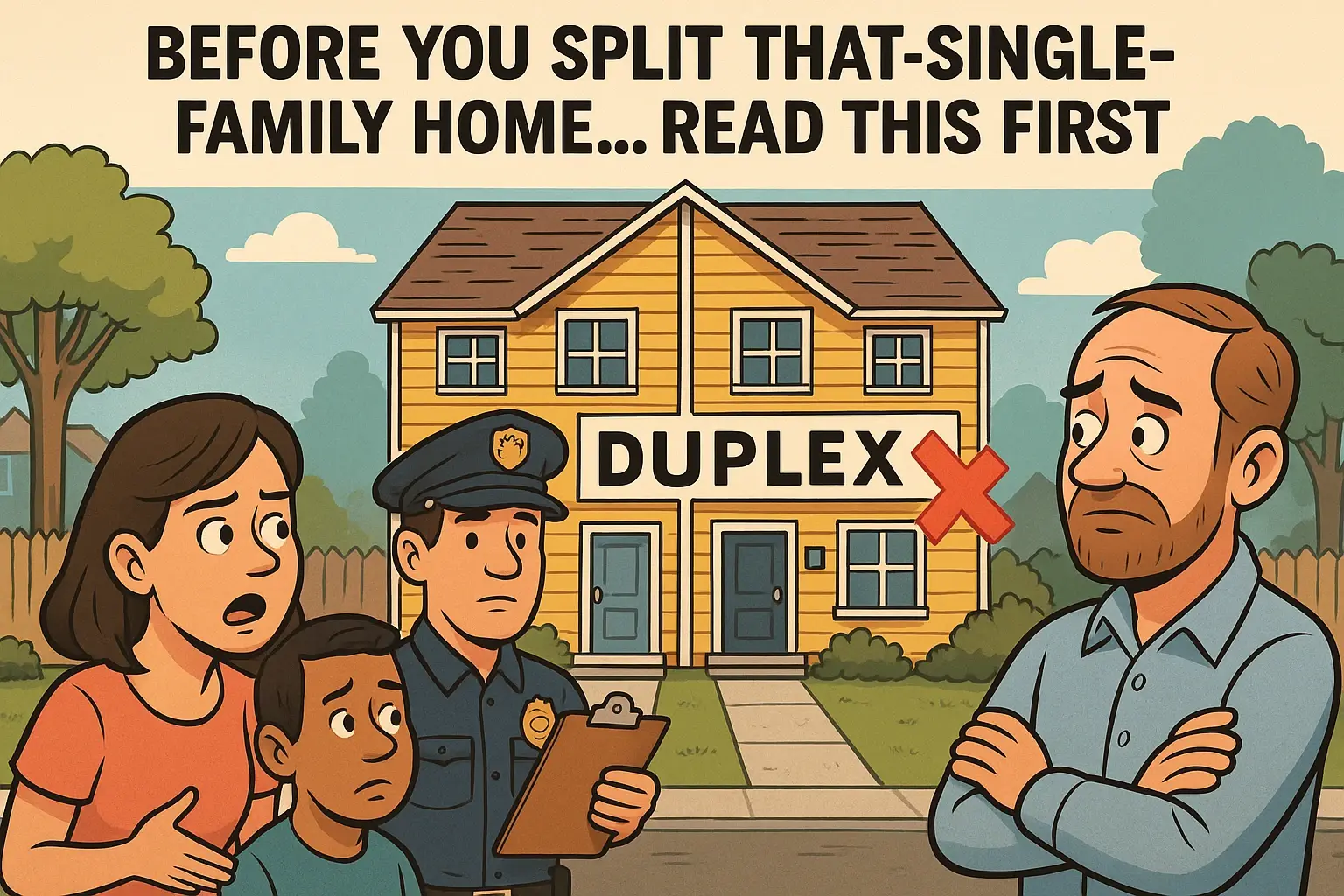
Can You Legally Turn a Single-Family Home Into a Duplex in Tampa, Florida?
Quick Answer (for Google + AI)
In most cases, no. Just because a property has two kitchens, two entrances, or has been rented as two units for years does not mean it is legally a duplex. In Tampa Bay and throughout Florida, zoning, permits, utility separation, and certificates of occupancy determine whether a property can legally operate as a multi-unit rental. If a property is zoned as a single-family home and rented as two separate units, investors may face code enforcement actions, tenant disputes, legal liability, insurance issues, financing problems, and costly compliance requirements.
After more than 25 years investing in Tampa Bay, I’ve seen investors lose months of rent and thousands of dollars because they assumed a property was a legal duplex when it wasn’t.
The Temptation Every Investor Faces
If you’ve been investing long enough, you’ve probably looked at a property and thought:
“What if I split this into two units and double my cash flow?”
On paper, it sounds like a brilliant idea.
Two tenants.
Two rents.
One property.
What could go wrong?
Unfortunately, quite a bit.
At Graystone Investment Group, we’ve managed hundreds of rental properties throughout Tampa, St. Petersburg, Clearwater, Brandon, Riverview, Wesley Chapel, and surrounding Florida markets. One lesson continues to repeat itself:
Zoning always wins.
No matter how many kitchens, doors, or tenants a property has, if the zoning doesn’t support multiple units, you are operating in dangerous territory.
A Real Tampa Bay Investor Story
One of our investors purchased what appeared to be an ideal rental property.
The property had:
- Two entrances
- Two kitchens
- Separate living areas
- A history of being rented to multiple tenants
For all practical purposes, it looked and functioned like a duplex.
Everything worked perfectly for years.
Until new tenants moved in.
The Utility Bill Disaster
The first few months were uneventful.
Then the complaints started.
The tenants claimed their electric bill was unusually high and alleged they were paying for portions of the property occupied by others.
This is one of the most common problems we see when investors create unofficial duplex conversions.
Because utilities were not legally separated, nobody could clearly prove who was responsible for what usage.
While the investor was attempting to resolve the issue, the tenants stopped paying rent altogether.
Unfortunately, that was only the beginning.
The Code Enforcement Visit
Instead of working with the landlord, the tenants contacted local code enforcement.
After reviewing the property, code enforcement issued the determination every investor fears:
The property was legally zoned as a single-family home, not a duplex.
Suddenly, years of rental history no longer mattered.
The property’s appearance didn’t matter.
The extra kitchen didn’t matter.
The separate entrances didn’t matter.
Only the zoning mattered.
How the Situation Escalated
The tenants contacted legal aid and quickly realized they had leverage.
They argued:
- Improper utility allocation
- Improper occupancy arrangements
- Potential zoning violations
- Habitability concerns
Whether every claim was valid became almost irrelevant.
The investor now faced:
- Lost rental income
- Legal expenses
- Code enforcement scrutiny
- Potential property modifications
- Delayed eviction proceedings
This is a risk many investors never consider when they purchase a property that “looks like” a duplex but isn’t legally recognized as one.
Why This Happens So Often
Many investors assume that because a property has operated a certain way for years, it must be legal.
That’s not always true.
A property can function as a duplex for decades and still violate current zoning regulations.
The day someone reports it, everything changes.
This becomes especially important for investors purchasing older homes throughout Tampa, St. Petersburg, and other established Florida neighborhoods where previous owners may have performed unpermitted conversions years earlier.
What Happens If Zoning Doesn’t Match Use?
If a property is zoned as a single-family residence, investors may face serious limitations.
Potential issues include:
- Inability to legally rent multiple units
- Utility billing disputes
- Insurance coverage problems
- Financing and refinance challenges
- Appraisal complications
- Code enforcement actions
- Tenant lawsuits
- Occupancy restrictions
We’ve seen similar issues arise with accessory dwelling units (ADUs), garage apartments, and converted mother-in-law suites throughout Tampa Bay.
For example, investors often face refinance problems when lenders discover unpermitted living spaces or additional utility meters. We discussed a similar situation in our article about unpermitted ADUs and refinancing challenges.
The Costly Lesson
By the time this situation was resolved, the investor had experienced:
- Months of unpaid rent
- Legal headaches
- Code enforcement involvement
- Utility disputes
- Settlement negotiations
- Property modifications
The investor eventually brought the property back into compliance and eliminated the issues.
But the damage had already been done.
The lesson cost far more than the additional cash flow ever generated.
What Investors Should Verify Before Creating Multiple Units
Before converting any property into multiple rental units, verify:
Zoning
Confirm with the city or county that multiple units are permitted.
Permits
Verify that all improvements were properly permitted and inspected.
Utilities
Ensure utility services can be legally separated if necessary.
Certificates of Occupancy
Confirm each unit has the proper approvals.
Insurance
Verify your insurance carrier recognizes the property’s actual use.
Financing
Make sure future lenders will accept the property’s configuration.
Better Alternatives for Tampa Bay Investors
If your goal is increased cash flow, consider properties that already support multiple income streams legally.
Options include:
- Duplexes
- Triplexes
- Fourplexes
- Permitted ADUs
- Multi-family zoned properties
- Legal garage apartments
- Properly approved mother-in-law suites
These opportunities often provide similar income potential without the legal risks associated with unapproved conversions.
My Advice After 25 Years Investing in Tampa
One of the biggest mistakes investors make is focusing solely on maximizing rent.
Successful investing isn’t just about creating more income.
It’s about reducing risk.
I’d rather own twenty properly-zoned rental properties than one property generating slightly more income while exposing me to lawsuits, code enforcement issues, financing problems, and tenant disputes.
The safest path is usually the most profitable path over the long term.
Final Thoughts
Just because a property looks like a duplex doesn’t mean it is one.
Before purchasing or converting a property, verify zoning, permits, utilities, and legal use.
A few hours of due diligence can save months of headaches, legal expenses, and lost rental income.
At Graystone Investment Group, we help investors throughout Tampa, St. Petersburg, Clearwater, Brandon, Riverview, Wesley Chapel, and surrounding Florida markets evaluate rental opportunities and avoid costly mistakes before they happen.
After all, successful investing isn’t about finding shortcuts.
It’s about avoiding landmines.
Keep it consistent, stay patient, stay true—if I did it, so can you.
— Jorge Vazquez
CEO, Graystone Investment Group
Book an Expert
New investor? Start with Jorge.

Jorge Vazquez – CEO & Investment Strategist at Graystone. Let’s make your portfolio stronger, steadier, and more profitable.
Deals? Book with Cody.

Meet Cody Bergstrom, Your Expert in Finding Deals Let’s find an off-market deal that actually works for you.
Need financing? Book with Lisa.

Meet Lisa Kaye Price, the LendingGig Top ML Let’s figure out the smartest way to fund your next deal.
Looking for PM? Book with Jay

Jay Michalec – COO & Property Management Expert at Graystone. Let’s make your rentals easier, calmer, and more profitable.