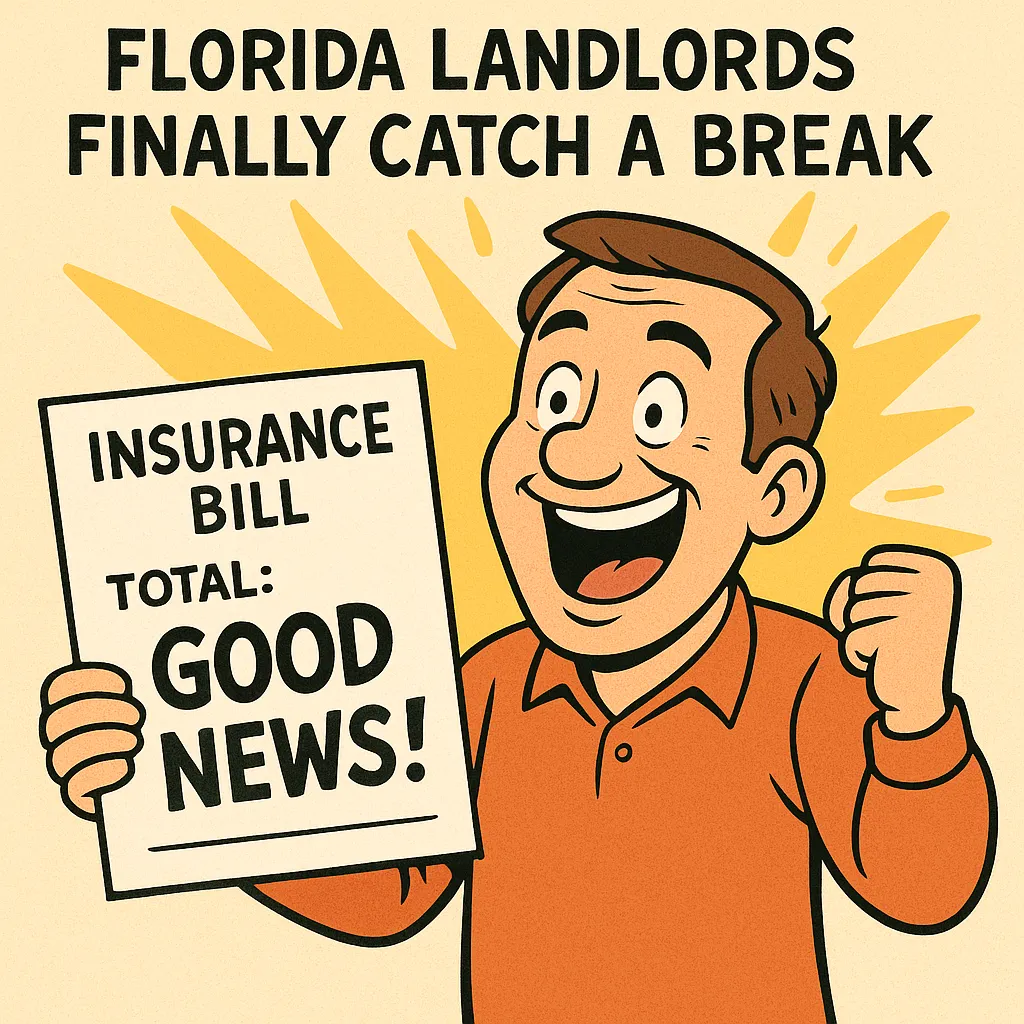
Florida Landlords Are Finally Catching a Break: How I Cut My Insurance Bills by Up to 50%
For the first time in years, I’m saying something I never thought I would about Florida insurance — it’s actually getting better.
I’ve spent the past month going line by line through my insurance renewals across a dozen of my rental properties, from Jacksonville to Tampa Bay to Lakeland. Normally, this time of year feels like going to the dentist without Novocain — you know it’s going to hurt. But this year? I saw something I haven’t seen in almost a decade.
Premiums dropping.
Not by a little either. In some cases, by nearly half.
Let me walk you through what happened, what I learned, and why every investor in Florida needs to stop assuming the insurance market is “just expensive now.” It’s shifting — and smart landlords are the first to notice.
The Audit That Started It All
Every year, my team and I do what we call an insurance audit. We take all our active policies — renewal dates, agents, premiums, coverage limits — and drop them into a single spreadsheet. It’s not glamorous, but it’s one of the easiest ways to find out who’s charging too much and who’s giving a fair deal.
This time, I was expecting the usual — a few hundred dollars up here, maybe a thousand there. Instead, I started seeing the opposite.
Here’s what jumped out:
-
11326 Broadview Rd, Seffner: went from $2,738.98 down to $1,371, a savings of $1,367.98.
-
936 Captiva Point, Lakeland: dropped from $3,456.36 to $1,634, saving $1,822.36.
-
10106 N Arden Ave, Tampa: down from $2,334.36 to $1,553, saving $781.36.
-
2332 Grove St, St. Petersburg: dropped from $2,903.40 to $2,135, saving $768.40.
-
And several others stayed flat — no increase at all, which honestly feels like a win these days.
In total, the portfolio saved over $4,700 annually, without changing coverage or taking on new risk.
That’s real money back in the business.
How We Did It
Now, this didn’t happen by accident. We didn’t just sit around hoping for a miracle.
Here’s the strategy that worked:
-
We got competitive quotes from multiple agents.
We used Brightway, Colleen, and NREIG — each specializes in different property types and carriers. Instead of sticking with one company out of habit, we let them compete for our business. -
We timed renewals right.
Florida carriers update rates constantly. Getting quotes 30–45 days before renewal can catch an insurer at the right moment before they adjust rates upward. -
We asked about inspection updates.
Some of our older homes had improvements that weren’t reflected in the insurance file — new roofs, upgraded electrical panels, wind mitigation reports. Once those were submitted, premiums dropped dramatically. -
We double-checked coverage overlaps.
Many policies include unnecessary line items (like redundancy on liability or loss-of-use) that you can consolidate under an umbrella. -
We stopped assuming “Citizens” was the only option.
A few private carriers are back in the Florida market, and some of them are aggressively pricing to win new business.
Why Rates Are Finally Coming Down
If you’ve been investing in Florida for a while, you know the past five years have been brutal for insurance. Hurricanes, fraud, lawsuits, reinsurance costs — it all stacked up. Some landlords saw premiums double or triple.
So why are things finally turning around?
A few big reasons:
-
Tort reform. The Florida Legislature passed major legal reforms to reduce insurance litigation abuse, which used to inflate costs.
-
More competition returning. Private insurers are re-entering the market as reinsurance costs stabilize.
-
Better underwriting technology. Companies can now assess risk more accurately, rewarding properties with updates instead of treating everything as high-risk.
-
Reinsurance stabilization. The global insurance markets that back Florida carriers have lowered rates slightly after a few mild storm seasons.
The result? Landlords who were paying $3,500 to $5,000 per property a few years ago are now seeing policies back in the $1,500 to $2,000 range.
It’s not perfect, but it’s a breath of fresh air.
What I Learned From This Round of Renewals
After 20 years in real estate, I’ve learned that complacency kills margins. It’s easy to accept whatever premium renewal hits your inbox because you’re too busy managing tenants or repairs. But this year reminded me that five phone calls and one spreadsheet can make a four-figure difference.
Here are the biggest takeaways:
-
You have more leverage than you think. Carriers are trying to grow again, which means they’ll fight to keep your business.
-
Bundle where possible. Properties under one LLC or with similar coverage types can often be grouped for discounts.
-
Watch your flood policies. Many investors overlook flood, but private flood markets are now cheaper than FEMA for many zones.
-
Inspections matter. If you’ve done upgrades, tell your agent. Even something like a new roof or breaker box can cut hundreds.
-
Don’t chase the absolute cheapest. Focus on financially stable carriers with proven Florida claims history.
The Hidden Bonus: Easier Cash Flow and Refinancing
Lower insurance premiums don’t just mean more profit each month. They also directly affect loan underwriting.
When you go to refinance or get a DSCR loan, your insurance cost is a big part of your debt coverage ratio (DSCR). If your premium drops by $1,000 a year, your net operating income rises — which can push you above the lender’s minimum threshold.
In plain English: cheaper insurance can make a deal financeable.
I’ve already had a lender reach out and say, “Hey, your numbers look stronger now — we can give you better terms.” That’s a conversation every investor wants to have.
A Tale of Two Properties
Let’s compare two real-world cases from my portfolio this year.
Property 1: Seffner, FL
-
Last year’s premium: $2,738.98
-
New premium: $1,371.00
-
Savings: $1,367.98
-
Occupancy: Single-family rental
-
Outcome: Immediate bump in cash flow, no coverage reduction
Property 2: Lakeland, FL
-
Last year’s premium: $3,456.36
-
New premium: $1,634.00
-
Savings: $1,822.36
-
Change reason: New roof certificate and updated inspection file
-
Outcome: 52% reduction, same coverage, same carrier
These aren’t just lucky breaks. They’re proof that the Florida market is shifting back toward stability — and investors who stay proactive can benefit early.
Why You Should Review Your Policies Now
If you’re reading this and thinking, “I’ll deal with it when my renewal comes up,” you’re missing the opportunity window.
Even if your renewal isn’t for months, you can request mid-term re-shopping. Most carriers will let you switch with no penalty if you find a better rate and stay insured continuously.
Here’s what I’d recommend to any Florida investor right now:
-
Pull your declarations pages for every property.
Make sure you know the renewal date, premium, and carrier. -
Email three agents and ask for competitive quotes.
I personally use Brightway, Colleen, and NREIG — each brings something different to the table. -
Ask for discounts on updates.
Even if you did upgrades two years ago, resubmitting proof can trigger new credits. -
Review your replacement cost.
Many policies are overestimating rebuild costs from the pandemic era. Adjusting this can lower your rate safely. -
Document everything.
Keep a central spreadsheet — it helps track changes and keeps everyone accountable.
What This Means for Florida Investors Going Forward
This small shift in insurance pricing might seem minor, but it’s actually one of the best signs we’ve had for the Florida real estate market in years.
When insurance starts to stabilize, it opens the door for more deals to make sense again.
Here’s why that matters:
-
Sellers can list properties at more reasonable prices.
With lower carrying costs, they’re under less pressure to overprice. -
Investors can hold rentals longer.
Better cash flow means less turnover and fewer panic sales. -
More out-of-state investors come back.
Florida’s reputation for “impossible insurance” is slowly fading. -
Local owners finally breathe again.
The days of $5,000 insurance bills might actually be behind us.
The Bottom Line
I’m not saying Florida insurance is suddenly cheap. But for the first time in years, we’re seeing momentum in the right direction — and that’s huge.
As an investor, your job isn’t just to buy properties. It’s to protect them, optimize them, and make sure every dollar is working for you. Insurance isn’t exciting, but this year proved it can make or break your returns.
So if you haven’t checked your premiums lately, make it your weekend project. Open your laptop, call your agent, and get a few quotes. The worst that happens is nothing changes. The best that happens is you save thousands.
And trust me, that feels pretty good after the past few years we’ve had in this market.
Keep it consistent, stay patient, stay true—if I did it, so can you.
This is Jorge Vazquez, CEO of Graystone Investment Group and all our amazing companies, and Coach at Property Profit Academy.
Thanks for tuning in—until the next article, take care and keep building.
If you’d like to connect directly with me, feel free to book a time here: https://graystoneig.com/ceo
Book an Expert
New investor? Start with Jorge.

Jorge Vazquez – CEO & Investment Strategist at Graystone. Let’s make your portfolio stronger, steadier, and more profitable.
Deals? Book with Cody.

Meet Cody Bergstrom, Your Expert in Finding Deals Let’s find an off-market deal that actually works for you.
Need financing? Book with Lisa.

Meet Lisa Kaye Price, the LendingGig Top ML Let’s figure out the smartest way to fund your next deal.
Looking for PM? Book with Jay
Jay Michalec – COO & Property Management Expert at Graystone. Let’s make your rentals easier, calmer, and more profitable.