
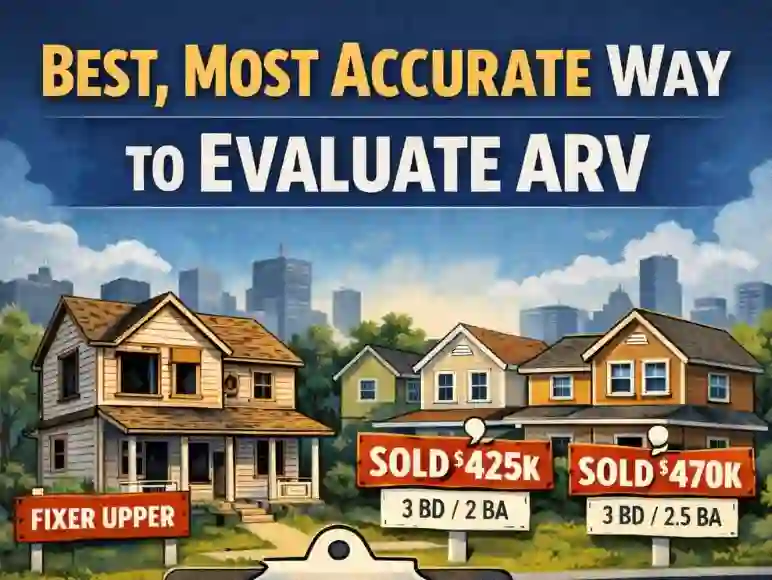
How I Estimate ARV Using Recent Sold Comps When Analyzing Deals
If you’re new to real estate investing, ARV can feel like this mysterious number that only appraisers and magicians understand.
ARV stands for After Repair Value. It’s simply what the property should be worth after you fix it up.
Sounds simple, right?
But here’s the truth: most investors don’t lose money because they bought wrong. They lose money because they guessed wrong on ARV.
And guessing is not a strategy.
Let me walk you through exactly how I estimate ARV using recent sold comps when I analyze deals, especially here in Tampa and across Florida.
No hype. No complicated formulas. Just real-world deal logic.
Step 1: I Keep It Simple First
Before I start building spreadsheets and running fancy reports, I do one basic thing.
I look at the three closest and most recent comps:
• One sold
• One pending
• One active
That’s it.
Why?
Because that gives me:
• The past (sold)
• The present (pending)
• The future expectation (active)
If you only look at sold comps, you’re living in the past.
If you only look at active listings, you’re dreaming.
If you only look at pending, you’re guessing.
When you combine all three, you get balance. That balance keeps your ARV realistic instead of emotional.
Step 2: The “Closest and Most Recent” Rule
Not all comps are equal.
When I say closest and most recent, I mean:
• Same neighborhood if possible
• Similar square footage
• Same bed and bath count
• Similar lot size
• Sold within the last 3–6 months
If the property is 1,500 square feet, I’m not comping it against a 2,200 square foot house just because it sold for a higher number.
That’s how investors trick themselves.
The market doesn’t care what you want the house to be worth. It cares what buyers just paid for something similar.
Step 3: Condition Matters More Than You Think
Two houses can have the same layout, same square footage, same year built… and still be $40,000 apart.
Why?
Condition.
Was the comp fully renovated with:
• New roof
• New HVAC
• New kitchen
• Updated bathrooms
• Modern flooring
Or was it lipstick-on-a-pig remodel?
If I’m analyzing a flip, I look at the best sold comp and ask myself:
“This is my ceiling.”
That means I cannot assume I’ll sell higher than the nicest, best-renovated house that already sold.
Instead, I ask:
What level of rehab did that comp have?
If that house had a high-end kitchen and smooth drywall finishes, I better not plan a basic Home Depot special and expect the same price.
My goal is simple:
Match or slightly beat the best comp.
Not dream past it.
Step 4: If It’s a Flip, I Work Backward
Once I have my ARV, I reverse engineer the deal.
Let’s say the best sold comp shows $400,000.
That’s my ceiling.
Now I subtract:
• Rehab costs
• Holding costs
• Closing costs
• Realtor commissions
• Contingency reserve
• My desired profit
What’s left?
That’s my strike price.
That’s the maximum I’m willing to pay.
If the seller wants more than that, I walk.
No emotions. No maybes.
This is where most investors mess up. They start adjusting the ARV upward to justify paying more.
That’s not analysis.
That’s hope.
And hope doesn’t pay contractors.
Step 5: Rentals Are Evaluated Differently
Now here’s where a lot of investors get confused.
ARV matters for rentals, but not the same way it does for flips.
If I’m buying a rental, I switch mental gears.
Now I care about:
• Cash flow
• Expense ratio
• Cap rate
• Insurance costs
• Property taxes
• Long-term demand
I’ll still run a CMA using MLS and sometimes use tools like RentCast to estimate market rent. But a rental isn’t about squeezing the highest resale number.
It’s about whether the property produces income safely and consistently.
A house can have a strong ARV and still be a terrible rental.
And a house with moderate ARV can be an amazing long-term hold if the cash flow is solid.
Different strategy. Different evaluation.
Step 6: Micro Location Can Shift Everything
One street can change the numbers.
I’ve seen it in Tampa dozens of times.
Same zip code.
Same size house.
But one backs up to a busy road.
The other is on a quiet interior street.
Guess what?
Different price.
That’s why I always zoom in, not just out.
You can’t comp across major barriers like:
• Highways
• School district lines
• Railroad tracks
• Major commercial corridors
Those things matter more than spreadsheets.
Step 7: Appraisers Think This Way Too
The funny part is when investors argue about ARV, I tell them:
You’re basically trying to think like an appraiser.
Appraisers rely heavily on recent sold comps.
They make adjustments for:
• Square footage
• Condition
• Upgrades
• Location
It’s an art.
And you get better with reps.
The more deals you analyze, the faster your brain recognizes patterns.
Common ARV Mistakes I See
Let me save you some pain.
Here are the biggest ARV mistakes I see newer investors make:
-
Using outdated comps from 9–12 months ago
-
Comparing remodeled homes to non-remodeled properties
-
Ignoring pending data
-
Overestimating their own rehab quality
-
Cherry-picking the highest comp in the area
-
Ignoring price per square foot trends
-
Adjusting numbers emotionally to make the deal work
If you find yourself saying:
“It should sell for around…”
Pause.
Go back to the data.
My Simple ARV Checklist
Before I feel comfortable with an ARV number, I ask:
• Do I have at least 2–3 solid sold comps?
• Are they within close proximity?
• Are they truly comparable in size and layout?
• Am I being realistic about condition?
• Is there any reason my property would sell for less?
If the answer is yes to the last question, I adjust downward.
I would rather be conservative and surprised on the upside than optimistic and crushed on the downside.
Why ARV Discipline Builds Wealth
Here’s what I’ve learned after thousands of deals.
You don’t build wealth by hitting home runs.
You build wealth by avoiding disasters.
One bad ARV estimate can wipe out the profit from three good deals.
That’s why I stay disciplined.
Sold comps first.
Closest and most recent.
Past, present, future balance.
Ceiling mindset for flips.
Cash flow lens for rentals.
Simple.
Repeatable.
Reliable.
Final Thoughts
Estimating ARV is not about being perfect.
It’s about being consistent.
The market gives you clues every single day. Sold properties are like receipts showing what buyers are actually willing to pay.
Use those receipts.
Don’t argue with them.
And never let excitement override math.
If you want to talk through a deal or sharpen your analysis process, you can always book a time with me here:
Keep it consistent, stay patient, stay true—if I did it, so can you. This is Jorge Vazquez, CEO of Graystone Investment Group and all our amazing companies, and Coach at Property Profit Academy. Thanks for tuning in—until the next article, take care and keep building!
Book an Expert
New investor? Start with Jorge.

Jorge Vazquez – CEO & Investment Strategist at Graystone. Let’s make your portfolio stronger, steadier, and more profitable.
Deals? Book with Cody.

Meet Cody Bergstrom, Your Expert in Finding Deals Let’s find an off-market deal that actually works for you.
Need financing? Book with Lisa.

Meet Lisa Kaye Price, the LendingGig Top ML Let’s figure out the smartest way to fund your next deal.
Looking for PM? Book with Jay

Jay Michalec – COO & Property Management Expert at Graystone. Let’s make your rentals easier, calmer, and more profitable.