
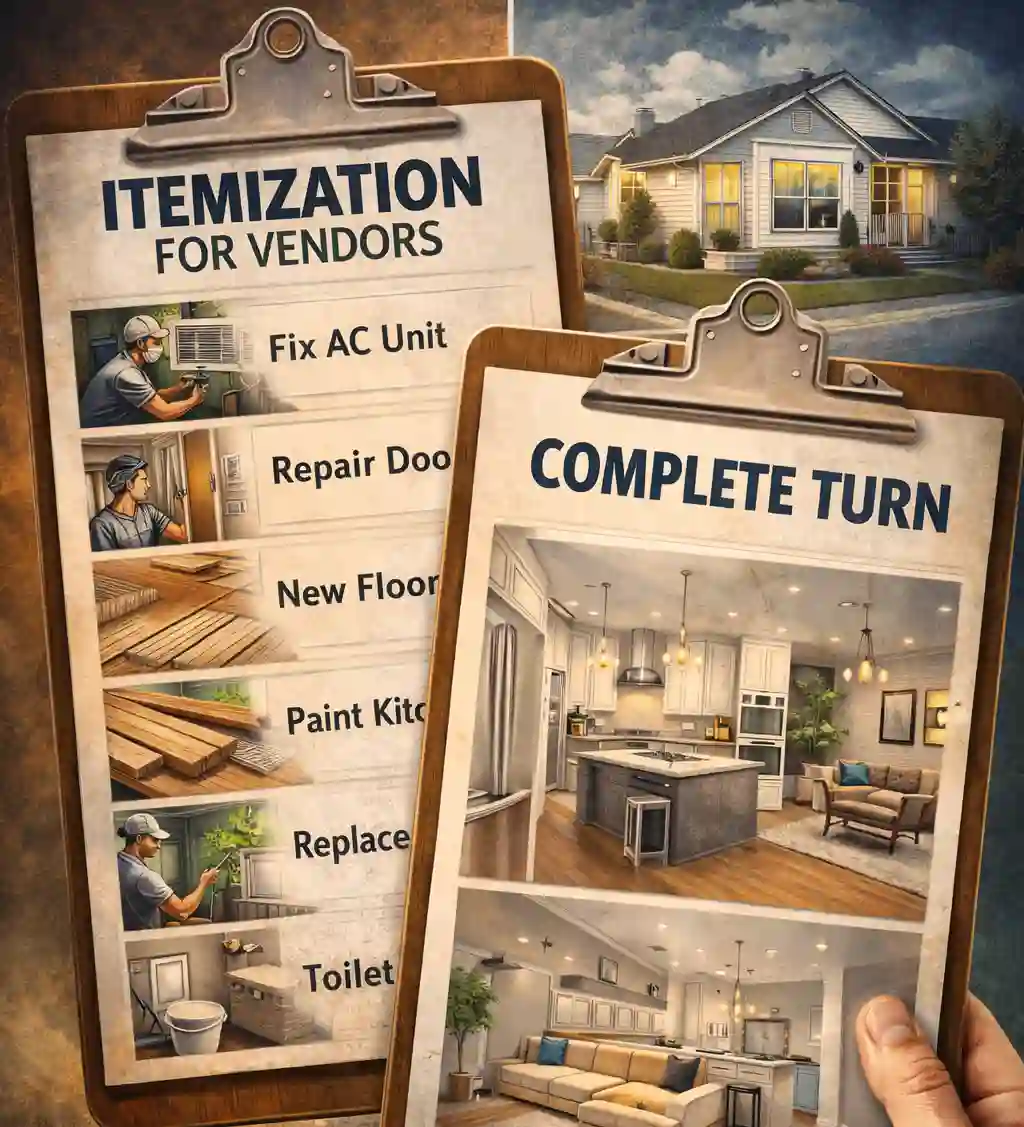
Do Not Itemize Turns to Save Money
I learned this one the hard way. Like most investors, I thought itemizing a rehab or a turn was the smart and responsible thing to do. Break everything down. Line by line. Paint. Baseboards. Outlet covers. Light fixtures. Touch ups. Repairs. It feels organized. It feels professional. It feels safe.
It is none of those things.
Itemizing turns is one of the most expensive mistakes I ever made in real estate. Especially when it comes to rental turns, appraisal clean ups, or light rehabs where you are not chasing specific upgrades or luxury finishes. If you are just trying to get a unit rent ready, itemization usually costs more, takes longer, and creates way more arguments than it solves.
Let me explain why.
What a Turn Really Is
A turn is not a remodel. A turn is not a renovation show on TV. A turn is simply taking a unit from move out to move in. Clean. Safe. Functional. Rent ready.
That is it.
No one is giving awards for the prettiest turn. Appraisers do not care about your receipt stack. Tenants care that things work, look decent, and feel clean. Owners care that it rents fast and does not blow up the budget.
Turns are about speed and outcome, not perfection.
Why Itemization Feels Like the Right Move
Most of us itemize because we think it protects us.
We think if everything is written down, nothing can go wrong.
We think it keeps contractors honest.
We think it gives us control.
In reality, itemization does the opposite.
It gives contractors room to hide pricing.
It gives them excuses when something is missed.
It gives them leverage for change orders.
Worst of all, it turns a simple job into a legal document where everyone argues about wording instead of results.
The Hidden Cost of Itemized Turns
When you ask for itemization, here is what actually happens.
Each line item gets padded. Contractors price defensively. They assume something will go wrong, so they build protection into every single task.
Instead of one efficient workflow, they now have twenty five separate jobs. Each job has its own minimum cost, labor setup, and profit margin.
Paint could have been bundled.
Repairs could have overlapped.
Touch ups could have been handled naturally.
Instead, you pay full price for everything separately.
That is how a simple turn quietly turns into a monster invoice.
Itemization Creates Amnesia
This is the part most investors do not realize until it is too late.
If it is not listed, it did not exist.
When you itemize, contractors are no longer responsible for the outcome. They are only responsible for the list. Anything they did not see, think of, or anticipate suddenly becomes not their problem.
Loose outlet.
Sticky door.
Missing trim.
If it was not written, they are excused.
And now you are either paying extra or eating the cost yourself.
Turns Are About Outcome, Not Receipts
This is the mindset shift that changed everything for me.
Stop managing receipts.
Start managing results.
For turns, the goal is simple. The unit must be rent ready. That means clean, safe, functional, and presentable.
When you give contractors a full scope with one price, you change the relationship. Now they own the outcome, not just the checklist.
They stop asking permission for every small fix.
They stop ignoring obvious issues.
They stop playing word games.
They focus on finishing the unit.
The Insurance Concept That Saves Money
This part matters.
When I stopped itemizing turns, I did not become reckless. I built in what I call insurance.
You agree on one price for the entire turn.
You agree on the condition the unit must be delivered in.
You agree that if something big and unexpected comes up, you will address it fairly.
That small flexibility removes fear from the contractor and padding from the bid.
Instead of pricing every worst case scenario into every line item, they price the job realistically.
Nine times out of ten, nothing major comes up.
And even when it does, you still come out ahead.
Itemization Slows Everything Down
Time is money in rentals. Every extra day vacant costs more than most small repairs.
Itemized jobs move slower because everything becomes a decision point.
Can I do this?
Is this included?
Do I need approval?
Is this extra?
One price turns eliminate that friction.
The contractor keeps moving.
The unit gets finished faster.
The property rents sooner.
That alone can pay for any minor overage that might come up.
When Itemization Does Make Sense
Let me be clear. I am not anti itemization forever.
Itemization makes sense when:
You are doing a full rehab
You need specific upgrades
You are changing layouts
You are doing structural work
You are working with lenders who require it
But a turn is not that.
A turn is operational. Not surgical.
Trying to treat it like a detailed renovation is how you overspend.
Appraisals and Clean Ups Are the Worst for Itemization
This is where I see investors burn money constantly.
They need a property to appraise.
They need minor repairs.
They itemize everything.
The contractor prices every tiny thing like it is a standalone job. The appraisal does not care. The bank does not care. The house just needs to meet condition standards.
One price. Clean finish. Done.
Why Property Managers Hate Itemized Turns
There is a reason experienced property managers push back on itemized turns.
They have seen this movie before.
Itemized turns create delays, disputes, and unhappy owners.
Bundled turns create consistency and speed.
The best run portfolios I have seen treat turns like systems, not projects.
The Psychology of Control
Itemization feels like control, but it is fake control.
Real control is:
Clear expectations
Clear outcomes
Clear timelines
Clear pricing
Not a spreadsheet with forty rows no one reads the same way.
How I Scope a Turn Today
This is my simple approach.
Walk the unit.
Define rent ready.
Agree on one price.
Agree on timeline.
Agree on how surprises are handled.
That is it.
No drama. No micromanaging. No nickel and diming.
The Bigger Lesson Investors Miss
This lesson goes beyond turns.
Real estate rewards simplicity.
Overcomplication almost always costs more.
When you trust good operators and manage outcomes instead of line items, your business gets calmer, faster, and more profitable.
If you are itemizing turns to feel safe, you are probably paying a premium for that feeling.
Final Thoughts
If I could go back and tell my younger self one thing, it would be this.
Do not itemize turns to save money.
It usually does the opposite.
Focus on results.
Build in reasonable insurance.
Move fast.
Rent faster.
That mindset alone has saved me tens of thousands over the years.
Keep it consistent, stay patient, stay true—if I did it, so can you. This is Jorge Vazquez, CEO of Graystone Investment Group and all our amazing companies, and Coach at Property Profit Academy. Thanks for tuning in—until the next article, take care and keep building!
If you’d like to connect directly with me, feel free to book a time here: https://graystoneig.com/ceo.