
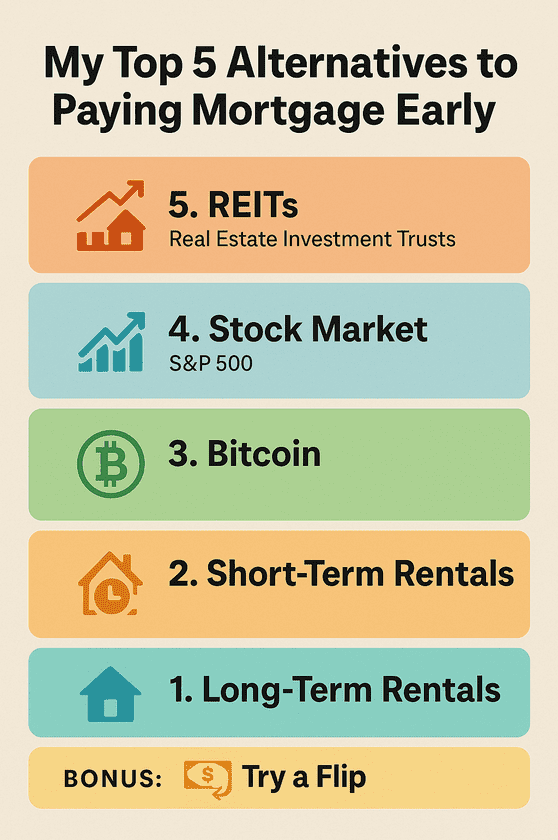
Here are my 5 preferred alternatives, starting with the one I like least. For each I lay out what history tells us about returns, what kinds of risk you run, and when it might make sense vs when it might not.
5. REITs (Real Estate Investment Trusts)
Why this is lowest (for me):
I like real estate, but REITs are a more hands‑off, more stock‑market‑like way to do it. Good option, but less control, less leverage opportunity, more exposure to market swings.
Historical Returns:
-
Over long timeframes (20‑50 years), some equity REIT indices have annualized returns exceeding or comparable to the S&P 500. Sarwa+2NerdWallet+2
-
Example: From 1972‑2019, REITs had ~11.8% annual returns vs ~10.6% for S&P 500. NerdWallet+2Sarwa+2
-
But in more recent periods (5‑10 years), sometimes S&P outperformed. Also, REITs tend to be sensitive to interest rates and economic cycles. Sortis Capital+2Reit.com+2
Risk / Volatility & Other Trade‑offs:
-
More volatile than holding physical rental property (especially in weak sectors or during recessions).
-
Sensitive to interest rates (higher rates → debt servicing cost, discount rates, etc.). Reit.com+1
-
Less control (you don’t decide tenant, property repairs, etc.).
-
Dividend yield is a plus, but taxes on dividends, plus less leverage.
When it might work for you:
If you want decent returns, somewhat passive, liquid (you can sell in the market). If you have moderate risk tolerance. If you don’t want the headaches of property management.
4. Stock Market (especially S&P 500)
Why above REITs:
More historical data, more liquidity, more diversification, well understood. Though swings can be big.
Historical Returns:
-
Historically, the S&P 500 has given around ~10–11% annual average return including dividends, over long horizons. NerdWallet+3Investopedia+3Sarwa+3
-
After inflation, that might drop to ~7‑8% depending on the period. Investopedia+1
Risk / Volatility:
-
Large swings: downturns wipe you out some years; requires strong stomach for volatility.
-
Less tangible control: you can’t fix a stock like you can fix property.
-
Liquidity advantage: sell quickly, smaller transaction costs vs selling real estate.
When it makes sense:
You have enough time (10+ years), you want high growth, can ride out bear markets, want liquidity. Good if mortgage rate < ~5% — you can likely beat that with S&P returns long‑term, though risk is real.
3. Bit of Bitcoin (or Crypto)
Why I place this in the middle:
It has upside, but also insane volatility. It’s more speculative; could blow up (good or bad). I only allocate a small percentage here.
Historical Returns:
-
The returns in crypto over last decade(s) have been phenomenal in some cases, but also lumpy. Some periods up hundreds of percent; others crash 70‑90%.
-
Harder to get stable, long‑term “average return” figures because many coins fail, regulation is uncertain, technology risk, etc.
Risk / Volatility:
-
Very high. You have huge drawdowns (losses) possible.
-
Regulatory risk, adoption risk, technological risk.
-
Not income producing (no rent, no dividends in most cases).
-
Could be illiquid in bad times.
When it works:
If you have high risk tolerance, only allocate a small portion of your “extra funds,” believe in the tech/promise, and can hold through volatility. As part of a diversified strategy. Not as your main driver.
2. Short‑Term Rentals / Airbnb / “Vacation/Short Lease” Properties
Why this is near the top:
Higher cash flow potential, higher returns than long‑term renting sometimes, especially in good locations. BUT more operational work.
Historical Returns:
-
The exact return depends heavily on location, management cost, seasonality, vacancy risk, regulations.
-
In good markets, returns (cash flow + appreciation) often exceed what you get from long‑term rentals plus stock market, especially when you can charge premium nightly rates.
-
If done well, you might get higher cap rates, faster recoup of initial investment.
Risk / Volatility:
-
More management required: dealing with frequent tenant turnover, cleaning, marketing, maybe more wear & tear.
-
Regulatory risk: many cities restrict short‑term rentals or require permits.
-
More variable income (seasonality, demand swings).
-
Higher ongoing costs (utilities, furnishing, maintenance) than long‑term rentals.
When it works:
In touristy or high travel demand areas; if you or your property manager can handle ops; good legal environment; you want higher cash flow, are okay with ups & downs. If your mortgage interest is < ~5%, you might beat it with short‑term rental returns (after costs).
1. Long‑Term Rentals / Buy‑and‑Hold Real Estate
Why this is #1 for me:
It hits a sweet spot: decent returns, cash flow, leverage, tax benefits, inflation hedge, equity buildup, reasonably predictable (more so than short‑term rentals or crypto). You get control.
Historical Returns:
-
Housing / residential real estate (long‑term buy & hold) tends to grow in value ~4‑6% annually in many U.S. markets, plus cash flow (rent) which might add more depending on cap rate. Some markets better, some worse. Investopedia+1
-
Commercial real estate or multifamily properties sometimes outperform even more when you scale and manage well. Master Multifamily
Risk / Volatility:
-
Less volatile than stocks or crypto.
-
More illiquid—selling a property takes time, cost, hassle.
-
Property specific risks: vacancy, maintenance, local market downturns, regulation, property damage.
-
Financing risk (interest rate, debt servicing), insurance, taxes, unexpected capex.
When it’s best:
-
If you plan to hold for many years.
-
If you have or can get good financing.
-
If you don’t mind being hands‑on or hiring someone good to manage.
-
If you want ongoing cash flow + equity growth.
-
If your mortgage rate is under ~5%, this tends to be one of the safest bets to “beat” that rate over time (once you factor in both cash flow + appreciation + leverage).
Beating the ~5% Mortgage Rate: What History + Risk Tell Us
Since you’re thinking: “Mortgage is around 5% (or under). What can I do with that extra money so I come out ahead?” Here’s how the options stack:
-
S&P 500 / stock market historically often beats ~5%, especially over long time horizons. If you can handle risk, you’re likely to beat your mortgage rate.
-
REITs sometimes beat S&P (especially over decades) and often outperform a 5% mortgage, but there are downside risks especially if interest rates spike.
-
Long‑term rentals have less volatility, and combined with leverage + rental income, they can comfortably beat a 5% cost of carry (your mortgage), especially in good markets.
-
Short‑term rentals may beat even more, but with more risk & effort.
-
Crypto / Bitcoin might blow past 5% in some years, but likely large swings and not reliable.
My Risk Tolerance & Why I Rank Them This Way
Here’s me speaking (Jorge style): I’m comfortable with some risk, but I want more consistent returns, control, predictability. I don’t want my whole nest egg swinging wildly, and I want something I can manage or control. So I prefer real estate I own (rentals) because I can fix things, adjust rents, refinance, etc. I’ll use stocks / REITs as side bets. Crypto gets a tiny allocation for upside, but never the core..
🎲 Bonus: Try a Flip — If You’re Feeling Lucky
Alright, here’s the wild card. If you’ve got a little extra risk tolerance and a good eye for deals (or a solid team that does), try one flip. Just one.
Flipping is like poker. You can go all in and win big… or fold and never know what could’ve been.
Returns (if done right):
-
If you buy under market value and manage rehab tight, returns can be 20%+ on your money in 4–6 months.
-
Some investors double their money on a flip—but only when the stars align: solid comps, tight reno budget, and quick sale.
Risks:
-
Hidden repairs, bad contractors, slow markets, interest rate changes.
-
If you borrow money (like hard money), delays = death. Carrying costs add up.
-
Market shifts can wipe your margin if you’re not careful.
My Take:
You don’t have to go HGTV mode and flip 12 homes a year. Start with one. Learn. Even if it’s not perfect, it’ll teach you more than 10 books ever could. It’s also a fun test of your investor instincts—and you’ll respect landlords more after managing a full gut rehab.
So here’s my full order from least to favorite:
-
REITs – Meh. Not terrible, just not exciting.
-
Stocks – Great for some, but I like control.
-
Crypto – Only if you like gambling with house money.
-
Short-Term Rentals – Great cash flow, but more work.
-
Long-Term Rentals – My bread and butter.
🎯 Bonus Flip – One and done. Test your skills.
If I had an extra $50K today and a 4.75% mortgage… I’m buying another rental or doing one clean, simple flip.
Want help deciding which route fits your personality and goals?
Book a call and we’ll map it out: https://graystoneig.com/ceo
Book an Expert
New investor? Start with Jorge.

Jorge Vazquez – CEO & Investment Strategist at Graystone. Let’s make your portfolio stronger, steadier, and more profitable.
Deals? Book with Cody.

Meet Cody Bergstrom, Your Expert in Finding Deals Let’s find an off-market deal that actually works for you.
Need financing? Book with Lisa.

Meet Lisa Kaye Price, the LendingGig Top ML Let’s figure out the smartest way to fund your next deal.
Looking for PM? Book with Jay

Jay Michalec – COO & Property Management Expert at Graystone. Let’s make your rentals easier, calmer, and more profitable.