
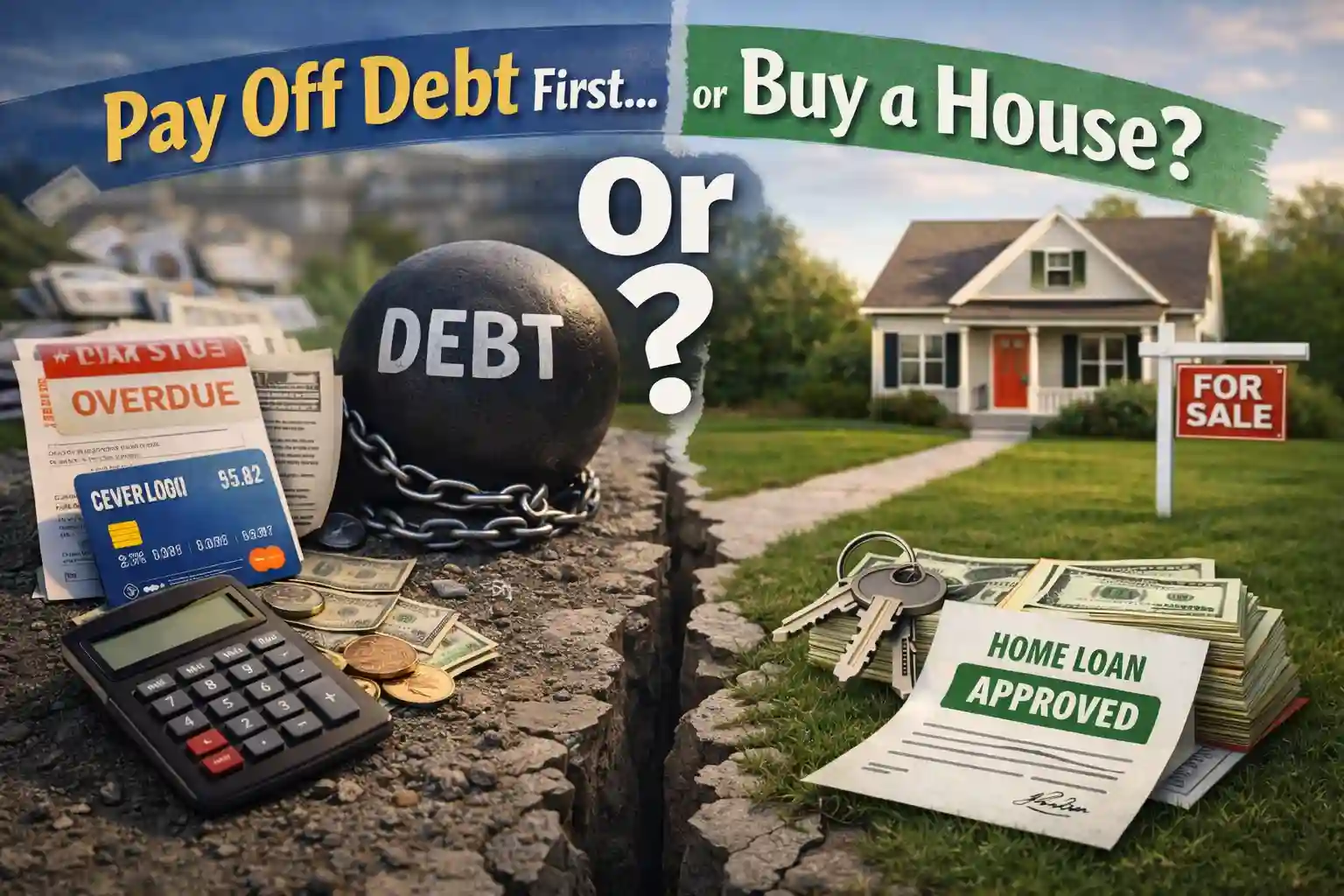
Pay Off Debt First… or Buy a House?
A Real-World Answer From 20+ Years of Investing
This question came up on social media today, and I loved it because it’s one of those questions that sounds simple but can quietly change the course of someone’s life.
“Should we pay off student loans first, or save for a house while paying debt?”
The comments usually split into two camps.
Camp one says: kill all debt first, then buy a house.
Camp two says: buy a house as soon as possible and let time do the rest.
Both sides argue like they’re 100% right.
Both sides are also incomplete.
I’ve been investing for over 20 years. I’ve owned homes, rentals, flipped properties, lost properties, rebuilt, paid off debt, carried debt, and done every mistake in the book so you don’t have to.
So let’s talk about this the real way. Not the emotional way. Not the Instagram way. Not the “one-size-fits-all guru” way.
Let’s talk math, timing, and real life.
Why This Question Even Exists
Student loan debt is emotional.
Buying a home is emotional.
Starting a family is emotional.
When emotions stack on top of each other, people freeze.
I see it constantly. Smart couples in their 20s or early 30s doing everything “right” but stuck in neutral because they don’t want to make the wrong move.
Here’s the hard truth.
There is no perfect move.
There is only the better move for your season of life.
And the only way to figure that out is to compare options side by side, not argue philosophies.
The Big Mistake Most People Make
Most people ask the wrong question.
They ask:
“Is debt bad?”
Of course it is.
But that’s not the decision in front of you.
The real question is:
“What is the cost of this debt compared to the opportunity cost of waiting?”
Debt has a cost.
Waiting also has a cost.
If you only focus on one and ignore the other, you’re flying blind.
What I Tell People to Do First
Before listening to anyone, including me, do this.
Open Excel.
Not TikTok.
Not Reddit comments.
Excel.
You’re about to compare apples to apples.
Because when you actually see the numbers, the answer usually punches you in the face.
Step 1: Look at Your Student Loan Interest
This is the part most people skip.
Don’t look at the balance.
Look at the interest.
How much money are you paying every year just to carry the debt?
That number matters more than the total balance.
If you’re paying thousands per year in interest, that’s real money leaving your life forever.
Now keep that number handy.
Step 2: Model Buying a Home Conservatively
I always tell people to be conservative on purpose.
No hype numbers. No fantasy appreciation.
Here’s what I use.
Assume the home only increases in value by 5% per year.
That’s not aggressive. That’s historically boring.
Then assume that about 1% of your mortgage interest comes back to you in tax benefits. Not exact. Not perfect. Just reasonable.
You’re not gaming the system here.
You’re getting clarity.
Step 3: Pick a Real Time Frame
Most people aggressively paying off student loans are looking at 3 to 5 years.
Perfect.
Use the same timeline.
Ask yourself:
“What happens financially if I rent for 3 to 5 years?”
“What happens if I buy and hold for 3 to 5 years?”
Same time frame. Same lens.
Step 4: Don’t Forget Rent Increases
This is where renting quietly hurts people.
Rent doesn’t stay flat.
Add a 5% rent increase per year to your spreadsheet.
Not because it’s scary.
Because it’s realistic.
Every year you wait, rent usually goes up while your mortgage payment stays the same.
That difference compounds quietly.
Step 5: Compare Everything Side by Side
Now you stack it all together.
Student loan interest paid over 3 to 5 years
Versus
Home appreciation
Plus tax benefits
Minus ownership costs
Versus
Rent paid with annual increases
This is the moment where emotion dies and math takes over.
And I’ll tell you what usually happens.
People realize that waiting isn’t free.
They realize paying debt isn’t always the highest return move.
They realize life doesn’t pause while spreadsheets feel comfortable.
The Dave Ramsey Angle (And Where People Get Stuck)
Dave would likely say: pay off all debt first, then buy.
And listen, that advice has helped millions of people who had no control, no plan, and no discipline.
If you’re drowning, you simplify.
If you’re reckless, you go extreme.
But disciplined people don’t need extreme rules.
They need smart ones.
If you hate debt and you’re responsible, you don’t need to delay life to prove discipline.
You already have it.
What I’ve Seen Over and Over
I’ve watched people wait too long.
They paid off debt perfectly.
They followed the rules.
They did everything “right.”
Then prices doubled.
Rates changed.
Kids came.
Life got louder.
And suddenly buying felt impossible.
I’ve also watched people buy responsibly while paying debt down.
They didn’t rush.
They didn’t stretch.
They didn’t gamble.
They just let time do some of the work.
Time is underrated.
Why Your 20s and 30s Matter So Much
This part is important.
Your biggest advantage isn’t money.
It’s time.
A modest decision made early often beats a perfect decision made late.
Waiting for the perfect moment usually costs more than people realize.
A Simple Rule I Live By
I don’t ask:
“Is this perfect?”
I ask:
“Is this better than standing still?”
If buying a home allows you to:
• Lock in housing costs
• Build stability
• Capture appreciation
• Still pay down debt responsibly
Then it deserves serious consideration.
What I’d Tell My Own Kids
If my kids were in their mid-20s and asked me this question, I’d say this:
Run the numbers honestly.
Be conservative.
Don’t rush.
Don’t freeze.
Debt matters.
But so does momentum.
Life doesn’t wait for spreadsheets to feel comfortable.
Final Thought
This isn’t about being anti-debt or pro-house.
It’s about understanding trade-offs.
When you compare everything side by side, the right move usually becomes obvious.
Stop arguing philosophies.
Start comparing math.
That’s how grown decisions get made.
Keep it consistent, stay patient, stay true—if I did it, so can you. This is Jorge Vazquez, CEO of Graystone Investment Group and all our amazing companies, and Coach at Property Profit Academy. Thanks for tuning in—until the next article, take care and keep building!
If you’d like to connect directly with me, feel free to book a time here: https://graystoneig.com/ceo.