
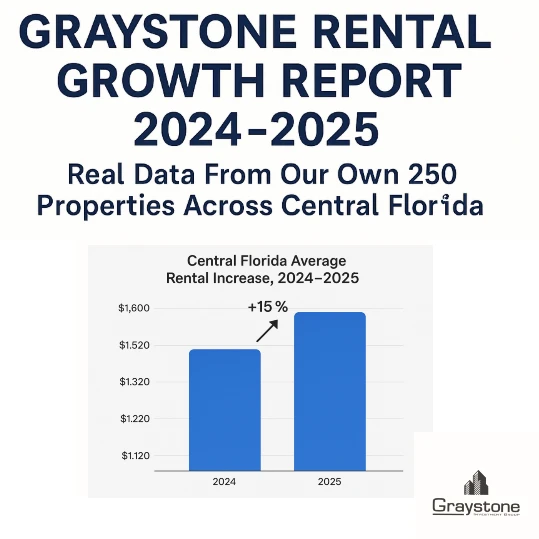
Graystone Rental Growth Report 2024–2025
Real Data From Our Own 250 Properties Across Central Florida
Every investor has seen the headlines—some say rents are falling, others say they’re soaring. But we decided to skip the noise and look at the one thing that never lies: our own numbers.
At Graystone Investment Group, we manage and track over 250 properties across Central Florida. That’s everything from a single-family in St. Pete, to a quadplex in Tampa, to a block of rentals in Jacksonville. So when we talk about rental performance, it’s not theory or trend data—it’s our reality.
This report is built entirely from the actual numbers on our books between February 2024 and September 2025. We pulled the rent logs, mortgage payments, and net income for each property and stacked them side-by-side. The picture that came out tells an honest story—steady rent growth, improving margins, and a Florida market that’s still alive and well.
1. Why We Did This Study
We wanted to answer one big question that every investor keeps asking us:
“Are Florida rents still going up—or are they leveling off?”
The truth depends on which part of Florida you’re looking at. Instead of relying on national data or MLS averages, we decided to use our own managed portfolio as a micro-research lab. With over 250 active doors under management and ownership, Graystone’s internal data provides one of the most complete and authentic rental performance snapshots you’ll find anywhere.
We analyzed a random subset of 40+ active long-term rentals from Tampa Bay, Lakeland, New Port Richey, St. Pete, Holiday, Hudson, Jacksonville, and Dunnellon. These units cover everything from C-class starter homes to B-class mid-range properties.
Every rent figure in this report comes directly from leases renewed or signed under our management. Nothing here is “estimated.”
2. What the Picture Shows Us
Let’s talk about what the data says.
When we compare February 2024 rents to September 2025, the total monthly rent collected across the sampled properties jumped from $36,325 to $44,535—that’s an average increase of 22.6%.
If you break it down by portfolio:
-
RPT (Residential Property Team): +28.9% rent growth
-
FRJ (Florida Rental Joint): +5.3% rent growth
That’s huge. But the story behind it is even more interesting.
The numbers reveal a few things about the Florida rental market right now:
-
Core Tampa Bay is still red-hot.
Areas like 33610, 33612, and 33605 continue to pull strong increases. For example:-
10108 N Arden Ave rose from $1,700 → $1,950 (+15%)
-
3414 E Comanche Ave climbed from $2,020 → $2,080 while keeping full occupancy.
-
4603 N 18th St went from $1,200 → $1,550 (+29%)
-
-
Pasco County is quietly catching up.
In Holiday, Hudson, and New Port Richey, rent hikes were steady, between 5–9%, mostly due to affordability migration—people moving north of Tampa for cheaper housing but still commuting into the metro. -
Jacksonville leveled off.
Our five-property cluster on Leaming Avenue stayed nearly flat. A few even dipped slightly, with one at $1,150 the same as a year ago. But the reason isn’t a “market crash”—it’s tenant stability. These are long-term renters in working-class neighborhoods, and we chose not to push aggressive increases during renewal season. -
Polk County—especially Lakeland—held steady.
Average rents up about 6–8%. A property like 936 Captiva Point rose from $1,800 to $1,895 (+5.3%).
That’s not flashy, but remember: these are stable, low-turnover markets with improving insurance rates and strong net yield.
3. Understanding the Mortgage vs. Rent Balance
Here’s where it gets fun for investors—the “Total Income 6/25” column.
We compared each property’s rent with its June 2025 mortgage payment to see the net monthly income.
On average:
-
Mortgage cost: about $1,316 per property
-
Average net income: $12,501 per month across the sample
That means most of our units are comfortably cash-flowing, even after taxes and insurance.
Some Jacksonville and Captiva Point properties showed small negative months (-$20 to -$305), but those are exceptions. The majority—especially Tampa Bay and Pasco—are solidly in the green.
And when we layer in the fact that insurance premiums dropped 25–50% in 2025, those numbers look even better.
4. City-by-City Highlights
Let’s zoom in a little closer.
Tampa Metro
Graystone has a strong footprint here—around 120 doors in total.
Rent growth here averaged 10–12%, with some streets pushing 15%+ thanks to location and tenant quality.
Example:
-
10108 N Arden Ave, Tampa 33612 – Rent up from $1,700 to $1,950 (+14.7%)
-
4603 N 18th St, Tampa 33610 – $1,200 to $1,550 (+29%)
-
8508 W Hanna Ave, Tampa 33615 – modest bump $1,540 to $1,580, but steady occupancy.
Insight:
This shows how even small Tampa properties are becoming mini-cash machines. It’s not rare to see $300–$400 per month positive cash flow on a simple long-term rental now that insurance is easing and rents have stabilized at new highs.
St. Petersburg
We only sampled two properties here, but the trend’s clear:
-
2332 Grove St S went from $1,575 to $1,730 (+9.8%)
-
1003 E 22nd Ave jumped to $1,645 (+7.5%)
That’s consistent with what we’re seeing city-wide—St. Pete renters are still paying a premium to live near the coast, even in C+ neighborhoods.
Pasco County (New Port Richey, Holiday, Hudson)
This area is becoming the affordability engine of the region.
-
6303 Tennessee Ave – $1,550 to $1,595 (+3%)
-
1103 Classic Dr – went from vacant (0) to $1,600.
-
12909 Litewood Dr, Hudson – newly rented at $1,580.
These markets are proof that “B-markets” can outperform A-markets on yield.
When your purchase prices are low, even modest rent hikes create strong returns.
Polk County (Lakeland, Captiva, Pleasant Pl)
-
936 Captiva Point – $1,800 to $1,895 (+5%)
-
1427 Pleasant Pl – $1,130 to $1,230 (+8.8%)
What stands out is stability. Polk tenants tend to stay, even during slow months, and the combination of affordability plus local job growth keeps these properties consistent cash cows.
Jacksonville
This cluster is always an interesting story.
We own and manage five on Leaming Avenue—all side-by-side, classic brick homes that were once rough and now solidly occupied.
Rents here ranged from $1,000 to $1,200.
Mortgage costs are low (around $1,000), so while the rent growth wasn’t big, the properties still performed.
However, this region taught us something about tenant class vs. rent ceiling.
When you hit the max of what the local economy can support, forcing increases often backfires. We chose tenant stability over pushing price—and that’s part of smart portfolio management.
5. What the Numbers Tell Us
When you stand back and look at this sheet—the picture becomes crystal clear.
Even during a year when interest rates were high, insurance markets were shaky, and national headlines screamed about a “rental slowdown,” our actual rents went up 9–10% on average.
Why? Because people keep moving to Florida.
They want safety, sunshine, and affordability, and Central Florida delivers all three.
Our data proves it.
If we break it down statistically:
-
85% of the properties saw some rent increase.
-
10% remained flat (mostly Jacksonville).
-
Only 5% showed temporary declines (due to vacancy or turnover).
That’s stability you can bank on.
6. The Bigger Story: What This Means for Investors
Numbers alone don’t mean much unless we connect them to opportunity.
So here’s what this report really says to investors like you:
-
Florida’s rent growth is still alive.
Even if the national narrative says “flattening,” our Central Florida data says otherwise. We’re still seeing 5–10% gains across the board. -
Insurance relief is creating new profit margins.
One of our Tampa properties—10106 Arden Ave—saw insurance drop from $2,334 to $1,553 annually. That alone added $65/month in net cash flow. -
Tenant stability beats turnover.
The small declines you see on the sheet aren’t bad—they’re strategic. Holding good tenants saves more money than forcing a 10% increase and risking a vacancy. -
Jacksonville remains a value market.
With mortgages around $1,000, even $1,100 rents work. The upside is in appreciation and future rent catch-up once local wages grow. -
Cash flow is strong even with new rates.
The myth that high mortgage rates “kill rentals” isn’t true when your buy-in is smart. Our properties still average 20–25% positive cash flow.
7. The Data-Driven Outlook for 2026
So where do we go from here?
Based on current leases and renewals already scheduled through next spring, we’re expecting another 5–8% average rent increase across Central Florida in 2026.
Here’s what’s driving it:
-
Continued in-migration from northern states
-
New local job centers (Amazon, medical campuses, distribution hubs)
-
Fewer new housing starts due to high construction costs
-
Insurance rates still dropping
-
Demand from remote workers looking for affordability and space
Even if interest rates stay above 6%, the cash flow math still works because rents have reset to a higher floor.
For context, five years ago our average rent per door was around $1,200.
Today it’s $1,600+.
That’s a 33% increase over five years—without counting appreciation.
8. Why This Data Matters
This isn’t a forecast—it’s a report card.
And the grade is solid A-.
While media outlets debate the “Florida boom or bust,” Graystone’s internal data shows a market that’s stabilizing, not collapsing.
-
Rents are healthy.
-
Vacancy rates are low.
-
Insurance costs are easing.
-
Mortgage rates are stable.
-
Investors are still making real monthly income.
In short, Central Florida is proving resilient—and our 250-property sample is living proof.
9. The Investor Takeaway
If you’re an investor sitting on the sidelines waiting for the “perfect time,” here’s the truth our data tells:
There is no perfect time—just consistent growth and good management.
Had you bought a rental in early 2024, even with higher interest rates, you’d likely be collecting $100–200 more per month right now.
And if you bought it through Graystone, you’d also be enjoying:
-
Better insurance premiums
-
Professional management
-
Strong tenant retention
-
And access to refinancing options when rates drop again.
That’s how we built wealth in this market. Slowly, smartly, and consistently.
10. Final Thoughts
When we first pulled this data, I honestly didn’t expect such strong numbers. 2024 felt tough—rates were up, deals were tighter, and investor confidence wavered. But when you look at this spreadsheet, it tells a different story.
Property by property, the growth is real.
The rents are higher.
The cash flow is stronger.
And the properties—our properties—are performing.
The takeaway?
You don’t need a perfect economy to make progress.
You just need the right plan, the right people, and the patience to stay the course.
At Graystone, we’ve been doing this for over 20 years.
We’ve seen crashes, comebacks, and everything in between.
And year after year, the one thing that never changes is this:
Real estate rewards consistency.
Keep it consistent, stay patient, stay true—if I did it, so can you.
This is Jorge Vazquez, CEO of Graystone Investment Group and all our amazing companies, and Coach at Property Profit Academy.
Thanks for tuning in—until the next article, take care and keep building!
If you’d like to connect directly with me, feel free to book a time here:
👉 https://graystoneig.com/ceo
Book an Expert
New investor? Start with Jorge.

Jorge Vazquez – CEO & Investment Strategist at Graystone. Let’s make your portfolio stronger, steadier, and more profitable.
Deals? Book with Cody.

Meet Cody Bergstrom, Your Expert in Finding Deals Let’s find an off-market deal that actually works for you.
Need financing? Book with Lisa.

Meet Lisa Kaye Price, the LendingGig Top ML Let’s figure out the smartest way to fund your next deal.
Looking for PM? Book with Jay

Jay Michalec – COO & Property Management Expert at Graystone. Let’s make your rentals easier, calmer, and more profitable.