Real Estate Crowdfunding in 2025: From “The Future of Everything” to a Reality Check
I remember back in 2015 when it felt like everything in real estate was going to be crowdfunding or syndication. Every conference, every podcast, every article made it sound inevitable. If you weren’t pooling money online and buying fractional interests, you were supposedly behind the times.
Crowdfunding was positioned as the future.
Syndication was positioned as the smarter path.
Owning individual properties was painted as inefficient, old school, and unnecessary.
The message was simple: why own one house when you can own a piece of many? Why deal with tenants when professionals can handle everything? Why take responsibility when you can be passive?
It sounded great. And for a while, it worked.
Fast forward to 2025, and the conversation couldn’t be more different. Now what I hear isn’t hype. It’s drama. Investor complaints. Frozen redemptions. Lawsuits. Fraud cases becoming public. Platforms shutting down or entering liquidation. Sponsors struggling to explain missed projections.
That shift didn’t happen because crowdfunding was evil. It happened because the market stopped being forgiving.
This article isn’t anti-crowdfunding. It’s pro-reality. I lived through the hype, reviewed the deals, logged into the platforms, and watched how things played out when conditions changed. And ultimately, I decided it wasn’t the lane I wanted to run in.
Here’s why.
Why crowdfunding sounded so convincing in 2015
To understand what happened, you have to remember the environment.
Interest rates were low. Real estate was recovering from the 2008 crash. Appreciation was strong. Refinancing was easy. Capital was everywhere. Risk felt distant.
Crowdfunding promised something incredibly appealing:
-
Exposure to real estate
-
No direct ownership
-
No tenants or toilets
-
No management headaches
-
Small minimum investments
-
“Professional” oversight
You could feel like a real estate investor without actually doing real estate.
And when markets are rising, almost everything works. Appreciation hides mistakes. Cheap debt forgives bad underwriting. Time covers inexperience.
But markets don’t stay kind forever.
What changed when the market got real
When interest rates rose and liquidity tightened, crowdfunding stopped being theoretical and started being operational.
Suddenly:
-
Exit timelines mattered
-
Debt terms mattered
-
Sponsor experience mattered
-
Transparency mattered
Deals that relied on constant refinancing stopped penciling. Projects that assumed perfect execution ran into delays. Sponsors who had never managed through adversity had to explain why returns weren’t arriving on schedule.
And investors realized something uncomfortable.
They didn’t own real estate.
They owned paper interests tied to real estate, managed by people they didn’t control, through platforms that could disappear.
That’s when confidence cracked.
Public platform failures changed the conversation
This isn’t rumor or internet noise. These are public cases.
One of the early U.S. leaders, RealtyShares, shut down in 2018 after failing to secure enough capital to continue operations. The properties still existed, but investors were left navigating long, complex wind-downs. Many learned for the first time that even if the asset survives, the structure around it can fail.
In Europe, Crowdestate entered liquidation in 2025. Rising interest rates, economic pressure, and declining investor participation made the model unsustainable.
Another example, Here, a fractional vacation rental platform, shut down in early 2024, citing the interest rate environment and economics that no longer worked.
Different platforms. Different markets. Same lesson.
When the platform is the middleman, the middleman becomes part of the risk.
My personal experience looking under the hood
I didn’t ignore this space. I studied it. I reviewed deals. I logged into platforms and looked at case models.
And here’s what stood out.
The effort required to truly understand the risk was high, while the returns didn’t feel proportionally better.
Once you factor in:
-
Sponsor fees
-
Asset management fees
-
Platform fees
-
Promote structures
-
Preferred returns that weren’t guaranteed
-
Long lockup periods
-
Limited transparency once the deal closed
I kept asking myself a simple question.
If I’m going to accept stock-like behavior, why wouldn’t I just buy real real estate stocks like REITs?
If I’m going to accept illiquidity and execution risk, why wouldn’t I just buy actual properties I can touch, improve, refinance, and control?
Crowdfunding sat in an uncomfortable middle ground for me.
The missing piece: physical ownership
This is the part I think many crowdfunding models missed entirely.
They missed the point of owning real estate.
Real estate isn’t just numbers on a spreadsheet. It’s a physical asset. A structure. A space. A tool. And when you own it directly, it gives you options that no crowdfunding structure can replicate.
That physical flexibility is what keeps investors alive when markets shift.
And markets always shift.
Real estate isn’t just about rent checks
Most crowdfunding deals are underwritten with one narrow use case.
Rent it.
Hold it.
Refinance it.
Sell it.
That works when the market behaves exactly as planned.
But real-world real estate doesn’t operate in a single lane.
When you own a property directly, you can adapt.
You can:
-
Rent it long term
-
Convert it to short term
-
Use it for storage
-
Rent rooms instead of the whole house
-
Lease it to a business
-
Pivot the tenant profile
-
Adjust the hold strategy
-
Delay the sale
-
Refinance creatively
-
Or simply sit on it safely
Crowdfunding investors don’t get those levers.
They wait.
Optionality is the real superpower
Optionality is one of the most underrated concepts in real estate investing.
When markets tighten, optionality becomes survival.
If rents soften, a physical property can be repositioned.
If buyers disappear, you can hold.
If lending dries up, you can operate.
If prices stall, you don’t have to sell.
Crowdfunding structures remove optionality.
You’re locked into:
-
A preset business plan
-
A preset timeline
-
A preset exit
-
A preset sponsor decision
Even if the property itself could be repurposed, you can’t.
That’s a massive difference.
Why owning boring real estate works better
This is why I’ve never been drawn to flashy, overly engineered deals.
Owning one solid property isn’t sexy.
Owning ten solid properties isn’t sexy.
But it’s efficient.
And efficiency beats excitement over time.
When you own a house, duplex, or small multifamily directly, you’re not just buying cash flow. You’re buying resilience.
You’re buying something that can:
-
Generate income
-
Store value
-
Act as collateral
-
Be restructured
-
Be refinanced
-
Be adapted
Crowdfunding traded all of that for convenience.
And convenience disappears fast when markets tighten.
Why REITs make more sense for paper exposure
If someone wants passive real estate exposure without owning property, I get it. Not everyone wants to manage assets.
But if that’s the case, REITs make more sense than crowdfunding.
They are:
-
Regulated
-
Audited
-
Liquid
-
Transparent
-
Publicly priced
-
Professionally managed
REITs still have risk. They still move with interest rates. But at least you know what you own and how it’s priced.
Crowdfunding often asks investors to give up liquidity and transparency without delivering a clear upside premium. That’s a tough trade.
How crowdfunding actually works in 2025
Crowdfunding didn’t disappear. It evolved.
In 2025, crowdfunding works best when it feels less like “fund my idea” and more like “help me finish something that’s already real.”
This mirrors other industries. Tabletop games succeed because they’re almost done and easy to understand. Video games struggle because years of broken promises made people cautious.
Real estate crowdfunding followed the same path.
Today, successful deals usually have:
-
A real property
-
Progress already made
-
Conservative underwriting
-
A sponsor with a visible track record
-
Clear communication
Crowdfunding now acts more as proof of demand than full funding.
That’s a much smaller role than what was promised in 2015.
What investors can learn from all this
This decade taught some hard lessons.
Passive does not mean safe.
Control matters more in bad markets.
The platform is part of the risk.
Complexity should be rewarded with higher returns.
Physical assets behave differently than paper ones.
Most importantly, structure matters.
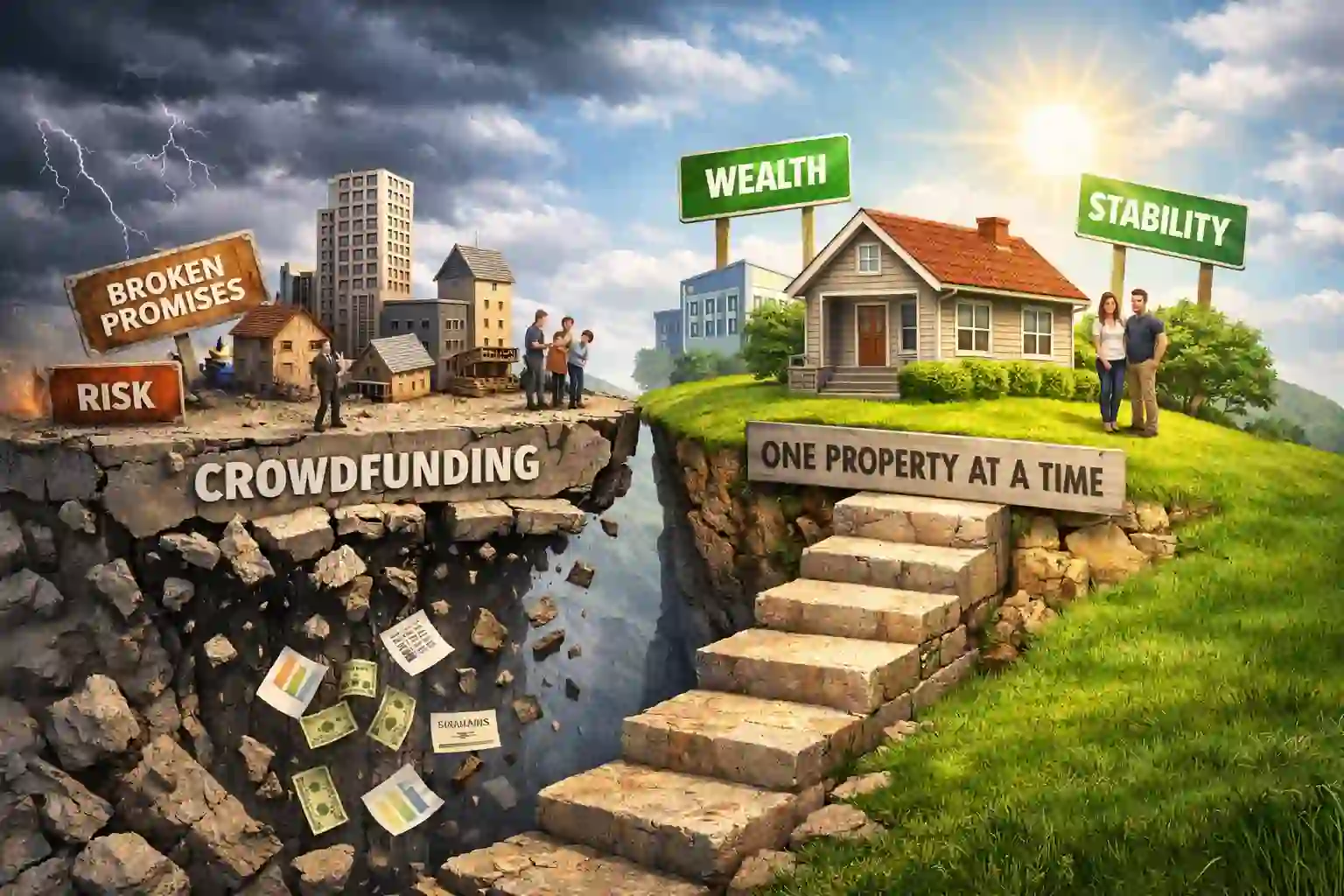
Many platforms didn’t fail because the properties were bad. They failed because the structure removed flexibility, control, and optionality.
Why we focus on one property at a time
This is where our philosophy comes from.
We help clients build wealth one property at a time.
Not because it’s trendy.
Not because it’s fast.
But because it works.
One property at a time allows investors to:
-
Understand the asset
-
Control decisions
-
Adjust strategy
-
Stack equity
-
Build confidence
-
Reduce dependency on others
It’s slower.
It’s less exciting.
But it’s durable.
Crowdfunding promised scale and speed. What it often delivered was distance and dependency.
Is real estate crowdfunding alive or dead in 2025?
It’s alive. But it’s no longer forgiving.
Crowdfunding is no longer the future of everything. It’s one tool among many, with very specific use cases and very real tradeoffs.
For some investors, it still makes sense.
For others, like me, it’s simply not the preferred lane.
Final thoughts
Back in 2015, crowdfunding and syndication were sold as the inevitable evolution of real estate investing. A decade later, we know better. They’re tools, not replacements.
Personally, I’d rather own real properties or buy real real estate stocks than sit in the middle with limited control, limited liquidity, and limited upside. That preference comes from experience, not theory.
Crowdfunding isn’t dead in 2025.
But blind faith in it absolutely is.
Keep it consistent, stay patient, stay true—if I did it, so can you. This is Jorge Vazquez, CEO of Graystone Investment Group and all our amazing companies, and Coach at Property Profit Academy. Thanks for tuning in—until the next article, take care and keep building.
If you’d like to connect directly with me, feel free to book a time here:
https://graystoneig.com/ceo