
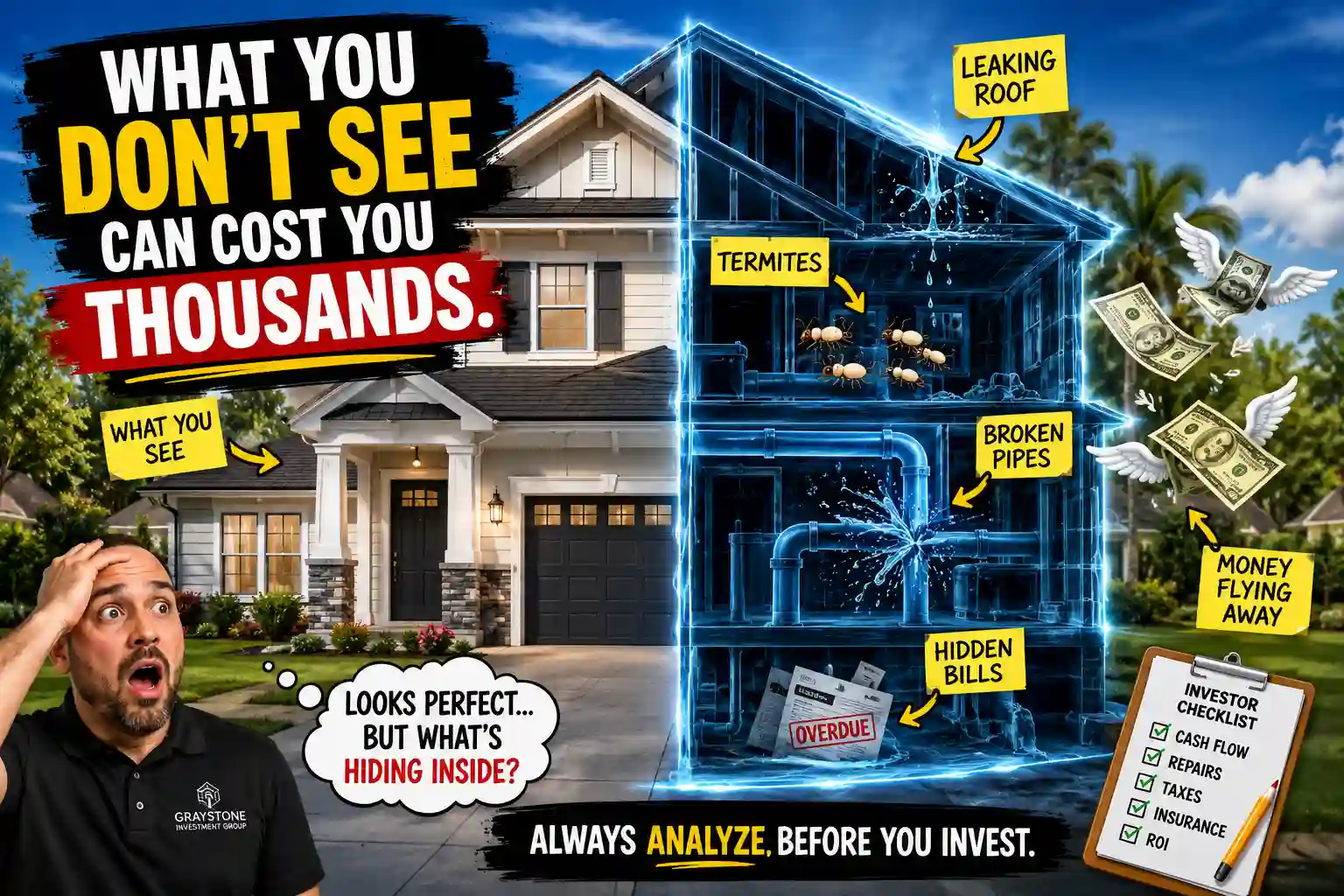
Twin-house image: left shows a sunny home, right reveals a ghostly blue blueprint with hidden home defects like termites, leaks, and broken pipes labeled with yellow notes; money flies away and a checklist is visible.

Real Estate Investment Property Analysis: The Simple Guide I Use Before Buying Any Property

Buying an investment property can be exciting.

It can also be expensive.

I’ve seen people make thousands of dollars on one deal. I’ve also seen people lose thousands because they skipped one simple step.

They didn’t do the math.

After more than 25 years in real estate and over 3,500 transactions, I’ve learned something important.

The best investment isn’t always the cheapest one. It’s the one where the numbers make sense.

That’s why I never buy a property without doing a real estate investment property analysis first.

Don’t worry if that sounds like a fancy term.

It simply means looking at the numbers before you spend your money.

Think of it this way.

Would you buy a used car without opening the hood?

Probably not.

Buying a rental property without analyzing it is the same thing. It may look great on the outside, but the problems are hiding where you can’t see them.

In this guide, I’ll show you the same process my team uses every day to decide if a property is worth buying.

You don’t need to be a math genius.

You just need a calculator, honest numbers, and a little patience.


What Is a Real Estate Investment Property Analysis?

Let’s keep this simple.

A real estate investment property analysis answers one question.

“Will this property make me money?”

That’s it.

Not…

“Is the kitchen pretty?”

“Do I like the paint color?”

“Would my mother live here?”

Those things don’t pay the mortgage.

The numbers do.

A good analysis helps you understand:

  • How much the property will cost
  • How much money it can make
  • What it will cost to own
  • How much profit you might earn
  • What could go wrong

The goal isn’t to find a perfect property.

Perfect properties don’t exist.

The goal is to find a property that makes financial sense.


Why This Step Is So Important

Here’s something I’ve learned.

A good deal can become a bad deal if you ignore the numbers.

I once looked at a property that seemed amazing.

The price was low.

The neighborhood was improving.

The photos looked great.

Everything seemed perfect.

Then we started digging deeper.

The roof was old.

The air conditioner was almost dead.

Insurance was much higher than expected.

Property taxes were about to increase.

Suddenly, that “great deal” wasn’t so great anymore.

We walked away.

A few weeks later we found another property.

It cost a little more.

But it needed fewer repairs.

The rent was stronger.

The insurance was lower.

That property made money.

The first one probably would have lost money.

Sometimes the best investment decision is saying, “No thanks.”


Start With Your Goal

Before you look at numbers, ask yourself one question.

Why am I buying this property?

Different goals need different plans.

Long-Term Rental

If you want monthly income, look for:

  • Good cash flow
  • Strong rental demand
  • Low maintenance
  • A safe neighborhood

Fix and Flip

If you want to renovate and sell, focus on:

  • Buying below market value
  • Repair costs
  • Selling price
  • Time needed to finish the project

BRRRR Strategy

If you plan to Buy, Rehab, Rent, Refinance, and Repeat, you’ll also need to know:

  • How much the property will appraise for
  • How much rent it can bring in
  • How much cash you’ll have left after refinancing

There isn’t one strategy that’s best.

The best strategy is the one that fits your goals.


Step 1: Find the Real Purchase Price

Here’s a mistake I see all the time.

Someone says,

“The house costs $250,000.”

Not exactly.

That’s only the beginning.

Buying a property comes with extra costs.

Some of them include:

  • Closing costs
  • Loan fees
  • Home inspection
  • Appraisal
  • Insurance
  • Utility deposits
  • Title fees

Think about ordering food online.

The burger might cost $10.

Then you add taxes.

Delivery.

A service fee.

Maybe dessert because… well… dessert.

Now it’s $22.

Real estate works the same way.

Always calculate the total cost before making an offer.


Step 2: Estimate the Repair Costs

This is where many investors get into trouble.

The house needs paint.

“No big deal.”

Then you find out the roof leaks.

The electrical panel is outdated.

The plumbing is from another century.

Now it’s a very big deal.

I like to divide repairs into three simple groups.

Cosmetic Repairs

These make the home look better.

Examples include:

  • Paint
  • Flooring
  • Cabinets
  • Countertops
  • Landscaping
  • Light fixtures

These usually make buyers smile.

Mechanical Repairs

These keep the home working.

Examples include:

  • Air conditioner
  • Plumbing
  • Electrical
  • Water heater

Nobody gets excited about replacing a water heater.

But everyone notices when there isn’t any hot water.

Major Repairs

These can cost the most.

Examples include:

  • Roof
  • Foundation
  • Structural damage
  • Sewer line
  • Termite damage

These are the repairs that can destroy your budget if you miss them.


Always Plan for Surprises

Here’s one rule I never break.

Something unexpected will happen.

It always does.

Maybe the electrician finds another problem.

Maybe the plumbing isn’t as simple as it looked.

Maybe the city wants permits you didn’t expect.

That’s why I always add extra money to my repair budget.

I’d rather finish under budget than call my wife and explain why I need another $15,000.

Trust me.

That second conversation is much less fun.


Step 3: Estimate the Rent

Now it’s time to see how much money the property can make.

Don’t guess.

Don’t use the seller’s opinion.

And definitely don’t believe your cousin who says,

“I think you could rent it for about three grand.”

Use real numbers.

Look at similar homes nearby.

Compare:

  • Bedrooms
  • Bathrooms
  • Square footage
  • Condition
  • Parking
  • Neighborhood

If similar homes rent for $2,100, don’t assume yours will rent for $2,700.

Hope is not an investment strategy.

Facts are.


Step 4: List Every Monthly Expense

This is another place where new investors make mistakes.

They think:

Rent = Profit.

I wish it were that easy.

Every rental has bills.

Some of the most common include:

  • Property taxes
  • Insurance
  • Property management
  • HOA fees
  • Lawn care
  • Repairs
  • Maintenance
  • Vacancy
  • Pest control

If you forget these expenses, your numbers will lie to you.

And numbers have a funny way of telling the truth after you’ve already bought the property.


Step 5: Calculate Net Operating Income (NOI)

Don’t let the name scare you.

It’s much simpler than it sounds.

Net Operating Income, or NOI, tells you how much money the property makes before paying the mortgage.

Here’s the formula:

Rental Income − Operating Expenses = Net Operating Income (NOI)

That’s it.

If your property brings in $30,000 each year and your yearly expenses are $10,000, your NOI is $20,000.

Simple math.

But it’s one of the most important numbers in real estate investing.


Step 6: Calculate Your Cash Flow

Now let’s answer the question everyone wants to know.

How much money do I actually keep each month?

Here’s the formula:

Rental Income

− Operating Expenses

− Mortgage Payment

= Monthly Cash Flow

If the answer is positive, that’s great.

If it’s negative, don’t panic.

Some investors accept negative cash flow if they expect strong appreciation.

Personally, I sleep better when my properties help pay me instead of me paying them.

After all, I already have kids asking me for money. I don’t need my rental properties joining the line.


Frequently Asked Questions

What is the most important metric when analyzing an investment property?

There isn’t a single metric that fits every situation. Rental investors often focus on cash flow and cash-on-cash return, while commercial investors rely more heavily on Net Operating Income (NOI) and cap rate. The best approach is to evaluate multiple metrics together rather than relying on one number.

How do I know if a rental property is a good investment?

A good rental property should produce positive cash flow after accounting for all operating expenses, vacancies, maintenance, insurance, taxes, and financing. It should also be located in an area with stable rental demand and long-term growth potential.

Should appreciation be included in an investment analysis?

Yes, but it should never be the primary reason for buying. Appreciation is difficult to predict, so experienced investors generally make sure a property works based on today’s numbers before considering future value increases.

What expenses do beginners often forget?

Commonly overlooked expenses include vacancy, capital expenditures, property management, maintenance reserves, insurance increases, utility costs during vacancies, and unexpected repairs. These items can significantly affect actual returns.

Can online investment calculators replace a professional analysis?

Online calculators are useful starting points, but they depend entirely on the accuracy of the information entered. A thorough investment analysis should include verified rental rates, repair estimates, comparable sales, insurance quotes, and local market conditions.

Related Articles

If you’d like to continue improving your investment analysis skills, these guides can help:

1. How Professional Real Estate Investors Actually Analyze Deals

This article expands on the exact underwriting process experienced investors use to evaluate properties quickly while avoiding costly mistakes.

Internal Link:
https://graystoneig.com/articles/how-professional-real-estate-investors-actually-analyze-deals


2. Beware Wholesalers Who Don’t Vet, Flip, or Manage Properties

Learn the warning signs of bad investment opportunities and how proper due diligence can protect your money before closing.

Internal Link:
https://graystoneig.com/articles/wholesalers/be-careful-with-wholesalers-who-dont-vet-dont-flip-and-dont-manage


3. Leveraging Real Estate in Florida for Higher Returns

Understand how ROI, leverage, and financing strategies work together to maximize long-term investment returns.

Internal Link:
https://graystoneig.com/articles/leveraging-real-estate-in-florida-a-strategy-for-maximizing-returns

author avatar
Jorge Vazquez CEO
Jorge Vazquez is the CEO of Graystone Investment Group and coach at Property Profit Academy. With 20+ years of experience and 3,500+ real estate deals, he helps investors build wealth through smart strategies, from acquisition to property management. Featured in Forbes and winner of multiple awards, Jorge is known for making real estate simple and impactful. Real estate investor, educator, and CEO helping others build wealth through smart, long-term real estate strategies.