
I’ve been in real estate long enough to know one thing for sure: there are no shortcuts that pay off in the long run. And yet, every year, I meet good people—smart investors, hard-working homeowners—who decide to build an ADU (Accessory Dwelling Unit) without pulling permits.
They tell me the same thing every time:
“The county takes forever.”
“The rules are confusing.”
“It’s just a small unit in my backyard—no big deal.”
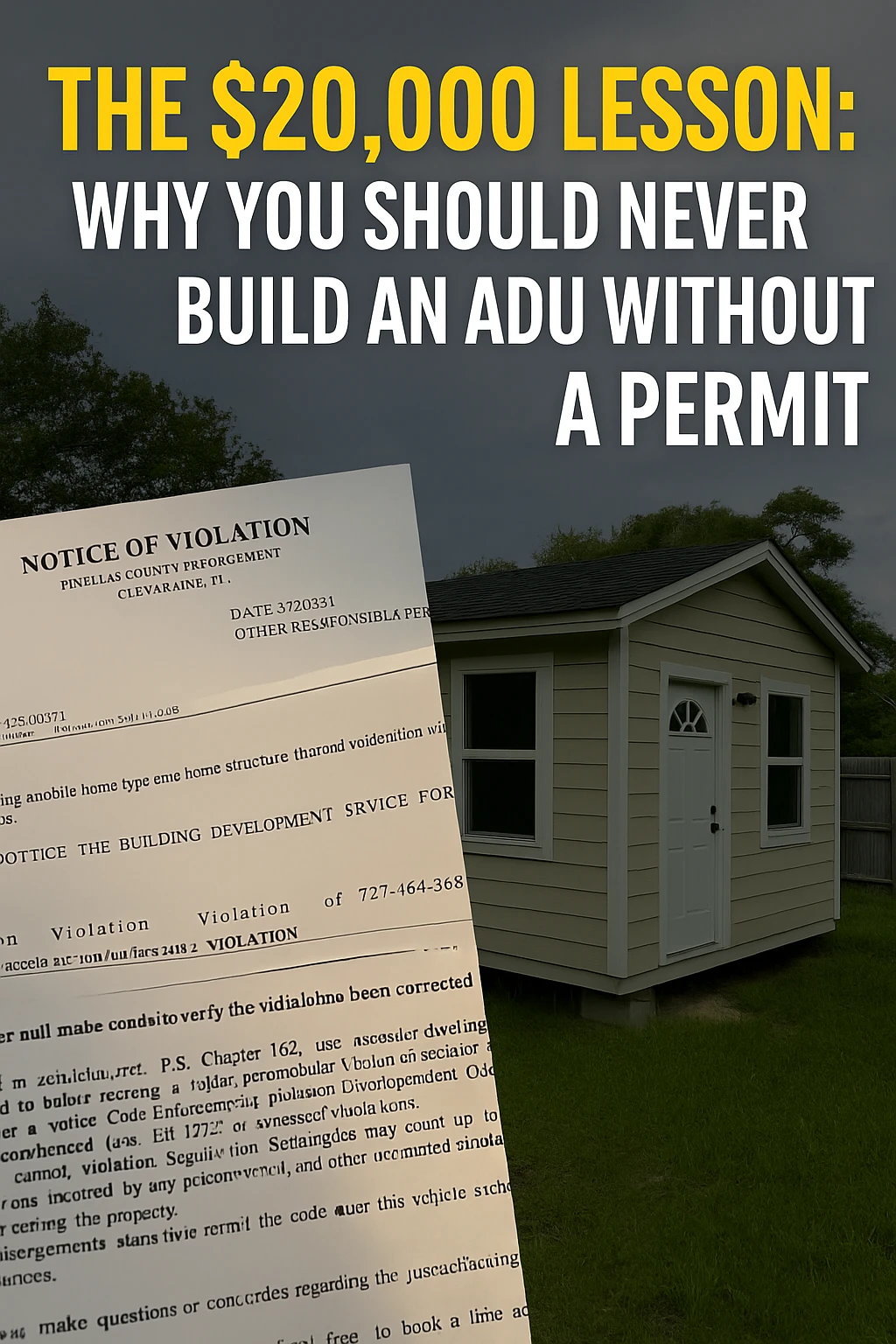
Then, a few months later, the white envelope shows up: Code Enforcement Notice.
Recently, one of my clients found that out the hard way. His story perfectly captures why skipping permits might save you time upfront but will cost you dearly in the end.
The Dream: “It’s Just a Small Unit”
We’ll call him John to keep things private. John owned a cozy single-family home in Clearwater. He wanted to build a small detached ADU—about 750 square feet, two bedrooms, one bath, one kitchen. The goal was to rent it out and help cover his mortgage.
He hired a contractor who told him, “It’s small, we can get it done fast, you don’t need to deal with the county.”
So they built it.
No wheels, set on blocks, solid-looking, and ready to rent. For a few weeks, everything seemed fine. Tenants were calling, John was feeling confident—and then came that dreaded envelope from Pinellas County Code Enforcement.
The Reality Check: “You Built a Mobile Home”
The letter stated that John had installed a mobile home-type structure without zoning approval. The county classified it as a mobile home because it wasn’t on a permanent foundation and didn’t meet Florida Building Code standards for ADUs.
To them, it didn’t matter that John called it an ADU or that it looked like a house. In the county’s eyes, it was an unpermitted mobile home—and those are not allowed in residential zones.
So now, he was officially in violation of Section 138-3210(f) of the Land Development Code. The letter included a case number, a compliance deadline, and a friendly but serious warning: fix it or face fines up to $1,000 per day.
The Panic Phase: “What Can I Do?”
John immediately emailed the zoning department trying to explain.
He told them, “This isn’t a mobile home—it’s set on blocks with 4x4s. No wheels, no chassis. I just wanted to build an ADU.”
He even pointed out that he had improved the property—cleared trees, landscaped, and kept the rent below market rates to help provide affordable housing.
To the county’s credit, the planner was professional and patient. She explained that definitions matter. Unless the structure was built and permitted under ADU standards—with engineered foundation, setback verification, plumbing and electrical sign-offs, and structural compliance—it couldn’t stay.
If he wanted to keep it, he’d have to bring it up to code.
The Long Road Back
That’s when the real work began.
John hired a drafting and design firm to create the proper drawings and help determine if the structure could be retrofitted to meet ADU standards. The process involved:
-
Surveying the lot to confirm legal setbacks.
-
Reviewing electrical and plumbing installations for compliance.
-
Consulting with an engineer for the foundation.
-
Submitting all new plans to the county’s Building and Development Review Services portal.
He even spoke with a Senior Code Enforcement Officer who suggested there might be a legal way to keep the structure—if he could prove it met code after modifications.
At that point, John was juggling designers, engineers, zoning officials, and a ticking clock on potential fines.
The Hidden Costs of Doing It Wrong
Most people think they’re saving a few thousand dollars by skipping permits. But here’s what they don’t realize until it’s too late:
-
Daily fines: up to $1,000 until the violation is resolved.
-
Design and engineering fees: to recreate plans after the fact.
-
Permit reapplication costs: plus county reinspection fees.
-
Insurance issues: unpermitted structures may void coverage.
-
Appraisal problems: unpermitted units often don’t count toward value.
John ended up spending more trying to fix the problem than if he had pulled permits from the start.
The project he thought would take two months turned into six—and the money he thought he saved disappeared twice over.
The Paper Trail That Never Goes Away
One thing people don’t realize: code enforcement records are permanent.
Once your property gets flagged for a violation, it stays in the system. Appraisers see it. Title companies see it. Lenders see it. Even future buyers see it.
And every time someone asks, “Is that unit permitted?”—you’ll have to explain the story all over again.
Even after you fix it, that history follows the property.
The Smart Way to Build an ADU
Now, I don’t tell this story to scare anyone away from building ADUs. I love them. They’re one of the best ways to add value, create housing, and build wealth. But they have to be done right.
If you’re thinking of building an ADU, here’s the checklist I give all my clients:
-
Confirm zoning. Ask your county if your lot allows an ADU.
-
Check setbacks. Know how close you can build to your property lines.
-
Get a professional design. Drafting companies know local building codes.
-
Submit permits online. Pinellas County uses an Access Portal that makes it easier.
-
Keep all records. Save every plan, permit, and inspection approval.
-
Talk to your neighbors. Sometimes a complaint starts simply because no one knew what you were building.
-
Hire licensed professionals. A real contractor will know how to make your project code-compliant from day one.
It’s not fun dealing with the paperwork—but you’ll thank yourself later when your investment is legal, insurable, and fully valued by appraisers.
The Real Lesson
Looking back, John told me, “I thought I was saving time, but I ended up losing six months.”
That’s how it goes. Every unpermitted project starts with confidence and ends with code violations.
And here’s the part no one talks about: sometimes you can’t fix it. Some structures simply can’t meet code after the fact, which means demolition is the only option.
Imagine tearing down something you built with your savings because a permit wasn’t filed. That’s the worst-case scenario—and it happens more often than you’d think.
Why People Still Risk It
After seeing this story play out over and over, I’ve learned why people take the gamble:
-
They think they won’t get caught.
-
They think permits cost too much.
-
They think it’s their land, so they can do what they want.
-
They don’t realize how strict Florida’s zoning codes are, especially in unincorporated areas.
But the truth is, inspectors drive by, neighbors notice, and the county has aerial imagery updated regularly. You can’t hide a new structure.
Sooner or later, someone notices—and when they do, the fines start adding up.
The Takeaway
Building an ADU is an incredible investment. It can double your income potential, increase your property value, and create housing options for family, tenants, or retirees.
But only if you do it right.
If you’re planning one, talk to your local zoning department before you even call the contractor. Get clarity on what’s allowed, where it can go, and how big it can be. Trust the process. It may take a little patience, but it’s a lot cheaper than rebuilding later.
In John’s case, he’s still working through the final approvals, but he learned the lesson every property owner eventually does: permits aren’t the enemy—they’re your insurance policy.
So don’t build first and ask questions later. Build right the first time.
Keep it consistent, stay patient, stay true—if I did it, so can you. This is Jorge Vazquez, CEO of Graystone Investment Group and all our amazing companies, and Coach at Property Profit Academy. Thanks for tuning in—until the next article, take care and keep building!
If you’d like to connect directly with me, feel free to book a time here: https://graystoneig.com/ceo.
Book an Expert
New investor? Start with Jorge.

Jorge Vazquez – CEO & Investment Strategist at Graystone. Let’s make your portfolio stronger, steadier, and more profitable.
Deals? Book with Cody.

Meet Cody Bergstrom, Your Expert in Finding Deals Let’s find an off-market deal that actually works for you.
Need financing? Book with Lisa.

Meet Lisa Kaye Price, the LendingGig Top ML Let’s figure out the smartest way to fund your next deal.
Looking for PM? Book with Jay

Jay Michalec – COO & Property Management Expert at Graystone. Let’s make your rentals easier, calmer, and more profitable.