
Let me just start with this: in 25+ years of managing and owning properties across Florida, I have never had an insurance claim that came close to the full coverage amount. Not once.
Sure, I’ve had roofs leak, tenants who left their “emotional support python” behind (true story), and even one fire started by a furious seller (more on that in a sec). But here’s the kicker—despite hurricanes, falling trees, and all the things that should go wrong when you manage hundreds of doors… I’ve never needed that top-dollar replacement value policy they always push.
So now I’m asking myself (and maybe you): why are we still paying for these high-dollar replacement value policies when the real-life claims don’t even come close?
Let’s talk about it.
What They Say vs. What Actually Happens
If you’ve ever sat down with an insurance agent, you already know the drill:
-
“You need full replacement value.”
-
“Don’t underinsure, or you’ll regret it.”
-
“You never know when a Category 5 hurricane will eat your duplex for breakfast.”
Okay, fine. But guess what I actually see?
-
Maybe a branch falls.
-
Maybe the AC dies and takes a few wires with it.
-
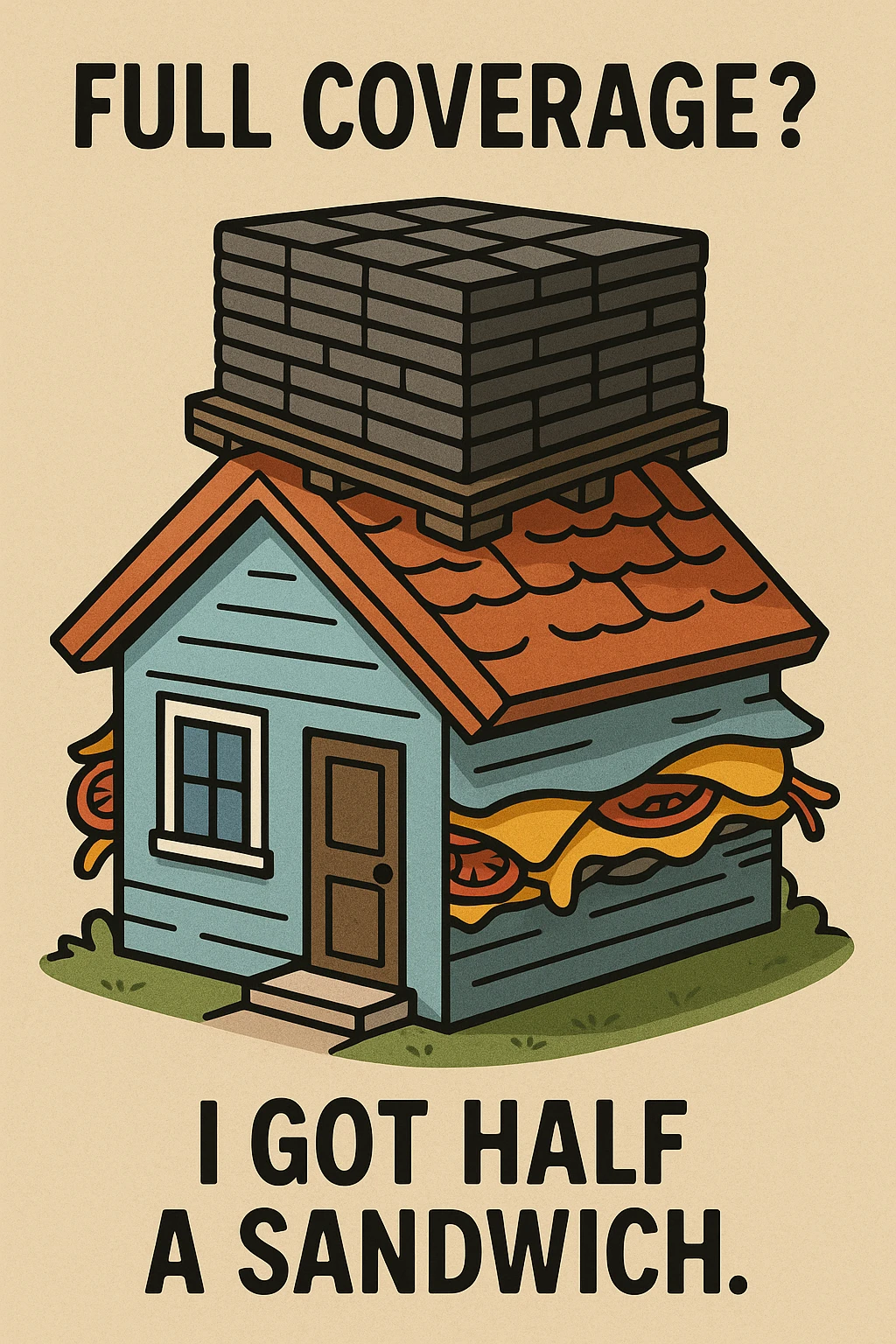
Maybe (and this happened once) a stack of shingles collapses a roof like a sandwich, and I’m standing there thinking, “Well, that’s not good.”
That’s it. And even the worst-case scenario—the sandwich roof—only cost me about $150,000 in claims. That’s after years of paying for $300,000+ replacement value coverage.
So again… why am I insuring properties for full value if history shows I’ll never even get close to using it?
Let Me Tell You About the Shingles Incident
This is one of those stories you can’t make up. I had a property with a nice, flat roof. A contractor left a big stack of shingles on it while waiting for a permit. Florida rain came in hard. The weight of those shingles eventually sank the whole thing like a grilled cheese left in the microwave too long.
I filed a claim. They gave me about $150,000. Sounds nice, right?
Well, replacement cost on that place would’ve been closer to $300,000. So even after everything, I only got half of what I was “insured” for.
It was like ordering the filet mignon and being told, “Here’s your Salisbury steak, sir.”
That One Time a Seller Lit the Place on Fire
Oh yeah, here’s a fun one. Angry seller. Couldn’t handle losing the house in a deal. Decided to go full Real Housewives of Tampa and lit the kitchen on fire.
Insurance payout? Around $50,000.
Not nothing—but again, nowhere near the replacement cost I was paying for.
Roof Damage, Sinkholes, and the Rest of the Usual Suspects
-
I’ve had branches hit roofs. Claim: maybe $30,000.
-
I’ve had tenants back their pickup trucks into garage doors. Claim: $6,200.
-
I’ve even had a minor sinkhole scare (just a cracked slab) and the payout was barely enough to fix a sidewalk.
What I haven’t had? A full rebuild.
What no one talks about? Most landlords never do.
I’m Not Saying Skip Insurance—But Let’s Be Smart
Listen, I’m not saying you should cancel your insurance and go rogue. Please don’t email me from a flooded basement yelling, “Jorge said I didn’t need it!”
What I am saying is this: maybe it’s time we push back a little when the lender or insurance agent insists we cover a $300,000 structure that sits on a $200,000 lot… when realistically, we’ll never see that full claim check.
I mean, do they really expect the sheriff to bulldoze the house, dig out the slab, and rebuild it brick by brick using artisanal Cuban clay bricks?
Come on.
My Real Math Strategy (a.k.a. The Common Sense Method)
These days, when I pay down a mortgage, I do the following:
-
Subtract the value of the land.
-
Ask myself: What would I actually need to rebuild if it came to it?
-
Set my insured value based on that—not some inflated number from a coverage calculator built in 2012.
For example, if a property is worth $300,000 and the lot is worth $200,000, I only need to insure about $100,000 worth of actual structure.
Maybe $150,000 max if I want to feel fancy.
Why insure for $300,000 when the slab isn’t going anywhere?
What the Banks Say (and Why They Might Be Wrong)
Banks love replacement value.
They’ll tell you the collateral has to be protected. “We need to be made whole,” they’ll say. But here’s the weird part…
They don’t subtract the land value either.
If a fire wipes out a house, the land is still there. It’s still buildable. The value is still recoverable. So why are we pretending the land evaporates?
A Quick Rant on Flood Insurance (Because Why Not)
Don’t get me started on flood insurance.
Actually… do.
You know what’s wild? The only people who ever seem to max out their flood insurance are people who:
-
Bought in a flood zone knowingly.
-
Didn’t maintain anything.
-
Parked their RV over the storm drain.
For me, I avoid flood zones like my mother-in-law when she starts talking about her new essential oil business.
And guess what? I’ve never had a flood claim.
So why am I being told to “upgrade my flood coverage to include subterranean water displacement due to cosmic rays” when I live on a hill?
It’s nonsense.
The Real Cost of “Overcoverage”
Here’s the part most investors miss: over-insuring hurts your ROI.
You’re throwing away hundreds—sometimes thousands—of dollars per year on a policy that’s more bloated than a Thanksgiving turkey.
And if you’ve got 10 or 20 properties like I do? Multiply that waste.
Would you rather spend that extra $500 a year on:
-
A better property manager?
-
A cleaner?
-
Marketing to get a better tenant?
-
Or insurance you’ll never use?
I’ll take the cleaner, thanks.
What’s the Solution?
Glad you asked.
Here’s what I do now, and maybe it’ll help:
-
Avoid flood zones.
Like, unless there’s a moat and a drawbridge, I’m out. -
Use common sense coverage.
Only insure for the realistic rebuild cost—not the fantasy number that assumes you’re hiring the crew from “Fixer Upper.” -
Shop around every single year.
Loyalty to insurance companies? Please. They’ll drop you after one windstorm. Switch if it saves you money. -
Document everything.
Photos, receipts, tenant logs, maintenance records. If you do have to file, you want to get paid fast. -
Get creative with banks.
Some banks will accept lower insurance if you provide a professional rebuild estimate. Worth asking.
Final Thought: Am I the Only One?
So, I’m just going to say it:
In 25 years, I’ve never maxed out an insurance claim. Not even close.
Am I alone? Or are there other landlords out there quietly nodding right now, realizing they’ve also been over-insuring for a disaster that never comes?
If you’re reading this and you’ve had a different experience—maybe you actually did get a $300,000 check and rebuilt from scratch—I’d love to hear your story. Send me a note: jorge@graystoneig.com
And if you’re still paying too much for bloated insurance, maybe it’s time to ask your agent a few hard questions.
Keep it consistent, stay patient, stay true—if I did it, so can you.
This is Jorge Vazquez, CEO of Graystone Investment Group and all our amazing companies, and Coach at Property Profit Academy. Thanks for tuning in—until the next article, take care and keep building!
👉 If you’d like to connect directly with me, feel free to book a time here: https://graystoneig.com/ceo
Book an Expert
New investor? Start with Jorge.

Jorge Vazquez – CEO & Investment Strategist at Graystone. Let’s make your portfolio stronger, steadier, and more profitable.
Deals? Book with Cody.

Meet Cody Bergstrom, Your Expert in Finding Deals Let’s find an off-market deal that actually works for you.
Need financing? Book with Lisa.

Meet Lisa Kaye Price, the LendingGig Top ML Let’s figure out the smartest way to fund your next deal.
Looking for PM? Book with Jay

Jay Michalec – COO & Property Management Expert at Graystone. Let’s make your rentals easier, calmer, and more profitable.